Quick Take
- Narration: Adenrele Ojo delivers a propulsive, committed performance that holds together a large and busy cast across 17 hours.
- Themes: identity and heroism, corporate power versus individual agency, the cost of crusades
- Mood: Kinetic and emotionally turbulent, with occasional soap opera detours
- Verdict: A satisfying fourth installment in The Pantheon Saga that rewards series loyalty while pushing each of its three POV characters into genuinely risky narrative territory.
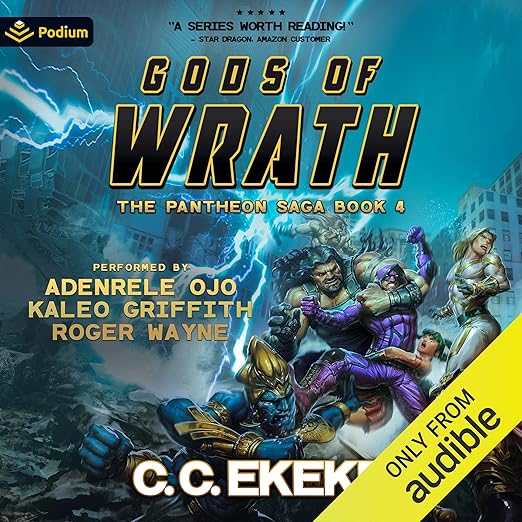
I was midway through a cross-country flight when I started Gods of Wrath, and I will say this for C.C. Ekeke’s Pantheon Saga: it is excellent air travel fiction. At seventeen hours, the fourth installment is substantial, but it moves. Ojo’s narration keeps the energy up through the quieter expository stretches, and the three-strand structure means there is always a new perspective to pivot to just when one thread starts to breathe too heavily.
The series operates in a well-populated superhero fiction space, but Ekeke has carved out something distinct with the San Miguel setting and a cast that is diverse in background, motivation, and moral complexity. Gods of Wrath is where several of those long-running tensions finally crack open.
Our Take on Gods of Wrath
The book picks up with Hugo Malalou, aka Aegis, at what should be a comfortable point in his sophomore year. He is working with Lady Liberty, holding his classes together, and casually dating three different women, a detail the synopsis presents without apology and the story handles with more nuance than you might expect. What ruptures that equilibrium is a near-fatal night patrol, which kicks off a pursuit that steadily strips Hugo of his support structure and forces the question the series has been building toward: what happens when the hero’s best instincts start to look indistinguishable from the villain’s worst ones?
The parallel threads work. Quinn’s investigation into Paxton-Brandt’s unethical superhuman research turns into something much more devastating than a corporate takedown story, and the fallout catches people she loves in ways that feel genuinely cruel rather than merely dramatic. Greyson’s crusade to purge the world of superheroes opens with him meeting more than his match, and a figure from his past introduces a wrinkle that complicates his certainty in interesting ways. One reviewer noted that this book ends one POV character’s arc, and while that departure lands with weight, it also closes off the investigative, less combat-focused strand of the narrative that some readers found most compelling.
Why Listen to Gods of Wrath
Adenrele Ojo is a real asset here. The book covers a lot of emotional register, from action-heavy sequences to moments of genuine grief, and Ojo shifts between them without the tonal whiplash that can afflict multi-POV audio. Reviewers consistently called the series out for action sequences that are “top notch,” and Ojo’s delivery of those scenes earns that description. The pacing of a seventeen-hour audiobook lives or dies by its narrator, and this one keeps you committed.
Ekeke’s worldbuilding is also stronger here than in earlier volumes. The Central Coast setting gets more texture, and the Paxton-Brandt storyline gives the book a contemporary edge that grounds the superhero spectacle in something recognizable: institutional power protecting itself at any cost.
What to Watch For in Gods of Wrath
The editorial note about grammatical issues in the printed edition is worth flagging for audio listeners, though the narration itself should not carry those errors. The bigger structural caution is complexity. This is book four in a dense saga, and Ekeke is not in the habit of recapping. Reviewers found it genuinely difficult to track Hugo’s multiple romantic relationships and the web of allegiances around them, and that is before the action sequences start reshuffling the board. If you have not listened to the earlier volumes recently, a quick recap of where each character stood is worth the time before you start.
The open relationship subplot will land differently for different readers. The author’s own content warning is frank about it, and the story does not treat it as a punchline. But it does take up narrative real estate, and not every reader found the romantic entanglements as engaging as the superhero mechanics.
Who Should Listen to Gods of Wrath
Series readers who are current on The Pantheon Saga will find this a confident, ambitious fourth book that is willing to make irreversible narrative choices. New listeners should start at the beginning of the series; there is no sensible entry point here. The content warning in the synopsis is genuine: this is adult superhero fiction with profanity, explicit relationship dynamics, and high-stakes violence. If you came looking for something closer to the Marvel Cinematic Universe in tone, the rawer edges of Ekeke’s world may surprise you. But if you want superhero fiction that takes its characters seriously enough to break them, Gods of Wrath earns its length.
Frequently Asked Questions
Can Gods of Wrath be listened to as a standalone, or is the full series necessary?
You need the full series. Gods of Wrath is the fourth book in The Pantheon Saga and assumes deep familiarity with Hugo, Quinn, Greyson, and the San Miguel world. Starting here would mean missing the character histories that make the emotional stakes in this installment register.
How does Adenrele Ojo handle the three-POV structure across 17 hours?
Very well. Ojo keeps each of the three main characters distinct and shifts smoothly between the action-heavy Hugo sequences, the investigative Quinn sections, and Greyson’s more menacing solo arc. The performance holds up across the full runtime without feeling fatigued.
The series is listed under LGBTQ+, how prominent are those themes in Gods of Wrath specifically?
The LGBTQ+ tag reflects representation within the series broadly rather than the dominant focus of this particular volume. Gods of Wrath is primarily a superhero action story. The cast includes queer characters, but the central preoccupations of this book are heroism, corporate power, and the cost of crusades.
Is there a content warning for this audiobook?
Yes, and the author puts it directly in the synopsis: the book contains profanity, open relationship dynamics, and intense action sequences. The romance content is more explicit than typical superhero fiction, and several plot threads deal with unethical experimentation on humans. It is adult fiction.