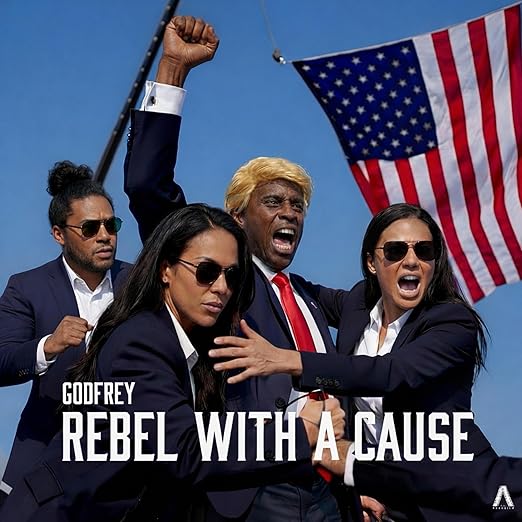
Godfrey Danchimah Jr. has been one of stand-up comedy's more distinctive presences for decades, building a reputation on the kind of observational work that appears casual but requires deep structural control. His comedy special, released as an audiobook under his name alone, offers exactly what the synopsis promises: brilliant storytelling, razor-sharp wit, and the fearless embrace of universal experiences that characterizes Godfrey at his best. Listening to this one-hour-and-three-minute special in audio form is an unusual experience in a specific way: comedy recorded for visual performance retains most of its power in audio, but the moments built around physicality or timing that depends on facial expression occasionally remind you that something is being translated across formats.
The impersonations are worth particular mention. Godfrey's ability to inhabit different voices and registers has always been central to his performance style, and in audio those impersonations come through with full effect since they depend entirely on vocal performance rather than visual support. The sections of the special built around character work are, if anything, better suited to audio than to video, because the listener's attention is entirely on the voice. This is the particular advantage that comedy in an audiobook format can have over a filmed special when the comedian's core instrument is verbal and versatile.
Comedy From the Gaps Between Cultures
Godfrey's comedy operates from a specific perspective: a man who has lived across cultures, observed the gaps between how different communities understand the same experiences, and finds the comedy in those gaps without using them as instruments of division. His observational mode is inclusive in the structural sense: he is not punching at outsiders, he is reporting on the universal strangeness of being human with the authority of someone who has looked at that strangeness from multiple angles simultaneously.
The fearless embrace of universal experiences in the synopsis is accurate but undersells the technical craft. Observational comedy at the level Godfrey practices it requires the comedian to identify what is genuinely universal in what appears to be specific and personal, a skill that takes years of stage time to develop and that many comedians who attempt it never fully achieve. His storytelling arc within individual bits reflects that craft: the setup premises are specific enough to create recognition, and the payoffs arrive at angles that feel both surprising and inevitable, which is the hardest combination in comedy writing to sustain consistently across an hour of material. The two five-star ratings reflect a clear audience satisfaction with exactly this quality.
When the Narration Is the Whole Performance
Godfrey C. Danchimah Jr. narrating his own material is not a circumstance that requires a standard casting assessment: when a comedian performs his own stand-up, the narration is the performance, and the quality of that performance is the entirety of what the audiobook offers. The voice work here reflects thirty-plus years of stage development, and the texture of a comedian who trusts his own material is audible throughout. He does not oversell the punchlines or signal amusement at his own jokes in ways that undermine the listener's experience. He delivers and moves on, which is the professional mark of a comedian who understands that the audience's laughter, not the performer's, is the measure of success.
At one hour and three minutes, this is among the more compact audiobook formats, more comparable to a podcast episode or a focused single session than to a conventional book commitment. For listeners who want to sample Godfrey's style before committing to longer format work, this special is an efficient introduction. For existing fans who know his work from television appearances and previous specials, this audiobook captures the stage presence they already associate with him, translated into a format that travels with you and benefits from being listened to on headphones in an environment where full attention is possible.
Precise Enough to Feel Universal
The structural architecture of Godfrey's storytelling is worth conscious attention, particularly in the longer form bits. He tends to open premises widely, establishing a situation that appears to be heading in one direction before redirecting through a specific observation that reframes everything that preceded it. Following the logical chain from setup through redirect to payoff reveals how much craft underlies what sounds like relaxed, improvisational storytelling. Paying attention to the scaffolding makes the performance more interesting, not less, and audio is the format where that scaffolding is most audible because there is no visual spectacle competing for attention.
The cultural observation material, where Godfrey draws on his Nigerian-American background and his experience navigating multiple cultural contexts, is particularly strong in this special. These sections do something specific that comedy can do better than almost any other format: they make a particular experience feel universal by making it feel precise. Listeners who pay attention to the mechanism by which that conversion happens will come away with a sharper understanding of what the best observational comedy actually does technically, beyond just whether it makes them laugh.
Verbal Enough to Survive the Translation
Fans of stand-up comedy who enjoy observational work with genuine storytelling ambition will find this special rewarding. Godfrey's style sits closer to the autobiographical, character-driven mode of classic observational comedy than to the current dominant mode of tightly structured premises-and-tags jokes, so listeners who prefer a more flowing, narrative approach to stand-up will be in the right territory here.
Those who have followed Godfrey's career from his television work and previous specials will find this audiobook consistent with his established voice while reflecting the maturity that comes from decades of stage development. At one hour, the investment is low and the potential return is high for the right listener. Those who prefer comedy that leans heavily on visual performance and physical bits may feel the translation to audio misses something; Godfrey's style is verbal enough that this concern is minimal, but it is worth noting for listeners whose comedy preferences run toward more physically dependent performers.
Is a stand-up comedy special a good fit for the audiobook format?
It depends on the comedian's style. Godfrey's comedy is verbal-first: the impersonations, character work, and storytelling arcs all depend on vocal performance rather than visual physicality. In his case, the audio translation works well. The moments that lose something are the bits where physical timing or facial expression contribute to the punch, but these are less central to his style than to comedians who rely more heavily on physical performance.
How long is this audiobook and is it worth the commitment?
One hour and three minutes, making it one of the more compact audiobook formats. The investment is low: it is comparable to a single podcast episode or a focused commute. Both available ratings are five stars, suggesting that the people who have listened to it found the hour satisfying. For listeners uncertain whether Godfrey's style will work for them in audio, the short runtime makes this a low-risk way to find out.
Godfrey narrates his own material. How does his performance hold up as the sole voice across the special?
Exceptionally well for a comedian whose core instrument is vocal range. His impersonations are among the best-translated elements to audio, and his ability to inhabit different voices means the one-hour runtime never feels monotonous despite the single-narrator format. Thirty-plus years of stage development are audible in the pacing and the trust he places in his material, neither over-explaining nor underselling.
Is this audiobook appropriate for listeners who are new to Godfrey's comedy?
It serves as an efficient introduction. The one-hour runtime means the commitment is minimal, and the range of material, from cultural observation to character work to storytelling bits, gives a representative sample of his approach. Existing fans will find it consistent with his established voice; newcomers will get a focused demonstration of what makes his observational style distinctive among comedians working in a similar mode.