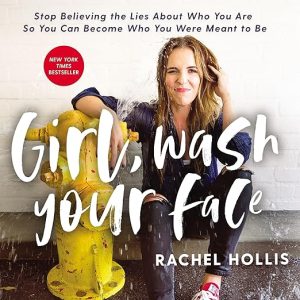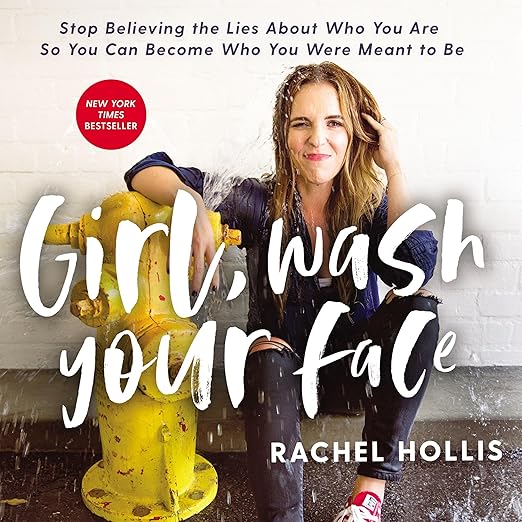
I came to Girl, Wash Your Face later than most people did. By the time I finally listened to it, the book had already been a cultural phenomenon and then survived its own public controversy, and I was honestly not sure what I would find on the other side of all that noise. I put it on during a long drive on a Tuesday afternoon, expecting something I would analyze from a comfortable critical distance. What I found instead was something considerably harder to dismiss.
Rachel Hollis's 2018 bestseller, which has sold over three million copies, is organized around twenty lies she believes women tell themselves, including things like something else will make me happy, I am defined by my weight, and I will never get past this. It is a memoir structured as self-help, or self-help structured as memoir, and the blending of those genres is both its greatest strength and the thing most likely to frustrate readers who expect one clean category. Hollis is not presenting research or citing studies. She is sharing her own experience and insisting, sometimes very loudly, that the obstacles you face are surmountable if you are willing to examine honestly what you are telling yourself about them.
What We Made of It
The audiobook format is not incidental to how this book works. Hollis narrates it herself, and the result is genuinely different from what you would get with a professional reader. Her pacing is uneven by industry standards, faster when she gets excited, slower when she is making a point she wants to land. She laughs at her own jokes. She gets earnest in ways that feel slightly vulnerable. Reviewer LozzyJ described it as feeling like you were sat down in a coffee shop face to face with the author, and that is exactly the register Hollis is working in. The lack of polish is part of the point, not a production oversight.
This matters because the book's argument depends on the listener believing that Hollis is being genuinely honest rather than performing honesty. Her credibility is relational rather than credential-based. She is not an expert on the psychology of self-deception with a PhD and a clinical practice. She is someone who has, by her account, made real mistakes and real recoveries, and who is willing to put those on the public record. Hearing her tell those stories in her own voice, with all its unevenness, makes that case more persuasively than any production-polished reading would.
What Makes Girl, Wash Your Face Worth Hearing
The structure gives the book a built-in variety that prevents it from becoming repetitive across seven hours. Some chapters deal with motherhood and identity. Others address body image, ambition, grief, sexual trauma, and the specific discomfort of wanting more than what your current circumstances contain. The range is wide enough that almost every listener will find at least three or four chapters that feel uncomfortably specific to their own situation, which is both the book's success and its occasional bluntness.
Reviewer Cucicucicoo noted approaching the book with skepticism, expecting a message that would not apply to someone with different religious views than Hollis, and finding instead that the core arguments held up across that difference. This is worth flagging because the book is explicitly Christian in its framing, with faith woven throughout as a foundational element of how Hollis explains her choices and her resilience. That framing is neither hidden nor aggressive, but it is consistently present, and listeners who are not religious should know what they are walking into. It does not require shared belief to find value in the material, but it does require some tolerance for that language and worldview throughout a seven-hour listen.
What Might Not Land
Girl, Wash Your Face has attracted substantial criticism since its publication, much of it focused on the particular flavor of American individualism that underpins its philosophy. Hollis's framework places a significant burden of circumstances on personal mindset, which can underweight the structural realities that shape what is and is not available to different women depending on their economic situation, health, race, and support systems. That critique is fair, and it is worth holding alongside whatever genuine usefulness the book offers.
The book is most effective for readers who are stuck in patterns largely of their own making and need someone to say that plainly without softening it. It is less equipped to address readers for whom the obstacles are structural rather than primarily psychological. Reviewer amynicolecleanliving described the book as encouraging and inspiring, filled with positive energy that leaves you ready to take on life, and that response is authentic to what the book delivers for its core audience. Both assessments, the limitation and the genuine uplift, can be true simultaneously.
Should You Listen to Girl, Wash Your Face?
Listen to this if you want a warm, direct, faith-adjacent motivational push organized around specific self-limiting beliefs rather than abstract inspiration. Listen if you are curious about why this book resonated so deeply with millions of readers and want to understand it firsthand rather than through secondary commentary. Listen if you know you are getting in your own way but cannot quite articulate how or why.
Consider a different listen if Christian framing will require more mental energy than the content is worth to you, or if you want evidence-based behavioral psychology rather than personal testimony. At 4.5 stars across 41 Audible ratings, the recording has held its audience even years after the book's initial cultural wave, which is the most honest indicator of whether it delivers what it promises.