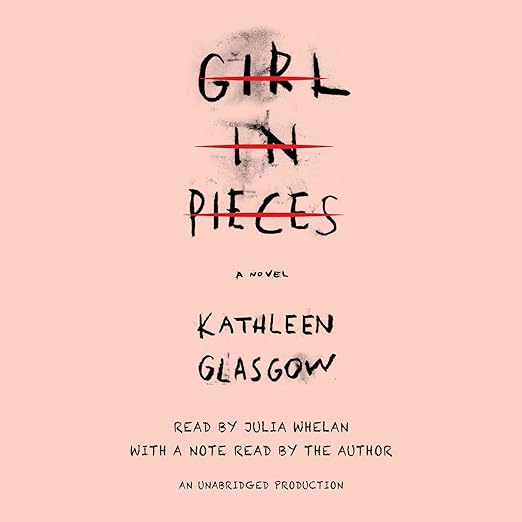
Charlie's hospital room in the opening pages of Girl in Pieces smells like disinfectant and muted grief, and Kathleen Glasgow makes sure you feel both in your body before you understand them in your mind. I listened to this audiobook on a gray afternoon in early spring, and Julia Whelan's narration dropped me so completely into Charlie Davis's fractured interiority that I missed my stop. Girl in Pieces is a novel about self-harm, loss, and the painstaking rebuilding that follows collapse, and it handles all three with a specificity that lifts it well above the category of issue-driven YA fiction.
Where This One Lands
Charlotte Davis is seventeen, and by the time the story opens she has already lost her father, her best friend, and her sense of any stable ground to stand on. Glasgow does not use these losses as dramatic backstory; she embeds them in the fabric of Charlie's consciousness, surfacing in fragments as the girl slowly, unevenly, reconstructs herself. The audiobook format suits this fragmented interiority especially well. Whelan's narration does not impose false clarity onto moments Glasgow deliberately leaves raw and unsettled. What reviewer Ashley Bockway noted in print, that the characters 'seem so realistically written about,' is amplified in the audiobook: Whelan finds the pauses, the incomplete thoughts, the moments where Charlie's voice breaks off because readers will find no words yet. That authenticity is the novel's central achievement.
What Makes Girl in Pieces Worth Hearing
Julia Whelan is one of the most consistently excellent narrators in the YA audiobook space, and Girl in Pieces is one of her strongest performances. She resists the trap of making Charlie sympathetic through softness; instead, she gives the character an edge and a guardedness that feels earned. When Charlie finally allows herself small moments of trust or connection, Whelan marks them without telegraphing them, which is exactly the right calibration for material this delicate. Reviewer Yang described the novel as 'raw, heartbreaking' and 'full of quiet hope,' and Whelan's performance honors both registers. The 'quiet' is the key word: hope in this audiobook is never triumphant, always tentative, which is far more honest about what recovery actually looks like than most narratives in this space allow themselves to be.
What Gives Us Pause
This is an audiobook that requires an honest content warning: self-harm is central to the narrative and is depicted with unflinching detail. Glasgow does not sanitize or romanticize it, which is both a strength and something listeners should be prepared for. The novel was compared in its promotional copy to Girl, Interrupted and Thirteen Reasons Why, and while those comparisons signal a general emotional register, Girl in Pieces is less interested in spectacle and more interested in the slow, undramatic labor of surviving. The second half of the novel moves Charlie out of the hospital and into a semi-independent life in Tucson, and some readers have found the pacing in this section less gripping than the intense first half. The Tucson arc is deliberately quieter, tracking Charlie's incremental gains and reversals, and listeners who came for the crisis intensity may find the pivot jarring. But Glasgow earns that quieter register, and it ultimately makes the ending more honest.
Glasgow's prose style in this audiobook is itself part of the argument the book is making. The sentences are often short, fragmented, and resistant to the kind of settled narrative authority that would imply Charlie has more control over her experience than she does. Whelan reads these deliberately broken rhythms without smoothing them out, which requires a kind of restraint that is genuinely rare in audiobook narration. A lesser narrator would impose coherence on Glasgow's intentional fragmentation, turning the listening experience into something more palatable but less honest. What Whelan understands is that Charlie's voice should feel like a person still learning to trust the act of narration itself, and she gives the character exactly that quality. The decision to audition for Glasgow's prose rather than simply perform it is what makes this one of the stronger literary YA audiobooks available.
One small note on the audiobook as a format for this particular novel: Girl in Pieces contains passages of Charlie's sketchbook writing, fragmented visual imagery, and stream-of-consciousness interiority that translate differently into audio than into print. Glasgow's prose fragments into white space on the page at key moments, and in the audiobook format those structural pauses have to be carried entirely by Whelan's delivery. She handles this well, using breath and timing where Glasgow uses typography, but listeners who are sensitive to formal experimentation in literary YA fiction may want to be aware that some of the novel's visual architecture does not survive the translation into audio. This does not diminish the audiobook experience significantly, but it is worth knowing before starting.
Who Should Pick Up Girl in Pieces
This audiobook is best suited to older teen and adult listeners who want fiction that handles mental health and self-harm without simplifying either the problem or the recovery. It is not appropriate for younger listeners or for anyone currently in acute crisis who might find the detailed depictions destabilizing. Readers who appreciated the emotional honesty of authors like Laurie Halse Anderson or Courtney Summers will find Glasgow operates in a similar register. Those who want an uplifting, resolution-forward YA story will find the ambiguity of Girl in Pieces difficult. But for listeners ready to sit with a character through the messiest, least photogenic parts of healing, this audiobook delivers something rare: fiction that earns its hope the hard way.
Good to Know
Does this audiobook contain graphic depictions of self-harm?
Yes. Self-harm is central to the narrative and is depicted with specificity and without romanticization. Listeners who are sensitive to this subject or currently in crisis should approach with care or consult a trusted person before listening.
How does Julia Whelan's narration shape the audiobook experience of Girl in Pieces?
Whelan's performance is integral to the audiobook's impact. She captures Charlie's fractured interiority without imposing clarity the text does not offer, and her ability to mark small emotional shifts without over-signaling them is essential to the novel's careful handling of recovery.
Is Girl in Pieces part of a series?
No. It is a standalone novel by Kathleen Glasgow. Glasgow has written other YA books dealing with difficult emotional subjects, but Girl in Pieces does not continue into a sequel.
At nearly eleven hours, how does the audiobook pace across its full runtime?
The first half, set largely in the hospital, is more intensely paced. The second half in Tucson is deliberately quieter and tracks incremental recovery. Some listeners find the shift jarring, but it reflects the novel's honesty about what rebuilding a life actually requires.