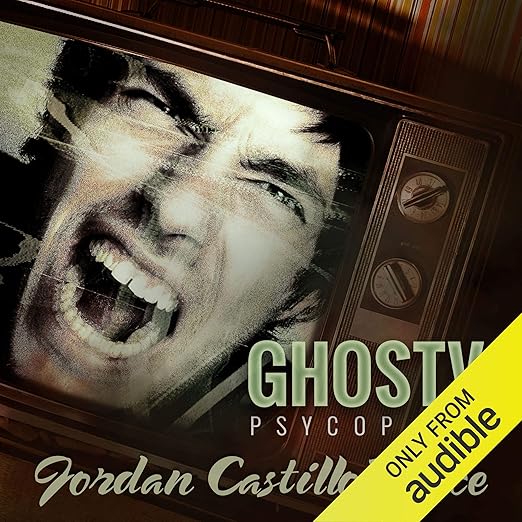
Quick Take
- Narration: Gomez Pugh has become synonymous with Victor Bayne across this series, and his performance here deepens that identification with a character who is awkward, moody, and entirely compelling.
- Themes: Psychic detection, loyalty and debt, queer identity in paranormal genre fiction
- Mood: Tense and character-driven, with sharp comic edges
- Verdict: GhosTV is the installment where Jordan Castillo Price demonstrates that a long-running paranormal series can still generate genuine surprise, pulling Victor into his most personal and psychologically complex case yet.
I came to GhosTV having listened to the first five PsyCop books in relatively quick succession, which is probably the ideal preparation for a book that functions simultaneously as a standalone thriller and as a deep investment in characters built across years of fictional time. By book six, Jordan Castillo Price trusts the reader completely, dropping references to earlier events without pausing to explain, advancing relationship dynamics without staging them for newcomers. That trust is earned and it is also somewhat unforgiving, which makes GhosTV a book that rewards loyalty.
The central premise of this installment is a clean and clever inversion of Victor Bayne’s core ability. For twelve years, Vic has solved murders by interrogating dead witnesses, which is an elegant procedural concept. Remove the ghosts and you remove his method. When his best friend Lisa disappears from PsyTrain, a California campus full of psychics, Vic is left without the forensic tool that defines him. No ghosts to cross-examine, no immediate advantage over the conventional investigators who view him with professional skepticism. That vulnerability, technical and emotional, drives the book’s tension in a way that earlier installments could not quite access.
The Price of an Uneasy Alliance
What PsyCop does consistently well, and what GhosTV does particularly well, is the use of obligation and debt as narrative engines. Vic’s alliance with an old enemy to track Lisa using methods outside his usual skillset is not comfortable. Price does not sand the edges off that discomfort. The debt Vic enters into at the end of this book is described in the synopsis as one he may never manage to settle, which is the kind of promise a series writer makes when they trust that the readership will stay for the consequences. Reviewers who have followed the series from the beginning noted that this installment made those consequences feel genuinely weighty rather than procedurally convenient.
One reviewer offered a careful critique noting that GhosTV falls slightly short of the earlier PsyCop stories, placing it at a still-generous 8/10. The critique centered on the tension between fresh plot complications and the cumulative emotional weight of the earlier books. That is a legitimate observation about series fiction generally: by the sixth entry, some freshness is inevitably displaced by depth, and readers value those things differently. The majority of reviewers, however, found this installment equal to or better than its predecessors.
Vic’s Character and the Specific Pleasure of an Imperfect Protagonist
One of the most useful observations in the existing reviews is that Victor is anything but perfect. He is awkward and moody and sometimes halfway delusional, yet compelling throughout. That quality, a protagonist who earns affection not through conventional appeal but through specificity and honesty, is relatively rare in paranormal romance and urban fantasy adjacent fiction. Price is not writing a power fantasy. She is writing a character study that happens to involve ghosts, and the psychic abilities are in service of characterization rather than the other way around.
Gomez Pugh’s narration has been the audio face of this series long enough to be effectively indistinguishable from Victor in the listener’s imagination. His handling of the occasional snark and wit that reviewers note is precise: the timing lands, the deadpan holds, and the emotional moments arrive without telegraphing. For listeners coming to the series via audio rather than text, Pugh’s performance is a significant part of what makes the character work at this level of nuance.
Five Faith and the Question of the Psychic Community
The antagonist element in GhosTV, the group called Five Faith that has been sniffing around PsyTrain and whose involvement in Lisa’s disappearance becomes central, adds an institutional dimension to the usual case structure. The campus setting, a whole community of psychics navigating their abilities in a semi-institutional context, is a rich backdrop for questions about how psychic ability functions as social identity rather than simply as a crime-solving tool. Price uses the setting to open up aspects of Vic’s world that earlier books set in more conventional police procedural territory could not access.
The PsyTrain campus is not just a backdrop. It is a space where the rules of Vic’s world are simultaneously intensified and destabilized: everyone around him is psychic, which removes his usual advantage of being the only person in the room who can see things others cannot, and replaces it with a more complicated social landscape where his particular abilities are neither exotic nor automatically trusted. That shift in power dynamic is one of the more interesting structural moves Price makes in this installment, and Gomez Pugh’s narration handles Vic’s adjustment to that environment with the right mixture of wariness and dark humor.
At twelve hours and six minutes, this is a substantial audiobook that earns its runtime through consistent plotting and character development. There is no padding here, only the accumulated specificity of a world built carefully over six books.
Who Should Listen and Who Should Skip
Listen if you have read or heard the first five PsyCop books and are ready to see Victor stripped of his main forensic advantage and forced into an uncomfortable alliance with consequences. Listen if you value character-driven urban fantasy with a queer protagonist written with genuine complexity rather than as representation shorthand. Skip if you have not started the series at the beginning, since GhosTV’s emotional power is almost entirely dependent on prior investment. Skip if you want a standalone paranormal thriller that does not require series commitment.
For listeners who have been following Vic since Among the Living, GhosTV represents a kind of inflection point in the series, a book where the accumulated weight of all those earlier decisions and relationships finally begins to exert serious structural force on the narrative. Price has been building toward consequences for six books, and this installment begins to collect on that investment.
Frequently Asked Questions
Can GhosTV be read as a standalone, or is it essential to have listened to the first five PsyCop books first?
Price and multiple reviewers make clear that the series should be read from the beginning. Each book builds on the previous ones, and GhosTV’s central emotional stakes, particularly around Lisa and the debt Vic incurs, will land with far less impact without the earlier context.
How does the removal of Vic’s ghost-interrogation ability change the tone and structure of GhosTV compared to earlier PsyCop installments?
It forces Vic into a more conventional investigative position and requires him to rely on alliance and relationship rather than his psychic advantage. This shifts the book toward a more character-driven thriller structure and is generally considered one of the most interesting choices Price makes in the series.
Is GhosTV appropriate for listeners who are new to LGBTQ+ paranormal fiction but interested in exploring the genre?
GhosTV is an excellent example of the genre’s best qualities, but it is not the right entry point for newcomers. Start with Among the Living, book one in the series, which introduces Vic and the world with enough clarity to make the subsequent volumes fully meaningful.
What does the Five Faith faction add to the story, and does their role feel fully resolved by the end of GhosTV?
Five Faith introduces an institutional antagonist that raises questions about psychic ability as social identity within the PsyTrain campus setting. Without spoiling the resolution, the group’s involvement deepens the plot’s complexity, and the consequences of the uneasy alliance Vic enters into carry forward into the series.