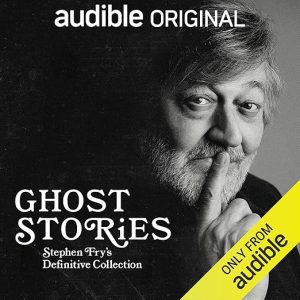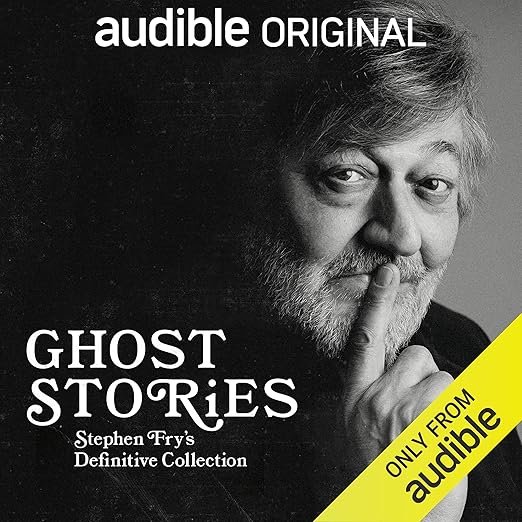
Stephen Fry reading Bram Stoker is not a difficult sell. Stephen Fry reading M.R. James, Edgar Allan Poe, Algernon Blackwood, Charlotte Riddell, and Robert Louis Stevenson across eight hours of spatial audio, with Dolby Atmos production, is something else entirely. Ghost Stories: Stephen Fry's Definitive Collection is an audiobook in the original sense of the term: a performance, an event, a piece of audio that uses the listening format to do something the print page cannot replicate. I put this on late in October with the lights low and was periodically unsettled in the most satisfying way possible.
Fry occupies a particular position in English literary culture that makes him an ideal curator for this project. He is not merely a celebrity reading somebody else's selection; this is his collection, assembled from his own deep knowledge of the ghost story tradition. The lineup reflects genuine critical judgment. Washington Irving's Sleepy Hollow is the obvious crowd-pleaser that anchors the set, but the choice to include Charlotte Riddell's The Open Door alongside the canonical Poe and James demonstrates a curator who has actually read widely in the form rather than simply pulled the most recognized names. Riddell's work has been largely overlooked in modern anthologies, and her inclusion here is a quiet act of scholarly affection.
Our Take on Ghost Stories: Stephen Fry's Definitive Collection
Fry's voice has an unusual quality for horror material: it is warm. He does not produce the sepulchral register many narrators adopt for ghost story collections, and that warmth makes the creeping wrongness of the best pieces more effective because it arrives without signaling. When James's spirits begin their unsettling work or when Poe's William Wilson slides into his confrontation with his doppelganger, Fry's voice remains companionable in its tone even as the content becomes genuinely disturbing. That disjunction is skilled work. He is telling you something terrible while sounding like a friend who happens to know a great deal about Victorian horror.
The spatial audio production is a meaningful contribution. Reviewer Donna noted that Fry's captivating voice makes it perfect listening for October, and that is an understatement of the production's contribution. The Dolby Atmos version places atmospheric sounds and secondary audio elements around the listener in ways that create a sense of environment rather than mere accompaniment. The Empty House by Algernon Blackwood, which depends heavily on the physical experience of a haunted space, benefits enormously from this approach. The Body Snatcher in stereo and The Body Snatcher in spatial audio are genuinely different experiences, and the spatial version is the more frightening one.
Fry also serves as introducer and context-setter between stories, which gives the collection a coherence that a simple anthology would lack. He situates each author briefly and frames the tale about to be told in ways that heighten anticipation without spoiling content. This is a classic radio drama technique, and Fry executes it with the ease of someone who has done exactly this kind of broadcasting work for decades. Reviewer Prime example noted that listeners who enjoyed his Sherlock Holmes recordings will find similar pleasures here, which is accurate: this is Fry operating in his natural register as a literary guide.
Why Listen to Ghost Stories: Stephen Fry's Definitive Collection
The curation is the argument for this audiobook over simply finding the individual texts elsewhere. Each story in this collection was chosen by someone who has read the full genre and decided that these specific pieces deliver the ghost story experience at its highest. The result is a set that balances the familiar with the unjustly forgotten, that includes the Atlantic tradition alongside the British one, and that covers a range of supernatural modes: the psychological double of Poe, the antiquarian dread of James, the body horror of Stevenson, the atmospheric isolation of Blackwood, and the domestic unease of Riddell.
For listeners who are not deep readers in the Victorian and Edwardian horror tradition, this collection functions as an excellent primer that does not condescend. Fry's introductions give enough historical and literary context to make each piece land with its intended force, and his narration brings enough character differentiation to make the dramatic sections work as performance rather than flat recitation. Was It an Illusion by Amelia B. Edwards and The Judge's House by Bram Stoker are less frequently anthologized than the other pieces here, and both reward a listener encountering them for the first time.
The eight-hour runtime represents good value given the quality of production throughout. Ghost story anthologies in audio often suffer from inconsistent pacing and tonal shifts when multiple narrators handle different pieces; the single-voice approach here creates a unified atmospheric register that serves the collection's Halloween positioning without limiting its appeal to a single seasonal listen. Reviewer Mike Smith's brief note that he loves Stephen Fry books may seem like slight evidence, but it captures something real: this is an audiobook that works because of a specific performer's specific qualities, and those qualities are on full display.
What to Watch For in Ghost Stories: Stephen Fry's Definitive Collection
The Dolby Atmos production is platform-specific and not universally available across all audiobook listening environments. Listeners on standard headphones in standard mono or stereo configurations will still have access to Fry's narration and the atmospheric audio bed, but the full spatial experience requires appropriate hardware and platform support. This is worth verifying before purchase if the production is a primary motivation for choosing this version over alternatives.
The collection is curated rather than comprehensive. Eight stories across eight and a half hours is a selective anthology, not a survey. Listeners expecting coverage of the full ghost story canon will find obvious omissions; Sheridan Le Fanu, Henry James, and Elizabeth Gaskell are notable absences. The title's claim to definitiveness is Fry's personal statement about which stories he considers most representative of the form's power, not a scholarly consensus. Understanding this distinction will prevent disappointment for listeners with more encyclopedic expectations.
The most dedicated horror enthusiasts may find some of the selections overfamiliar. Sleepy Hollow and The Body Snatcher are staples of the anthology format, and listeners who have heard multiple versions of these stories may be evaluating the production rather than the content. Fry's narration is distinctive enough to make familiar territory feel newly inhabited, but the discovery value of this collection is strongest for listeners who have not encountered the lesser-known pieces before.
Who Should Listen to Ghost Stories: Stephen Fry's Definitive Collection
Anyone who wants an exceptionally produced, curated ghost story listening experience anchored by one of English literature's best-known voices will find this audiobook delivers on its premise. It is ideal for October listening but genuinely pleasurable year-round. Listeners who want deep coverage of the full ghost story tradition should treat this as a starting point. For Fry's existing audiobook audience, this collection demonstrates his performance range beyond comedy and autobiography. The spatial audio version is worth seeking out if your setup supports it.
Key Details
- Narration: Stephen Fry self-narrates with warmth and controlled atmospheric skill, making the supernatural wrongness more effective by not announcing it. The Dolby Atmos production adds a genuinely distinctive spatial layer.
- Themes: Haunting and possession, the uncanny double, Victorian dread in domestic and antiquarian settings
- Mood: Companionable and slowly creeping, like sitting with a brilliant storyteller who knows exactly when to drop his voice
- Verdict: A beautifully curated ghost story audiobook that earns its runtime through production quality and Fry's particular gift for inhabited literary performance, strongest for listeners new to the Victorian supernatural tradition.
Frequently Asked Questions
Which stories are included in this audiobook collection?
The collection includes The Legend of Sleepy Hollow by Washington Irving, Lonely Hearts by M.R. James, Was It an Illusion by Amelia B. Edwards, The Body Snatcher by Robert Louis Stevenson, The Empty House by Algernon Blackwood, William Wilson by Edgar Allan Poe, The Open Door by Charlotte Riddell, and The Judge's House by Bram Stoker.
Is this audiobook appropriate for listeners who are not familiar with classic ghost stories?
Yes, and in some ways it is ideal for this audience. Fry introduces each story with context about the author and the tale, which gives newcomers the framing that makes Victorian and Edwardian horror land effectively. Familiar listeners will also find value in Fry's specific interpretive choices and the spatial audio production.
How does Stephen Fry's narration in this audiobook compare to his other recorded works?
This collection sits alongside his Sherlock Holmes recordings as a strong example of Fry in literary performance mode rather than memoir or comedy mode. His ghost story narration benefits from the same qualities as those recordings: warmth, careful pacing, and the ability to build dread without announcing it.