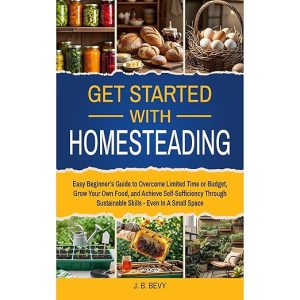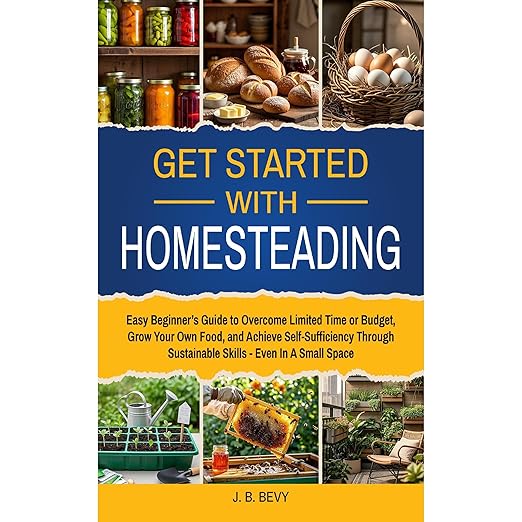
Count the checklists: eight of them, plus six reflective exercises, plus a shortlist of the six best crops for container gardening. That inventory comes from the publisher's own description of Get Started with Homesteading, and it tells you what kind of book this is well before anyone reaches the writing. This is a reference volume with a motivational wrapper, and the audiobook runs three hours and fifty-two minutes. Both facts matter, and they pull hard against each other in ways worth understanding before you buy.
J. B. Bevy is selling permission as much as instruction. The pitch is self-sufficiency without land and without experience, aimed at the reader who has decided the whole idea is too complicated, too expensive or too rural for someone in an apartment. The content list backs that up: container gardening for small spaces, beginner composting, rainwater collection, low-cost tools and where to find them, food preservation on a budget, plus a straightforward guide to backyard livestock regulations and basic legal considerations. It is orientation rather than mastery, and it says so.
Two of the three five-star reviews describe exactly that. joanne bergeron calls it "a practical and accessible guide for beginners looking to embark on a homesteading journey, regardless of their time or budget constraints" and singles out the "Clear and concise guidance" on offer. CRG goes further, describing "the perfect launching point for anyone curious about self-sufficiency, food independence, or sustainable living, regardless of their location or level of experience (or land ownership)". Both are responding to the same thing: a book that lowers a barrier rather than raising a standard.
Regulatory Chapters, the Genuinely Useful Boring Parts
The genuinely useful sections are the boring ones. The regulatory material covers exactly the questions a new homesteader discovers too late, usually after the chickens have arrived, and they are exactly the sections a book selling the lifestyle has every incentive to skip. Rainwater collection is handled the same way. So is the section on communicating with skeptical neighbors, which sounds like padding until you have had the conversation. Bevy consistently chooses the unglamorous obstacle over the aspirational image, and that instinct is the book's best quality.
CRG's five-star verdict turns on balance, and Bromjess arrives at the same place from another direction, praising the handling of a subject range that runs from soil to statute. Neither is claiming expertise conferred; both are describing a barrier lowered. This is a wide subject handled without sprawl, which is harder than it sounds when the topic runs from soil to statute.
The runtime is well judged for what is being attempted. Nobody needs twelve hours of encouragement to start a container garden, and the length signals honestly that this is a starting point rather than an encyclopedia. Listened to end to end on a weekend, it functions as a decision-making tool: by the close you will know whether you want to do this, roughly what it costs, and which three things to try first. That is a legitimate job for a book to do.
Virtual Voice Handles Lists but Misses the Warmth
The format problem is real and needs stating plainly. Eight checklists, six reflective exercises and a ranked crop list are print artifacts. A listener cannot tick a checklist, cannot glance back at item four, and cannot pause on a reflective exercise the way a reader pauses on a page. Nothing on this listing says whether printable extras ship with the audio, and that single detail changes the value of the purchase more than anything else about it, so check before committing. Without one, the most concrete material on offer arrives in the least usable form available.
The review pool carries its own warning. Bromjess opens with "I really appreciate the feel and format of this hard copy" and goes on to call it "a great reminder of how satisfying a physical book can be", which is unambiguous: that five-star verdict is about a printed edition. Across the three reviews visible on this listing, not one evaluates the audio. The praise is worth having, but it is praise for the text, and a listener should read it as such rather than as evidence about the recording they are considering.
Which brings us to the voice. The credited reader is Virtual Voice, which is software rather than a person, and the mismatch here is uneven rather than total. Procedural content survives machine reading reasonably well: a list of low-cost tools does not need interpretation, and a section on local ordinances arguably benefits from a flat register. What does not survive is the other half of the book. This title also wants to sell you a way of living, with family bonding, reflective exercises and the joy of growing your own food, and persuasion of that kind runs on warmth that a synthetic voice has no means of supplying. The practical material should survive that. The inspirational material has nothing to draw on.
One last thing about the copy itself. The description still ends by telling you to scroll up and add the book to your cart, a leftover from the page it was written for. It is a small thing, but it fits a wider pattern in this corner of publishing, where the marketing material and the manuscript are produced at the same speed. The content underneath is sound and specific. The packaging around it was assembled quickly, and a listener should judge the two separately.
Suited to Balconies and Families, Light on Expertise
The right listener here is a beginner with a balcony, a small yard or a recent move to the countryside, who wants to know what is actually involved before spending money. Anyone weighing the idea against their real constraints of time, budget and space will find the book meets them where they are rather than where a photogenic homestead would want them to be. Families are explicitly catered for too, since involving children in the work is treated as a feature rather than an obstacle.
Experienced growers and smallholders should look elsewhere entirely; this covers ground they cleared years ago. Anyone who wants the checklists and exercises as working documents should buy the text outright. My advice is to use the recording as a survey pass, deciding what you want to attempt, and then acquire the written version for the parts you intend to act on. Used that way, four hours of orientation earns its place. Treated as the whole package, it is half a book.
Does the Get Started with Homesteading audiobook include the checklists and exercises?
The listing does not say, and this is the detail worth confirming before purchase. The description promises eight checklists, six reflective exercises and a ranked crop list, all of which are print formats that a listener cannot tick, revisit or work through aloud. If nothing printable ships with the recording, a meaningful share of the promised value arrives in an unusable form.
Is this useful if I live in an apartment with no land?
That is the stated audience. The book is organized around small-space and urban approaches, with container gardening, six recommended crops for pots, beginner composting and rainwater collection all pitched at people without acreage. One reviewer singles it out for working regardless of location or land ownership, so the promise is at least being kept for some readers.
Is this audiobook read by a person?
No. The narrator credit reads Virtual Voice, which is software. It is disclosed openly rather than buried, and it is the single biggest difference between this edition and the paperback. Anyone who finds machine reading distracting over four hours should treat the printed version as the default and the audio as a supplement.