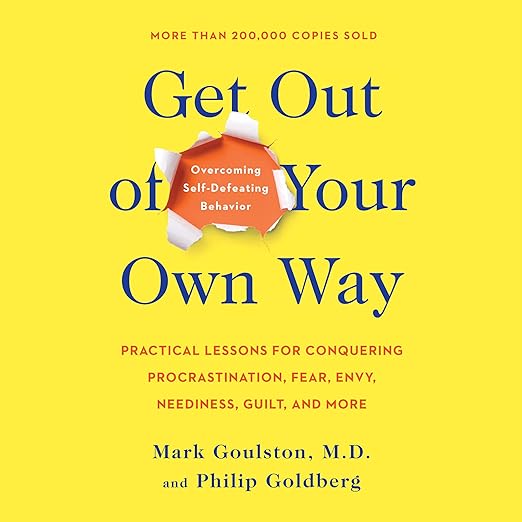
Mark Goulston writes about self-defeating behavior the way a clinician who has actually sat across from suffering people writes about it: with specificity, with compassion, and without the performance of optimism that makes so much popular psychology feel hollow. What struck me most about the audiobook for Get out of Your Own Way: Overcoming Self-Defeating Behavior is that Goulston reads his own work, and that choice transforms the material in ways worth examining carefully.
Is Get out of Your Own Way: Overcoming Self-Defeating Behavior Worth Your Time?
Goulston's central argument is that self-defeating behavior, whether it manifests as envy, compulsion, inaction, grudge-holding, or paralysis, is the leading reason people seek therapy. Not external circumstances. Not bad luck. The obstacle people most consistently encounter is themselves. This is not a novel observation, but Goulston builds on it with forty case-study-anchored chapters, each addressing a specific behavior pattern with clinical grounding and practical reframing. The distinction between self-defeating behaviors that hurt primarily the individual and those that damage relationships is threaded throughout, and it gives the book a structural coherence that prevents it from devolving into a list of unconnected problems. Reviewer Han Qi described it as 'by far the most helpful and relevant' among several self-defeating behavior books read in parallel, specifically praising how it 'nails the core of everyday problems in plain English' rather than cataloging exotic pathologies.
The Best Parts of Get out of Your Own Way: Overcoming Self-Defeating Behavior
Goulston narrating his own work is the most significant production decision here, and it pays off. Decades of clinical practice have given him a particular voice: unhurried, direct, never scolding. When he describes a patient's pattern of behavior, implicit warmth comes through in how he frames it, a sense that he has heard these confessions many times without losing the ability to take them seriously. The self-narration gives the material authenticity that a hired voice actor, however skilled, could not reproduce. You are essentially in a session with the author. Reviewer Toya M. Johnson, who called the book 'awesome,' noted that anyone could find something that 'reflects you and something you need to work on' in the forty chapters. That kind of comprehensive coverage is easier to absorb across multiple listening sessions than in a single sitting, and the short-chapter format supports that approach.
The anecdotes drawn from clinical practice are the book's real engine. Goulston illustrates each behavior pattern with cases specific enough to feel real without identifying patients. The result is that abstract patterns become legible in terms of actual human situations, which accelerates recognition. You hear a patient's story and find yourself locating the parallel in your own life before Goulston has finished the analysis.
Before You Commit to Get out of Your Own Way: Overcoming Self-Defeating Behavior
The book was originally published in 1996, and some cultural references and clinical language reflect that era. The core psychology is durable, but readers who prefer their self-help grounded in post-2000 research on behavioral economics, neuroplasticity, or acceptance and commitment therapy will find the framing more traditional than current. Goulston works primarily within a psychodynamic and cognitive-behavioral framework, which is effective but not cutting-edge by contemporary standards. That said, the practical steps he outlines are genuinely usable rather than aspirational, which is a significant advantage over many more theoretically current titles that stop short of telling you what to actually do differently.
The runtime of just under five hours is calibrated well. It is long enough to develop each of the forty behavior patterns substantively but short enough to complete in a week of commutes, which aligns with the book's stated goal of offering steps you can begin working into your routine immediately.
Goulston's clinical grounding also shapes how he handles the relationship between self-defeating behavior and the people around the person engaging in it. Many self-help frameworks focus exclusively on the individual as the unit of change, which can inadvertently reinforce a kind of therapeutic narcissism. Goulston attends carefully to the relational damage that self-defeating patterns create, and his practical steps account for the fact that changing your own behavior happens in an interpersonal context that does not pause to accommodate your growth. That contextual awareness is one of the features that gives the audiobook staying power beyond the session in which you listen to it. The ideas resurface when you are in situations where they apply, which is exactly what clinical wisdom distilled into accessible language should do when it lands correctly.
One further dimension of the audiobook that deserves mention is its structure as a reference rather than a linear read. Goulston's forty chapters are organized thematically but designed to be dipped into according to the listener's current situation. Someone recognizing a specific pattern of procrastination or grudge-holding in their own behavior can navigate to the relevant chapter without having digested the entire work in sequence. The short-chapter format supports that kind of targeted return engagement, and Goulston's clarity means that individual chapters hold their meaning without requiring the surrounding context. For a self-improvement book in audio form, that functional modularity is a genuine structural asset.
The Right Listener for Get out of Your Own Way: Overcoming Self-Defeating Behavior
This audiobook rewards listeners who recognize specific patterns in themselves and want a structured, clinical framework for addressing them rather than motivation-poster reassurance. It is particularly well suited to people who have considered therapy but not yet tried it, or who are in therapy and want supplementary insight. Listeners looking for cutting-edge neuroscience or heavily research-cited frameworks should look to more recent titles. If you want a seasoned clinician speaking directly and practically, Goulston delivers that in his own voice.
The Short Version
- Narrator: Goulston reads his own work with clinical warmth and unhurried directness; self-narration here is a genuine asset, not a novelty.
- Subjects: Self-defeating behavior patterns, therapeutic reframing, practical behavior change.
- Tone: Grounded and compassionate, with the measured pace of a therapy session.
- Bottom line: A clinically grounded audiobook on self-sabotage that earns its runtime through specificity and a narrator whose decades of patient experience come through in every chapter.
Good to Know
Does Mark Goulston narrating his own audiobook change how the material lands?
Significantly. Goulston's clinical background gives his self-narration an unhurried, warm directness that a hired voice actor could not replicate. The experience of listening feels genuinely closer to hearing a therapist explain a pattern than hearing a book read aloud.
Does the audiobook cover all forty self-defeating behavior topics in enough depth to be useful, or does it feel superficial?
Each chapter is substantive rather than cursory. Goulston grounds every behavior pattern in clinical anecdotes specific enough to feel real, and the practical steps he provides are actionable rather than vague. Multiple reviewers singled out the plain-English clarity and everyday applicability as distinct strengths.