
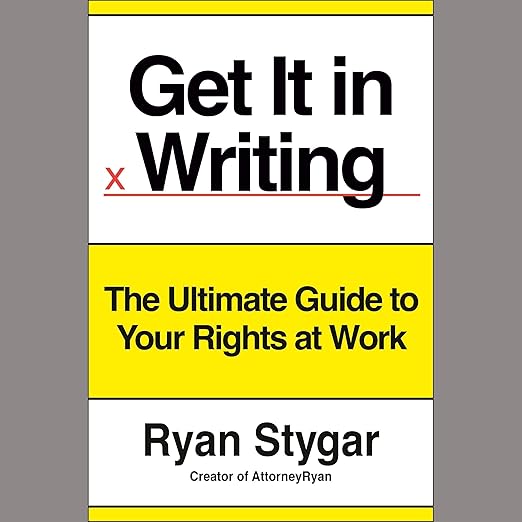
Key Details
- Voice: Ryan Stygar self-narrates with the directness of someone who has explained these frameworks to real workers in real trouble; a strong and appropriate match for the material.
- Big ideas: Workers' rights and employment law demystified, the role of documentation in legal protection, at-will employment and its limits.
- Atmosphere: Direct and practically urgent, like getting legal advice from a knowledgeable friend.
- Worth it?: Stygar's labor law audiobook is most valuable for workers currently navigating workplace difficulty, and his self-narration gives the legal content rare accessibility.
Attorney Ryan Stygar begins from a striking biographical position: he was a firefighter before he became a labor lawyer. That professional arc, from frontline public servant to workers' rights advocate, is not incidental to what Get It in Writing does well. Stygar knows what it feels like to do work that carries real physical risk, to be subject to institutional authority, and to have your livelihood dependent on an employer's goodwill. That knowledge gives this audiobook a different texture than most legal self-help titles, which tend to be written from the outside in rather than the inside out. Stygar self-narrates, and his voice carries the directness of someone who has spoken these same frameworks to actual workers, not just written them for a general reader.
What draws workers to Stygar's online presence, which has made him one of the better-known labor law commentators in the US, is the same quality that drives this audiobook: he removes the mystification from employment law without oversimplifying it. The questions he addresses, whether at-will employment really means no rights, what to do when a boss is bullying, how to respond to wrongful termination, how to handle a wage dispute, are real questions that real workers search for answers to in moments of anxiety and need. This audiobook is designed to be useful in those moments, not merely informative in the abstract.
Write It Down, Because Records Get Enforced
Stygar's central argument is that fear is the mechanism by which most labor violations are sustained. Workers who do not know their rights accept mistreatment because the alternative seems to be unemployment. Get It in Writing is structured as a counter to that fear: chapter by chapter, Stygar explains what workers are actually entitled to, what documentation they should be creating, and what escalation paths exist. The book's title is both practical advice and a summary of its philosophy: write everything down, because the written record is where rights get enforced or lost.
The chapter structure follows the major categories of employment law rather than building a sustained narrative, which means each section functions somewhat independently. Wage and hour law, workplace harassment, at-will employment doctrine, accommodation rights, severance negotiation: each chapter gives you a functional framework for understanding your position in that specific domain. Listeners who are dealing with a particular workplace situation will likely find the relevant chapter without needing to listen to the full eleven hours sequentially, though the cumulative effect of listening straight through is a more complete picture of how these issues interact.
Explaining Labor Law Like It's a Friend in Trouble
Self-narration is the right decision here. Stygar's online persona is built on directness and accessibility, and his reading of the material matches that persona rather than replacing it with something more formal. He speaks like someone explaining labor law to a friend who is in trouble, not like a textbook reading itself aloud. That quality, the sense of an actual person on the other side of the audio who has sat across from workers in exactly the situations being described, is what distinguishes this from a standard legal reference.
The practical advice is genuinely actionable. When Stygar says to document every interaction with HR in writing, to send follow-up emails confirming verbal conversations, to keep a personal log of workplace incidents, he is giving advice that has evidentiary consequences in real legal proceedings. The book is most valuable for workers who are currently navigating a difficult employment situation and need both the legal framework and the practical steps. It is secondarily useful as preventive education for workers who want to understand their rights before a problem arises.
The absence of ratings and reviews at the time of this assessment means this evaluation is built from the book's premises, Stygar's public track record, and the structure of the material as presented in the synopsis. Listeners should consult current reader reviews for more recent listener perspectives on specific chapters or arguments.
Stygar's background as a firefighter before his legal career is worth returning to as a framing device. Firefighting is a profession defined by institutional culture, hierarchy, and collective action, and Stygar's understanding of workplace dynamics, of what it means to depend on your employer while also being subject to their authority, comes from lived experience rather than theory. That grounding makes the advice in this audiobook feel less like legal instruction delivered from above and more like the kind of information a knowledgeable colleague might share across a table.
Openly Pro-Worker, Transparent About Its Own Bias
Employment law is both federal and state-specific, and the book operates primarily at the federal level while noting where state variation matters. Workers in states with stronger or weaker employment protections than the federal baseline will need to verify how local law modifies the general frameworks Stygar describes. The book cannot substitute for jurisdiction-specific legal advice, and Stygar is clear that some situations require an actual attorney rather than a self-help guide.
The political framing of the book is openly on the side of workers rather than employers. That stance is transparent rather than concealed, but listeners who come to the material expecting a balanced presentation of both employer and employee perspectives will find the framing weighted. Stygar's argument is explicitly that the power imbalance between employer and employee is the structural problem, and the book is organized around addressing that imbalance rather than presenting it neutrally.
Eleven Hours of Groundwork Before Calling a Lawyer
This audiobook is most immediately useful for workers who are currently in a difficult employment situation, whether they are facing potential termination, dealing with a hostile manager, navigating a wage dispute, or unsure whether what they are experiencing constitutes a legal violation. It is also valuable for anyone who wants to understand US employment law well enough to protect themselves before a problem develops. Stygar's self-narration and accessible style make eleven hours of legal material considerably more digestible than it sounds. Listeners should treat it as a starting point for legal thinking rather than a replacement for actual legal counsel in high-stakes situations.
Questions Listeners Ask
Is this audiobook useful only if I am currently dealing with a workplace problem?
No, though it is most immediately useful in that situation. The book also functions as preventive education, helping workers understand their rights in wage and hour law, harassment, accommodation, and termination before a crisis develops. Understanding these frameworks in advance is part of what Stygar argues makes the difference.
Does the audiobook cover state-specific employment law, or only federal law?
Stygar primarily works at the federal level while noting where state variation matters. Employment law has significant state variation, and workers in states with stronger or weaker protections than the federal baseline will need to verify how local law modifies the general frameworks he describes.
How is this audiobook different from a standard legal self-help book?
Stygar's background as a firefighter before becoming a labor lawyer, and his online track record building worker-focused legal education, give the book a different texture. He writes from an understanding of what it actually feels like to be subject to employer authority, and his narration has the directness of someone explaining these frameworks to a friend in trouble rather than a textbook presenting information neutrally.







