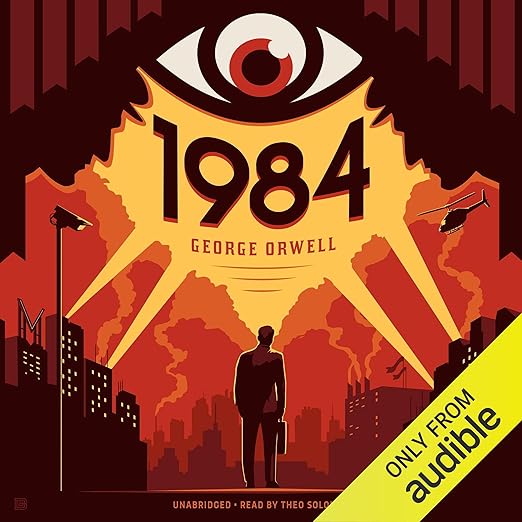
George Orwell completed Nineteen Eighty-Four in 1948 while dying of tuberculosis on the island of Jura, working against time on a novel he knew might define how the century understood itself. Seventy-seven years later, this audiobook brings Winston Smith's story to a generation for whom the vocabulary Orwell invented, Big Brother, doublethink, newspeak, thoughtcrime, has so thoroughly entered common usage that the original text can feel both familiar and newly strange. Theo Solomon's narration navigates that paradox thoughtfully, presenting the novel neither as comfortable classic nor calculated shock, but as what it has always been: a story about the specific experience of living inside a system designed to make resistance unthinkable.
This edition is listed as part of The English Edition series, and the production reflects care for the source text. The cover illustration by the Anderson Design Group is a separate matter, but the reading itself is the thing. Solomon works through Orwell's prose at a pace that honors the novel's structure, which deliberately withholds momentum in the first half to create the suffocating weight of Oceania before the narrative begins to move with any urgency in the second.
Winston's Job Is Believing and Disbelieving at Once
Orwell's achievement in this novel is not primarily its ideas, though the ideas are genuinely rigorous, but in its phenomenology: the way it makes the reader inhabit the texture of life under total surveillance before theorizing about it. Winston's job at the Ministry of Truth, altering historical records to match the Party's current position, is not just a plot device; it is a sustained examination of what happens to a person who must systematically believe and disbelieve the same facts. The Party's slogan, "War is Peace, Freedom is Slavery, Ignorance is Strength," is not presented as obvious propaganda; it is presented as the logical endpoint of a system that controls not just behavior but the cognitive categories people use to evaluate behavior.
Solomon's reading captures the dissociation at the center of Winston's experience. He voices Winston's internal contradictions without smoothing them out, which is the right interpretive choice. Winston is not a clean rebel; he is a man trying to hold onto a sense of reality in a world that is systematically dismantling the concept of reality itself. The love affair with Julia, rendered here with appropriate fragility, carries more weight because Solomon does not oversell its romantic dimensions. Its significance is existential as much as romantic, and the narration honors that.
Solomon's Voice Externalizes Winston's Forbidden Thoughts
The audiobook format does specific things for Nineteen Eighty-Four that silent reading cannot replicate. The telescreen surveillance of the novel creates an atmosphere in which the very act of private thought becomes transgressive, and listening to the book rather than reading it produces a subtly different relationship to Winston's inner monologue. The narrator's voice becomes a kind of externalization of what should be unspoken, which creates its own productive tension with the novel's central concern about the privacy of thought.
At twelve hours and eighteen minutes, this is a full and unhurried reading. Orwell's prose does not rush, and Solomon does not attempt to impose pace where the author has built deliberate stillness. Listeners who encountered the novel in a school context and felt the pacing as a difficulty will find that an unhurried adult listen changes the experience considerably. The slow accumulation of Oceanian dread in the first third is not a flaw to get through; it is the novel's central method.
The Line Between What You Say and Believe
Existing reviews for this specific edition primarily address the physical book rather than the audio production, which limits how precisely I can speak to the particular qualities of Solomon's narration compared to other available recordings. What the reviews confirm is that the text itself remains as resonant as it has been in every decade since publication, and that the story's applicability to contemporary political reality is not a retroactive projection but something built into the novel's structure. Orwell was writing about the distortion of language and the engineering of belief; those concerns remain precisely calibrated to the present moment.
Julia's line, "They can make you say anything, anything, but they can't make you believe it," is one the novel ultimately interrogates rather than affirms. Whether that interrogation satisfies or disturbs you depends partly on what you bring to the text. Listeners approaching Nineteen Eighty-Four for the first time should know that the novel is not a thriller in the conventional sense; its ending is among the most deliberately uncomfortable in twentieth-century fiction, and Solomon's narration gives it the weight it requires.
Orwell Completists Reach a Natural Culmination Here
This audiobook is for anyone who has not yet read Nineteen Eighty-Four and recognizes that gap in their literary education, and for those who read it years ago and want to return to it with adult perspective. It is also for listeners interested in the specific experience of how this novel sounds rather than reads, which is a genuinely different encounter with material this compressed and deliberate.
The audiobook is not for listeners who want action-heavy fiction or narrative momentum as a primary driver. Orwell's novel is about atmosphere and idea as much as plot, and Solomon's narration reflects that. For listeners already immersed in Orwell's work, whether Animal Farm, his essays, or his journalism, this audiobook serves as the natural culmination of an engagement with a writer who was one of the twentieth century's most precise and unsparing observers of political language.
Key Details
- Narration: Theo Solomon brings a restrained, measured quality to Winston's voice that suits the novel's atmosphere of perpetual surveillance and suppressed interiority.
- Themes: totalitarianism, surveillance, the erasure of truth and individual thought
- Mood: Relentlessly claustrophobic, with moments of fragile hope rendered all the more affecting by what surrounds them
- Verdict: A canonical text that earns its reputation in every re-read or re-listen, and Theo Solomon's narration gives the material a contemporary gravity it can always carry.