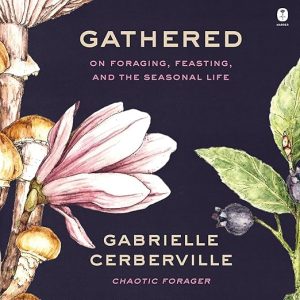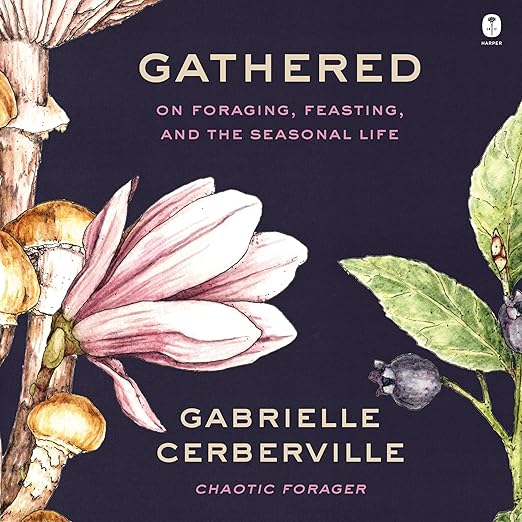
Foraging has moved from the margins to the tasting menu, and this audiobook lands in the middle of that shift. Gabrielle Cerberville, who built an audience online as The Chaotic Forager and is introduced in the publisher's copy as 'The Internet's Mushroom Auntie', has written something that is a memoir, an illustrated field guide and a recipe collection at once. Eleven hours and ten minutes, narrated by Cerberville.
Harper published it in October 2025 and the listing carries a 4.8 average across 34 ratings. The description also notes that a supplemental enhancement PDF accompanies the recording, and on a book of this kind that is not a footnote. Hold on to it, because it becomes the single most important thing to understand before you decide which format to buy.
Foraging Mistakes Stay in the Story
The book runs season by season, which is the correct organizing principle for the subject and a good one for a long listen. Cerberville moves through what a year actually offers, taking in successful harvests and outright failures, and the recipes attached to each stretch land as evidence rather than as filler. The copy names Wild Blueberry Ginger Gimlets, Pulled Hen of the Woods with Juneberry BBQ Sauce, and a Chanterelle Peach Pie with Basil.
Weight comes from the memoir strand. Alongside the identification and the cooking, Cerberville writes about indigenous practices of honoring the earth and about their own long road toward self-acceptance, and the argument connecting the two is that a reciprocal relationship with land teaches you something transferable about yourself. A five-star reader summarized the mixture accurately as 'the honorable harvest approach mixed in with practical tips, accurate ID, and personal experience by the author'.
Cerberville writes better prose than this category usually gets. One reviewer, recommending it as a gift, wrote that 'Cerberville writes with clarity, lucidity, and heart about earth's gifts', and another described a book that manages to be technical, creative, philosophical and humbling by turns. Those are not contradictory descriptions. The register genuinely does shift between instruction and reflection, sometimes within a page.
What I appreciated most is that Cerberville keeps the mistakes in. Foraging writing has a strong pull toward competence theater, in which the author never misidentifies anything and every meal works. This one records the missteps alongside the wins, which is both better company and, for a subject where errors have consequences, considerably more responsible.
Why Self-Narration Matters for The Chaotic Forager
The memoir is the half that audio serves best, and it is substantial enough to justify the format on its own. Cerberville's account of finding a life in the woods, of the seasons as a structure for attention, and of what reciprocity with land actually asks of a person, all of that works entirely in the ear and loses nothing by not being on a page.
Self-narration is close to essential here. Cerberville's readership arrived through a voice they already knew from short video, and one long-standing follower described ordering the book without hesitation the moment it was announced, having consumed as much of that content as possible since 2020. Handing a hired performer a book whose entire appeal is a specific personality would have been the wrong call.
Worth noting how the book handles risk, too. One reviewer praises the accuracy of the identification guidance and cites the honorable harvest framing that runs alongside it, which is an ethical position about taking rather than a safety protocol. Both matter. A forager needs to know what is edible and also how much of it to leave standing, and Cerberville treats those as the same question rather than as separate chapters. That integration is what lifts the book above the field-guide shelf, and it survives the move into audio completely intact.
Seasonal architecture also suits a slow listen across a real year. Take the spring chapters in spring and the fungal chapters in autumn, and the book turns into a companion rather than a task to complete. I would not listen to this one straight through, and I do not think it wants to be heard that way. Eleven hours is long for the category, and this is one of the few nonfiction structures that genuinely rewards being spread out.
Spore Prints and Gill Patterns Audio Cannot Show
The identification problem is the thing to be honest about. A field guide exists to help you tell one organism from another, mushrooms punish that judgment more harshly than almost any other food, and a recording cannot show you a spore print or a gill pattern. The supplemental PDF carries the visual material, which means the reference function lives in a separate document you are not looking at while walking in a wood.
Please do not treat this recording as an identification tool. Cerberville is careful in the text and the review pool is warm about the guidance, and none of that transfers to a listener trying to key out a specimen by memory. Buy the audio for the memoir and the philosophy, and keep a printed guide, or the PDF on a screen, for anything you intend to eat.
Recipes carry a milder version of the same issue. Quantities, timings and technique are hard to retain aurally and awkward to retrieve later, so anyone buying primarily to cook from it should plan around the companion document from the start rather than discovering the gap mid-recipe.
One note on the ratings. All five written notices award five stars, yet the average across 34 ratings sits at 4.8, which means some readers scored it lower and wrote nothing. The comments are therefore the enthusiastic end of the response rather than the whole of it, and the reviews cluster in the first months after publication.
Best for Readers Who Already Forage
This belongs with existing foragers who want the philosophy rather than another key, with readers of nature memoir in the Robin Wall Kimmerer tradition, and with anyone who has followed Cerberville's short-form work and wants the long version. Cooks who like wild ingredients will find plenty here too, provided they have the companion material open.
It fits poorly for a beginner hoping this is the only foraging resource they need, for listeners who want a straight reference work, and for anyone impatient with memoir when they came for mushrooms. The personal material is not a garnish. It is roughly half the book.
Buy it for the writing and the year-long structure, and buy a proper illustrated guide alongside it. On those terms eleven hours in the company of a genuinely engaging guide to the wild edible calendar is time well spent, and the 4.8 average reflects a book attempting something a good deal more ambitious than its shelf usually allows.
Before You Press Play
- Read by: Cerberville narrates their own book, which suits a readership that arrived through that voice online; a supplemental PDF carries the visuals.
- At its heart: Seasonal foraging, reciprocity with land, indigenous harvest ethics, self-acceptance
- Vibe: Earthy, generous, quietly philosophical
- Short version: Excellent as memoir and ethics, and unusable on its own as an identification guide.
A Few Questions About Gathered
Can you learn to identify wild edibles from this audiobook?
Not safely, and it should not be used that way. Identification depends on visual comparison, and mushrooms in particular are unforgiving of error. The supplemental PDF holds the illustrated material, so anything you intend to eat should be checked against that document or a printed guide rather than against memory.
Does the audiobook include the recipes and the illustrations?
An enhancement PDF ships alongside the recording, and that document is where the visual and reference material lives. The recipes are spoken in the text as well, but quantities and timings are difficult to retain aurally, so treat the companion document as essential rather than optional.
Is Gathered mainly a memoir or mainly a reference book?
Both, in roughly equal measure. Cerberville alternates between seasonal instruction, recipes, and personal writing about self-discovery and indigenous harvest ethics. Reviewers describe the mixture as technical and philosophical by turns, so a listener wanting only one of those two things will spend a lot of time in the other.
How much does Cerberville's online following shape the book?
Considerably. The persona known as The Chaotic Forager is named in the publisher's copy, and one reviewer describes following that work since 2020 and buying the book on sight. The voice on the recording is the voice that built the audience, which is a genuine advantage for anyone arriving from the videos.