Quick Take
- Narration: Elisabeth Rodgers brings a warm, unhurried quality to the material that suits the book’s blend of literary criticism and gardening lore – her pacing lets the more digressive passages breathe without losing momentum.
- Themes: the garden as crime scene, botanical toxicology in fiction, the intersection of domestic space and violence
- Mood: Erudite and playful, like a very well-read garden party
- Verdict: For anyone who has ever noticed that Miss Marple’s garden was doing more narrative work than it seemed, this book is a genuinely illuminating companion to a lifetime of mystery reading.
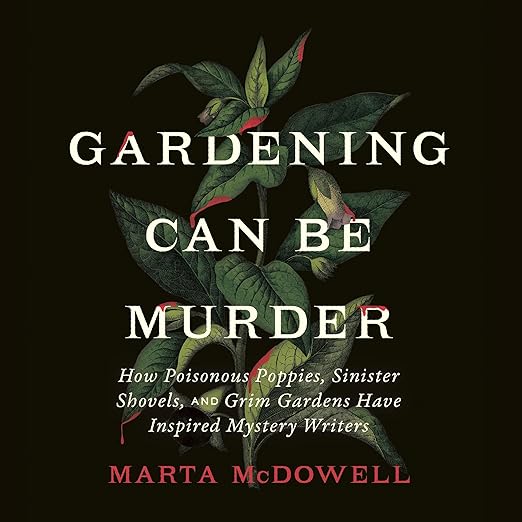
I came to Gardening Can Be Murder sideways, in that particular way books find you when you weren’t looking for them. I’d been in the middle of a run of classic cozy mysteries, that comfortable genre where the murder is almost beside the point and the setting is really the protagonist, and somewhere between an Agatha Christie and a contemporary English village thriller, I started wondering who had ever written seriously about the role of gardens in crime fiction. Marta McDowell, it turns out, had written exactly the book I was imagining.
McDowell is a writer and gardener with, as the synopsis puts it, near-encyclopedic knowledge of the mystery genre. That description undersells her. This is a book written by someone who has clearly spent years noting every foxglove and suspicious compost heap in a hundred years of mystery fiction, from Edgar Allan Poe forward to today’s bestseller lists. What she’s assembled is part literary survey, part gardening reference, and part love letter to both obsessions simultaneously.
Our Take on Gardening Can Be Murder
The book’s central argument is compelling and surprisingly underexplored: gardens are structurally ideal for crime fiction. They offer deadly plants available without a pharmacy, implements already calibrated for harm, secluded corners out of eyeline, and ground that receives bodies without complaint. Beyond mechanics, gardens carry class associations and domestic symbolism that crime writers have exploited for a century. McDowell maps this territory with genuine scholarly attention while keeping the writing accessible and, frequently, funny. The tone is closer to a knowledgeable friend showing you around than an academic presenting a thesis.
The organization is one of the book’s strengths. Rather than proceeding chronologically or author by author, McDowell has structured the book around themes: means, motive, the detective-gardener, the suspicious groundskeeper, the poisonous tea party. This gives listeners a sense of the whole shape of gardening’s presence in the genre rather than a disconnected list of examples. One reviewer described it as “exploring means, motive, gardeners and gardens, history, specific writers and their series,” and that range keeps the book from feeling repetitive even when covering familiar territory.
Why Listen to Gardening Can Be Murder
Elisabeth Rodgers is an excellent casting choice for this material. Her narration has the quality of a well-informed guide rather than a performer, which is exactly what a book like this needs. McDowell’s prose is engaging but not theatrical, and Rodgers matches that register. The result is something that works particularly well as an audiobook because you can listen while actually gardening, which several reviewers seem to have done. At five hours and ten minutes, it’s a comfortable single-weekend companion.
The blurb from Vicki Lane, author of the Elizabeth Goodweather Appalachian Mysteries, captures something true about the experience: “This book is dangerous. A veritable cornucopia of crime fiction and gardening lore, it faces the reader with multiple temptations.” You will finish this book with a reading list. Reviewers consistently mention discovering books they hadn’t encountered, or being reminded of books they’d forgotten. As a guide to the genre’s horticultural underside, it functions as both retrospective and recommendation engine.
What to Watch For in Gardening Can Be Murder
One reviewer notes the book contains some errors, which seems worth flagging for listeners who intend to use it as a reference. For readers who know the genre deeply, there may be occasional moments where a claim feels imprecise. McDowell writes with enthusiasm rather than the kind of footnoted rigor that academic treatment would demand, and occasionally that shows. This is not a fatal flaw, but listeners who intend to follow up the book’s recommendations should verify details rather than take everything as gospel.
The book also has a slight imbalance between historical and contemporary coverage. The earlier sections on Poe, Christie, and the Golden Age writers are particularly strong. The coverage of contemporary authors, while present, feels somewhat thinner by comparison, which is understandable given the volume of modern cozy mysteries published each year but is worth knowing if your primary interest is in recent fiction.
Who Should Listen to Gardening Can Be Murder
The ideal listener is either a mystery reader who gardens or a gardener who reads mysteries, ideally both. Crime fiction fans who have read widely in the genre will find this a satisfying meta-text that illuminates books they already love. Gardeners who have picked up a cozy mystery and wondered about the botanical accuracy of a poisoning scene will find both validation and deeper context here. Aspiring mystery writers are specifically called out by one reviewer as likely to find this genuinely useful as both reference and inspiration. Listeners with no interest in either mystery fiction or gardening will find little traction, but the Venn diagram of people who enjoy both is apparently large enough to have made this a New York Times bestseller.
Frequently Asked Questions
Do you need to be a mystery fan to get value from this book, or does the gardening angle stand on its own?
The mystery fan angle is more dominant. The gardening content is present and interesting, particularly the sections on poisonous plants and their fictional uses, but the book’s real engine is literary criticism of the crime fiction genre. Gardeners with little interest in mystery novels will likely find the first chapter or two engaging before the balance tips toward fiction analysis.
Does Marta McDowell cover only cozy mysteries, or does she range across the whole crime fiction spectrum?
She covers the full range, from cozy to hardboiled, classic Golden Age writers to pulp, contemporary literary crime to genre fiction. The thematic structure means you move across subgenres within each chapter rather than staying in one lane, which gives a broader picture of how gardens function differently across crime fiction’s many registers.
Is the book likely to introduce mystery readers to titles they haven’t encountered?
Almost certainly yes, based on reviewer responses. Even readers who described themselves as widely read in the genre found new titles to pursue. McDowell draws on authors across multiple decades and countries, so there’s enough breadth that most listeners will come away with at least a few books they hadn’t read.
How does Elisabeth Rodgers handle the shift between literary analysis and more casual, humorous passages?
Smoothly. Rodgers reads the analytical sections with appropriate authority without becoming stiff, and the lighter passages with warmth without tipping into performance. The consistent tone across the five-hour runtime is one of the audiobook’s assets, making transitions between close reading of Christie and anecdotes about gardening authors feel natural.