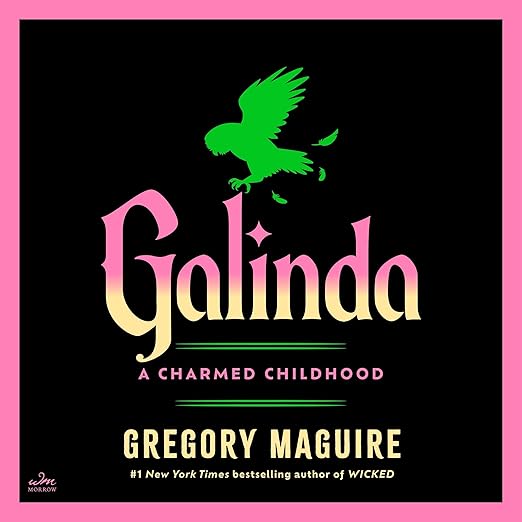
Quick Take
- Narration: No narrator is confirmed yet for this September 2026 release, details are likely pending closer to publication.
- Themes: The invisible daughter, class anxiety and social performance, becoming versus being seen
- Mood: Quietly observant and literary, with Maguire’s characteristic irony running just beneath the surface
- Verdict: For readers who loved Wicked and Elphie, Galinda rounds out the origin story with the same revisionist intelligence Maguire has always brought to Oz.
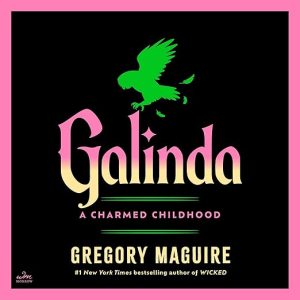
I have a complicated relationship with Gregory Maguire’s Oz. I read Wicked the year it came out and was genuinely unsettled by it in the best possible way, not because it was dark, but because it insisted that every character I thought I understood had a full interior life I had been choosing not to see. That approach has defined Maguire’s career, and it is exactly what Galinda promises: a full accounting of the girl who would become Glinda the Good, before she became anyone’s icon.
The book is positioned as a sister volume to Elphie, which told the early story of the Wicked Witch. Where Elphie presumably dealt in green skin and social exile, Galinda deals in the quieter forms of invisibility: the youngest child of a family that is high-born but financially precarious, pampered enough to be comfortable and ignored enough to go largely unseen. It is a portrait of a girl who has every social advantage except the one that actually matters, which is being noticed as a real person rather than an ornament.
Our Take on Galinda
What makes this premise work in Maguire’s hands is the specificity of the class dynamics. Galinda’s family is down on their luck, which means her grace in the district dance competitions is not merely a talent but a form of capital, something she can leverage against the family’s declining position. At the same time, her focus on those competitions blinds her to the merchant resentments accumulating around her father’s business practices. Maguire is interested in how self-absorption is not a character flaw so much as a survival mechanism, and how it leaves people catastrophically unprepared for the world’s actual dangers.
Why Listen to Galinda
The appeal here is the same appeal that made Wicked endure: Maguire takes a character who seemed purely decorative in the original story and argues, with real literary seriousness, that she had a life that was neither simple nor pink. The synopsis describes Galinda as finding in herself neither canniness nor the need to cultivate it, which is a precise and slightly painful observation about the particular blindness of a comfortable childhood. This is Maguire writing about how privilege protects you from developing the skills you will eventually desperately need.
What to Watch For in Galinda
Readers of Elphie will want to watch for the structural parallels between the two books, the ways Maguire is building toward their eventual meeting at Shiz University from two very different angles. Galinda’s arc, as described, moves from self-satisfaction toward something more aware, which is the reverse of a typical bildungsroman: instead of gaining confidence, she is gaining perception. The dance competitions serve as a recurring motif that grounds an otherwise interior story in physical, performative action, which should translate particularly well to audio.
The synopsis describes Galinda finding in herself neither canniness nor the need to cultivate it, and that formulation is worth sitting with. What Maguire is identifying is the particular blindness of a comfortable childhood: when your circumstances are just good enough, you never develop the radar for danger that more precarious lives produce early and necessarily. Galinda’s dance competitions are not frivolity, they are the only form of control she has. But they also occupy the exact psychological space where perception of external threat would otherwise live. Her father sees the snares being laid; she watches her feet.
Who Should Listen to Galinda
This is for readers who have spent time with Maguire’s Oz, particularly those who have listened to or read Wicked and Elphie. It is not a book for listeners who want plot-driven fantasy with clear heroes and villains, Maguire’s interest has always been in the textures of motivation and self-deception rather than in narrative momentum. If you are comfortable with a literary pace and genuinely curious about who Glinda was before she became a symbol, this will reward that patience. Listeners who found Wicked too slow or too political may want to look elsewhere.
Frequently Asked Questions
Should I read Elphie before Galinda, or can I start here?
Maguire designed these as companion volumes rather than sequential books, so Galinda can be read independently. That said, readers who have experienced Elphie will have a richer sense of the symmetry Maguire is building, particularly since both books eventually converge at Shiz University.
How closely does Galinda follow the events of Wicked?
This is a prequel focusing on Galinda’s childhood before she meets Elphaba, so it covers ground that Wicked largely skipped over. Maguire is filling in her life before the university scenes that open the original novel.
Is this appropriate for listeners who only know Glinda from the musical rather than the book?
Yes, though be prepared for a very different version of the character. Maguire’s Galinda is more complicated and less sparkly than the stage version. Familiarity with the Wicked novel will help, but it is not strictly required.
At 12 hours, does Galinda have enough plot to sustain the length?
Maguire’s books are character studies at heart, and the pace reflects that. If you found the interior focus of Wicked satisfying, 12 hours will feel appropriate. If you need more external plot momentum, it may feel slow in places.