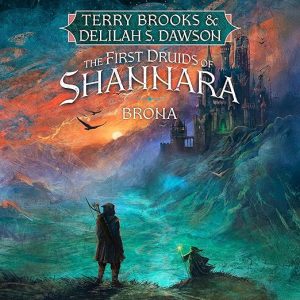
Nothing on this page names the person who will read it. The narrator field for this ten-hour audiobook is blank, the rating box is blank, and the release date sits in the future, which explains the other two: the record was built before the recording had a voice attached to it. That is ordinary for a pre-order and still worth stating plainly, because who speaks ten hours of fantasy matters nearly as much as who wrote it, and anybody committing now is committing without that information.
Galaphile came first, and this is its sequel. Years have passed since Galaphile Joss and his life partner Nirianne established Paranor to bring harmony to the Four Lands, and their two sons are growing up inside the peace that project produced. Peace bores the eldest. Abronja is sixteen, acutely conscious of a famous father, and hunting for something to prove himself against. What turns up is the dark sorcerer his father once defeated without destroying, back and stronger. So far, so familiar. The turn that makes the premise worth ten hours arrives a paragraph later and is genuinely uncomfortable: Abronja was conceived while that sorcerer had control of Nirianne, and Galaphile has always feared a spark of the same malevolence lives on in his child.
Two names appear in the description and one appears in the byline. The copy credits the New York Times bestselling authors Terry Brooks and Delilah S. Dawson, plural and explicit, while the author field on this record carries Brooks alone. On a collaboration that is not a small omission. Somebody following Dawson will not surface this book by searching that name, somebody following Brooks may never register that the prose is shared, and anyone calibrating expectations from four decades of Shannara novels is calibrating from half the information. The description says what it says. The field ought to agree with it.
Why Brona Works as an Audiobook
Inherited evil is the engine, and it has been set up more sharply here than the genre usually bothers with. Galaphile is not worried about a prophecy. He is worried about his own son, for a reason bound up with the worst thing that ever happened to the person he loves. Abronja knows none of this and is certain he could never be corrupted, which is precisely the certainty that makes a sixteen-year-old useful to a sorcerer. The structure hands a listener two anxieties running in opposite directions for ten hours: one adult who suspects too much and one adolescent who suspects nothing at all. The copy also promises consequences reaching across centuries, which in a world this long-running is a load-bearing claim about where the book sits.
Position in the sequence is unusually clear for once. Both series fields are filled in, naming The First Druids of Shannara and marking this as book two, and the copy opens by inviting you to return to the world of Shannara with the sequel to Galaphile. The entry point is named and the reading order is unambiguous. Founding-era stories carry a particular appeal in long-running secondary worlds, because they let a reader watch institutions and catastrophes acquire their origins, and the pitch here is exactly that: how the seeds of the greatest evil the Four Lands has known grew, inadvertently, out of somebody's dream of peace. Newcomers can begin with Galaphile without decades of homework first.
Weak Spots in Brona
Brona is the title, and Brona appears nowhere in the description. The young man at the center of the summary is called Abronja, the sorcerer is never named at all, and no sentence here connects the word on the cover to anybody in the story. Longtime readers will have a theory about that. A buyer who is not a longtime reader is looking at a proper noun with no referent, which is a peculiar way to sell a book. The description also stops rather than ends, trailing away after a clause about consequences reaching across centuries into a row of spaced periods. Jacket teases do that. It still leaves the last thing this page tells you unfinished.
Almost nothing a buyer normally decides on is present here, which deserves itemizing instead of glossing over. No reader is credited. No rating exists, no rating count, and not one written response. The runtime is posted as a flat ten hours, the sort of round number that appears before a finished file has been measured, so treat it as an estimate rather than a specification. Random House Audio is the publisher and the release date is set for later in August. What is on sale, in other words, is a commitment priced as a product. Anyone who pre-orders Shannara novels on the strength of the byline already knows that and does it anyway. Anyone weighing an unfamiliar series should give it a couple of weeks and buy once the credits are filled in.
The Right Listener for Brona
Shannara readers who have already finished Galaphile are the obvious audience and probably the only settled one. You know the register, you know how a threat gets built in these books, and the sequel hook is doing its work. Fantasy listeners drawn to origin stories about institutions, the founding of an order, the first mistake, the long consequence, will find this pitch attractive whatever their series history, provided they start one book earlier. Readers who came for Delilah S. Dawson should note that the collaboration is real even where the byline conceals it, and that this is the second half of a pair and not a standalone door into the world.
Wait if the reader matters to you, and across ten hours of fantasy it should. One voice will be carrying a sorcerer, a sixteen-year-old, a founder of Paranor and the invented vocabulary of the Four Lands, which is not a small ask of anybody. The page will presumably name somebody before release, and buying afterward costs nothing extra. Newcomers should not start here under any circumstances, since the story opens years into an established situation and assumes you were present for the first book. Listeners who want a verdict from other buyers have none available: this record carries no reception whatsoever, which is a reason to hold off rather than a criticism of the book.
Questions Listeners Ask
Who narrates the Brona audiobook?
Nobody is named. The reader slot on this listing sits empty, which fits a title whose release date has not yet arrived. Random House Audio has posted no reader, and the ten-hour figure is a round number, not a measured one, so both details should be treated as provisional until the release date passes.
Do I need to read Galaphile before starting this audiobook?
Yes. The publisher presents this as the sequel to Galaphile and opens years after the events of that book, with Paranor established and two sons already grown. The series fields mark it as the second entry in The First Druids of Shannara. Beginning here means beginning after the setup has already happened.
Why does the description name two authors when the byline names one?
Both writers are named together in the description, plural and unambiguous, while the author field carries only the first of them. Nothing suggests a dispute; a field simply went unfilled. What it costs a listener is calibration, since ten hours written by two people rarely sounds like forty years of one person's sentences.