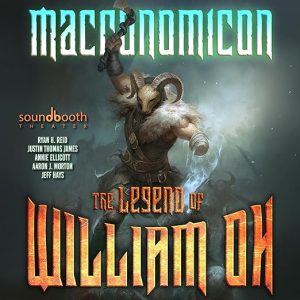
William Oh wants to punch the parents who abandoned him, and the only route to that grudge runs up The Tower, the structure at the center of the world through which all magic flows. The audiobook, ten hours and thirty-seven minutes of it, is read by Ryan H. Reid for Soundbooth Theater. An orphan with a petty motive and no advantages starts climbing a structure that eats people. A betrayal, an act of generosity and an inconvenient talent for surviving things he should not survive begin turning him into a story other people tell, and then the story gets away from him.
William's Legend Outpaces Him Across Ten Hours
Legend as a mechanic is what lifts this above the standard tower climb. Macronomicon is not simply tracking a character getting stronger, the book tracks what other people say about him getting stronger, and those two curves come apart early. A March five-star describes the pleasure precisely: William makes a legend of himself while remaining, for a good stretch, ignorant and improvising. Reputation arriving ahead of competence is a genuinely funny engine, and it hands the book a second problem to solve besides the next floor up.
Ten hours and thirty-seven minutes is generous for a first volume in this genre, and the length goes on character rather than on mechanics. The opening is rough on William by design: a five-star filed on the twelfth of March warns that the story starts terribly for him, betrayed and cornered, and that escaping demands something desperate and gruesome enough to make that reader wince. Matters improve quickly afterward. But the comedy is earned because the first stretch costs the protagonist something real.
Dashing Humor Built on Situational Comedy
Humor is the differentiator. Dashing and chaotic, funny above all, epic and clever: those are the words this column keeps reaching for, with unusual consistency for a page this new. Comedy in progression fantasy usually means a sarcastic interface making jokes at the protagonist's expense, and what gets promised here instead is situational, built out of a character whose reputation keeps writing checks his actual abilities cannot yet cash. That is a harder joke to sustain and a much better one.
Loot is the other thing buyers keep raising, and one March entry is explicit: everyone gets a class carrying powers, and the gear stacked on top interacts with those powers to grant further abilities. That is the progression-fantasy contract stated without embarrassment. If it sounds like bookkeeping to you, this is not your genre and no amount of jokes will fix that. If it sounds like the good part, note that the same entry calls the loot the single best thing in the book.
Systems in audio are a known problem and worth thinking about before you spend a credit. Stat blocks, level-up notifications and item descriptions are visual objects on a page, and a recording has to speak them aloud, which either settles into a rhythm you stop noticing or becomes an interruption you never stop noticing. A five-star from mid-March calls the system built for this world decently interesting while conceding that its more entertaining parts arrive later, which suggests the mechanical load in book one is lighter than the genre's reputation would lead you to expect.
Launch-Week Reviews and an Unmentioned Serial Past
Four of the five written entries are signed with a default storefront handle rather than a name, and all five were filed between the twelfth and the nineteenth of March, within days of the recording appearing. The ones naming an activity name reading. What that column represents is a launch week among an existing readership, which tells you a great deal about the author's following and very little about this particular edition of the book.
Serialization is the thing the record never mentions. One March five-star is thrilled to see the story move into full novel form, which means a version of it existed somewhere before this one, and nothing on the page acknowledges that. For most listeners the detail is trivia. For anybody who followed the earlier version it is the difference between new material and a rerun, and the page offers them no way at all to tell which they are buying.
Genre fields on this record are doing something strange. The book is filed under literature and fiction as well as under science fiction and fantasy, with a tag reading Action and Adventure, and not one of those three phrases contains the word that would actually deliver its audience. A novel with classes, gear, a System and a tower to climb belongs on a specific shelf, and the readers of that shelf search for it by name. Filing it beside literary fiction helps nobody find it and may puzzle the people who do.
Progression Fantasy Fans Are the Obvious Audience
Progression fantasy listeners are the obvious audience and this delivers for them: a first volume, a clean premise, a protagonist starting from nothing, and a structure promising floors to climb for as long as the series runs. A five-star from the nineteenth of March captures the particular discomfort of arriving early, having finished the book without any idea how long the wait for the next one will be, and pronouncing it worth the trouble regardless.
Newcomers to the genre could do considerably worse as a first experiment, provided the mechanical vocabulary does not put them off inside the opening hour. Anybody who wants fantasy without character sheets should stay well clear, because the numbers here are not decoration. And if you have been looking for a reason to try a tower-climbing series in audio rather than on a screen, an opener of this length with a hero whose reputation keeps outrunning him is a sensible place to start.
- Voice: Ryan H. Reid takes the whole book solo for Soundbooth Theater, a first-volume casting decision that will define the series for however many floors it ends up running.
- Big ideas: reputation outrunning ability, a tower that filters the world's magic, an orphan's small and very specific grudge
- Atmosphere: Chaotic, funny, escalating
- Worth it?: A strong genre opener, let down only by a page that hides which shelf it belongs on.
Before You Listen
Does the Legend of William Oh audiobook stand on its own, or does it end on a cliff?
It closes an arc while leaving the climb unfinished, which is standard for the genre and clearly signposted by the series field. Buyers who reached the end have been vocal about wanting the next one immediately, so treat it as a satisfying first volume rather than a complete story with everything resolved.
Does the audiobook demand that you track numbers to follow the story?
Less than newcomers fear. Classes, gear and levels matter, and you will hear them described, but the plot turns on what people believe about the protagonist rather than on his statistics. You can let a level-up wash past and still follow everything that matters, which is not true of every book on this shelf.