Quick Take
- Narration: Tom Parks reads Govindarajan and Venkatraman’s material cleanly, matching the book’s confident, strategic register without overdramatizing the examples.
- Themes: Physical-digital integration, competitive advantage, industrial transformation
- Mood: Forward-leaning and strategic, written for leaders who feel the ground shifting
- Verdict: A sharp, well-argued playbook for industrial companies facing the data-driven era, though at six hours it sometimes covers complex terrain faster than the ideas deserve.
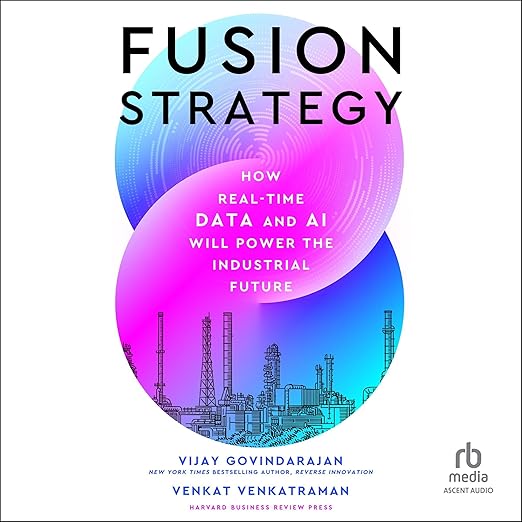
I was partway through a conversation with a friend who runs operations at a manufacturing company when I thought of this book. She kept describing a version of the problem Vijay Govindarajan and Venkat Venkatraman have named with precision: her company makes excellent physical things, but the companies eating her lunch are companies that make decent physical things and extraordinary amounts of data about how those things are used. She hadn’t heard of Fusion Strategy. She’s heard of it now.
The premise is compact and well-stated: the convergence of cheap sensors, supercomputing, and AI has created an opportunity for industrial companies, those that design and make physical products, to fuse what they do best with what digital companies do best. The result isn’t simply digital transformation, a phrase that has lost most of its meaning through overuse. What Govindarajan and Venkatraman are describing is something more specific: a shift in the basis of competitive advantage from owning the best assets to having the richest, most actionable data about how those assets are used.
The Logic of the Fusion Model
The authors distinguish between companies that remain purely physical, those that have made awkward partial moves toward digital, and those that have achieved genuine fusion. That taxonomy is more useful than it might sound, because it gives industrial leaders a vocabulary for diagnosing their own position and a direction to move in. The laws of competitive advantage are changing, Govindarajan and Venkatraman write, rewarding those with the most robust data-driven insights rather than the most valuable assets. This is not an original observation in 2024, but they substantiate it with specific examples from industrial sectors where the shift has been most pronounced. Tom Parks handles the narration with appropriate steadiness; this is a book of strategic argument rather than narrative storytelling, and Parks matches that register. He doesn’t try to make the material more dramatic than it is, which is the right call.
Brighton, Brentford, and the Sports Analytics Thread
Govindarajan and Venkatraman use football analytics, specifically the rise of data-driven clubs like Brighton and Brentford, as a through-line for illustrating fusion principles in a domain that most readers will find vivid and legible. This is a smart structural choice. The football examples function as a proof of concept for the broader argument: clubs that learned to use expected goals models and other performance metrics didn’t just improve their scouting; they rebuilt their entire decision-making architecture around data. The transfer to industrial contexts is made explicit and handled well. A companion PDF is included with purchase, and it adds useful supplementary material, particularly for the frameworks and diagrams the authors reference.
Where the Six Hours Strain Against the Ambition
At six hours and thirty-four minutes, this is a relatively short book for the size of its claims. Reviewers with backgrounds in connected intelligence and industrial strategy have praised the ambition of the roadmap, and it is genuinely ambitious. But the brevity means that some of the sector-specific analysis moves faster than it perhaps should. The treatment of how companies in, say, heavy equipment or medical devices specifically operationalize fusion strategy is suggestive rather than detailed. If you come to this book as a practitioner in an asset-heavy industry looking for granular implementation guidance, you’ll find the strategic framing excellent and the operational depth thinner than you might want. If you come as a senior leader trying to understand what direction to point the organization, it’s a more complete resource.
The book’s strongest contribution is its insistence that the industrial-digital divide is not a technology problem but a strategic and organizational one. Companies that frame fusion as an IT initiative will miss it. Those that frame it as a fundamental reorientation of competitive logic have a chance. That argument is made clearly and with enough evidence to be convincing.
Frequently Asked Questions
Does Fusion Strategy work for companies that don’t manufacture physical products?
The book is explicitly written for industrial and physical-product companies. Service businesses and purely digital companies are used as foils rather than primary audience. If you’re in professional services or software, the strategic concepts translate partially, but many of the examples will feel adjacent to your context.
Is the companion PDF necessary to get value from the audio version?
The PDF supplements the frameworks and diagrams the authors reference. The core arguments are fully accessible through audio alone, but the supplementary material is worth downloading before you listen, particularly for the sections on fusion architecture.
How does this compare to other books on digital transformation for industrial companies?
Govindarajan is known for The Three Box Solution and reverse innovation research, and Fusion Strategy applies a similar level of structural rigor to the physical-digital integration question. It’s more precise than most digital transformation books about what specifically changes in industrial competition, and less focused on change management or implementation than something like Leading Digital.
Does Tom Parks’ narration work for the more technical strategic sections?
Yes. Parks is a reliable narrator for business nonfiction and keeps the material moving without losing precision. The book’s register is confident and strategic rather than academic, and his delivery matches that tone well across the full runtime.