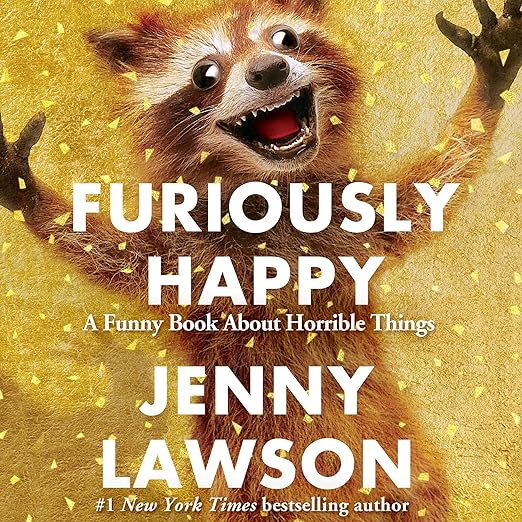
Jenny Lawson’s Furiously Happy is one of those audiobooks that genuinely requires the author’s voice to function as intended. At eight and a half hours, narrated by Lawson herself, this is not simply a reading of a book about depression and anxiety; it is a performance that treats the gap between the clinical reality of mental illness and the sheer absurdity of trying to live cheerfully through it as the source of an almost inexhaustible supply of comedy. That this works at all is surprising. That it works as well as it does is a function of timing that no professional narrator could replicate, because the timing is inseparable from the experience Lawson is describing.
The title comes from Lawson’s personal philosophy, which she articulates in the book with her characteristic mix of clarity and self-aware ridiculousness. When mental illness steals time and capacity, the moments when things are actually fine need to be treated not as ordinary but as extraordinary, as something to be seized and amplified. Being furiously happy is about making the good moments count in direct proportion to how catastrophic the bad ones feel. This is not a wellness framework constructed for a marketing pitch. It is not a set of coping strategies designed to manage symptoms. It is a way of being in the world that Lawson embodies rather than prescribes, and the audiobook is the format in which that embodiment is most fully realized.
The kangaroo story, which Lawson uses near the book’s opening to introduce the central idea, is funnier in audio than it could ever be in print. The deadpan delivery, the precise placement of the pause before the punchline, and the sound of someone who is genuinely delighted by their own absurdity are not things that punctuation and white space on a page can reproduce. Lawson is, as one reviewer noted accurately, at her snort-inducing funniest in this book, and that assessment is borne out fully by the audio experience.
Humor and Pain Coexist in Real Time
What makes the recording distinctive is not just the comedy; it is the way Lawson transitions between the genuinely hilarious passages and the ones where she describes what depression actually feels like from inside it, without warning and without a tonal gear-change that announces the shift. The humor and the pain inhabit the same register, which is exactly what she is arguing about in the book. These are not opposites but conditions that coexist in the same person, often simultaneously, often in the same conversation. Hearing that coexistence performed in real time, in Lawson’s voice, is what separates this audiobook from the experience of reading the same words on a page.
Lawson is beloved for her honesty, and in this book she is more direct about the specific shape and texture of her experience than she was in her earlier memoir. She describes depressive episodes with a specificity that goes beyond the general and into the particular: the exact quality of the paralysis, the specific way the world narrows, the particular absurdity of trying to explain to people who do not experience this what it is that you are actually going through. For listeners who have their own experience of anxiety or depression, or who care for someone who does, those passages carry a quality of recognition that the comedy cannot supply on its own and is not trying to supply.
Digressive Passages Demonstrate More Than Describe
A few reviewers noted that some of the comedic sequences run longer than they need to, and this is an accurate observation about Lawson’s style. Her writing is digressive by design, and some tangents land with more precision than others across the eight-plus hours of the recording. Listeners who prefer tightly controlled narrative arcs with clearly signaled movements between sections may find the looser passages frustrating. But for readers who have their own experience of a mind that moves in directions you did not choose, those digressive passages often demonstrate more than they describe, and the demonstration has its own value as testimony.
The audiobook also contains material that some reviewers flagged as pushing against conventional standards of taste. Lawson is entirely aware of this and entirely unapologetic about it, which is consistent with the book’s central argument that the parts of experience that make us uncomfortable are often the most important to acknowledge honestly. Prospective listeners who need a content advisory: this is a book about mental illness that does not ask for your comfort, that refuses to make depression or anxiety palatable for audiences who have not encountered it personally, and that treats the full range of its subject with the same seriousness it brings to the comedy.
Hearing Lawson Narrate Is the Right Way
This audiobook is for anyone who has ever felt that the conventional ways of talking about mental health were missing something essential about the actual experience of living with it day to day. Lawson is not a therapist and does not pretend to be. She is a person who lives with depression and anxiety and who has decided that the most honest and most useful thing she can do is describe what that is actually like, with full comic access to the parts that are also genuinely absurd. The audio format is essential to the full experience; if you are going to encounter Furiously Happy for the first time, hearing Lawson narrate it is the right way to do it. Those who prefer memoirs that build toward resolution or who find dark humor in the context of serious illness difficult will find the book demanding in a way that is specific to their reading preferences. Those who have spent any time in the territory Lawson is mapping will recognize it immediately and be grateful for the company she provides across these eight and a half hours.
Common Questions
Is it essential to listen to Furiously Happy as an audiobook rather than reading it in print?
Lawson’s self-narration is widely regarded as the definitive way to experience this book. Her comedic timing, her pauses, and her emotional authenticity in the more vulnerable passages are not reproducible on the page. Listeners who have read the print edition often return to the audio specifically for the qualities the written version cannot supply.
How does this audiobook handle the mental illness content given its comedic framing?
Lawson does not separate the humor from the pain; they coexist throughout. She describes what depression and anxiety feel like with real specificity, and the comedy arises from the same material rather than covering it over. Listeners with their own experience of mental illness tend to find this approach more honest than most clinical or inspirational treatments of the subject.
Is the Furiously Happy audiobook suitable for someone unfamiliar with Jenny Lawson’s previous work?
Yes. This book stands entirely on its own. Knowing her earlier memoir provides some context for recurring references, but Lawson writes in a way that introduces her world and her sensibility from the first chapter, and no prior familiarity with her work is necessary to engage fully with this one.
At 8 hours and 28 minutes, does this audiobook maintain its energy throughout or are there slower sections?
The energy varies deliberately. Some sections are high-tempo comedy; others are slower and more reflective. A few reviewers noted that certain tangents run longer than they need to. Overall the recording sustains its tone across its full length, but listeners should expect variation in pace rather than a uniform comedic drive from beginning to end.