Quick Take
- Narration: Adam Verner brings a professional, measured quality to 17 hours of technical material, keeping the prose accessible without oversimplifying the content.
- Themes: Data engineering lifecycle, cloud architecture decision-making, tool-agnostic framework thinking
- Mood: Authoritative and clarifying, like a senior engineer finally explaining why things work the way they do
- Verdict: The rare technical audiobook that holds up as a standalone listening experience because its ideas are architectural rather than code-dependent.
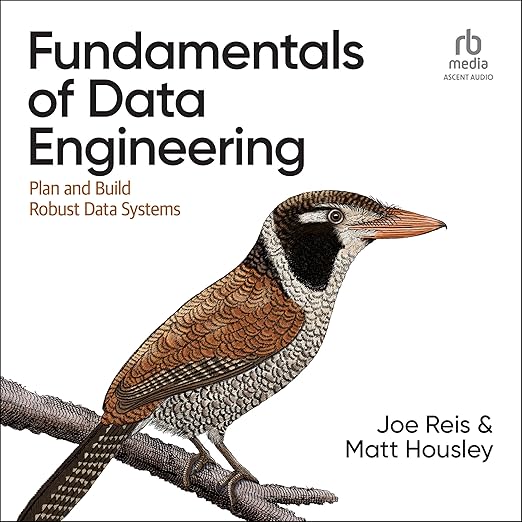
I finished Fundamentals of Data Engineering on a long train ride from Paris to Lyon, the kind of journey where you bring one book and hope it carries you the whole way. What I didn’t expect was to spend the final two hours slightly annoyed that we were arriving. Joe Reis and Matt Housley have written something that is less a technical manual than an intellectual framework, and frameworks, it turns out, translate well to audio in a way that code tutorials rarely do.
The data engineering field has a paradox problem. It moves fast enough that any book covering specific tools risks obsolescence before it goes to print, but the underlying decisions, what data to store, how to move it, how to govern it, remain relatively stable. Reis and Housley identified this tension and made a deliberate choice: write about the lifecycle, not the tooling. That decision transforms this from a book with a shelf life into one with genuine durability.
The Lifecycle Framework That Makes Everything Else Click
The organizing principle here is the data engineering lifecycle: generation, ingestion, transformation, storage, serving, with data governance and security running as undercurrents beneath all of it. This structure gives every chapter a home. When Reis and Housley discuss orchestration or storage formats, the listener already has a mental map of where that discussion sits in the larger flow. It’s the kind of scaffolding that makes 17 hours feel coherent rather than encyclopedic.
The most valuable section, at least for listeners coming from adjacent fields like software engineering or data science, is the early material on what data engineering actually is and how it differs from the roles it’s often confused with. The authors draw a careful line between data engineers who build and maintain pipelines and the data scientists or analysts who consume the outputs. That distinction matters enormously in organizations where the boundary is contested, and the book names the tension without becoming a territory dispute.
Tool-Agnostic Thinking as a Pedagogical Choice
Multiple reviewers flagged this as the book’s defining quality, and they’re right. The tool-agnostic approach is not a cop-out but a considered stance. Reis and Housley explicitly teach the reader how to evaluate data technologies against the lifecycle framework, asking questions like what stage of the lifecycle does this tool address, what are its tradeoffs in terms of scalability and maintenance overhead, and does it serve downstream consumers in the way the organization actually needs.
This is genuinely rare. Most data engineering writing either defaults to opinionated stack recommendations or avoids tool discussion entirely. This book does neither. It gives listeners a decision-making apparatus. A reviewer who described it as essential for data professionals highlighted exactly this quality. You come away not knowing how to use any particular tool better, but knowing how to think about which tools belong in which architectures and why.
Where 17 Hours Can Feel Like Longer
The book’s comprehensiveness is a strength and a challenge. Reis and Housley cover a lot of ground, from data governance frameworks to batch versus streaming patterns to the organizational dynamics of data teams. Some of this material is densely conceptual, and the audiobook format means you can’t scan ahead to check whether a given section is worth your attention. Verner’s narration is steady and professional throughout, but at the 12-hour mark, when the book moves into governance and security topics, the pace can feel like it’s asking more patience than insight in return.
The book was also written in a period when cloud data warehousing was experiencing rapid evolution. Some of the architectural comparisons feel slightly dated relative to where platforms like Databricks or Snowflake have landed, but the conceptual framing holds. This is a companion caveat rather than a criticism.
The Listener This Was Written For
A data scientist who wants to understand what the engineers building infrastructure around their models are actually doing will find this more illuminating than almost anything else available in audio format. A software engineer transitioning toward data work will get a principled map of the field that saves months of confusion. A manager overseeing a data team will understand why architectural debates keep surfacing and how to evaluate competing proposals more intelligently.
It is not a book for complete beginners. The authors assume comfort with basic programming concepts, some familiarity with databases, and enough organizational context to understand why data governance isn’t just a compliance checkbox. Listeners who lack that foundation will find the early chapters clarifying but the middle sections opaque.
Who Should Listen, Who Should Skip
Listen if you work in or adjacent to data and want a principled view of how the field fits together. Listen if you’re evaluating architectural decisions and want a framework that transcends vendor marketing. Listen if you’re a data scientist who has always wondered what data engineers are actually doing upstream of your notebooks.
Skip if you need hands-on implementation guidance with specific tools. Skip if you’re looking for cloud certification prep tied to a particular platform. This is a book about thinking, not a book about doing.
Frequently Asked Questions
Is this audiobook appropriate for someone transitioning from software engineering into data engineering?
Yes, this is one of the better entry points for that transition. The authors explicitly address what distinguishes data engineering from software engineering and provide a lifecycle framework that helps orient someone familiar with software development principles. You’ll understand the landscape and the key decisions before you start picking up specific tools.
How does Fundamentals of Data Engineering hold up given how fast the cloud data space moves?
Better than most technical books in this space, precisely because the authors wrote to the lifecycle framework rather than specific tools. The architectural thinking and decision-making criteria remain valid even as individual platforms evolve. Some specific comparisons between tools have dated, but the core framework is durable.
Does the audiobook work without any companion PDF or supplementary material?
Yes, unlike many technical audiobooks this one holds up as a standalone audio experience because it’s organized around conceptual frameworks rather than code examples or diagrams. The lifecycle model can be followed aurally without needing visual reference material.
How does this compare to something like Designing Machine Learning Systems for a data professional deciding what to listen to first?
They address adjacent but distinct territory. Fundamentals of Data Engineering covers the pipeline infrastructure that gets data from source to a usable state. Designing Machine Learning Systems picks up closer to where models live and are deployed. For a complete view of modern data work, both are worth listening to, but if you build pipelines, start here; if you build models, start with Chip Huyen’s book.