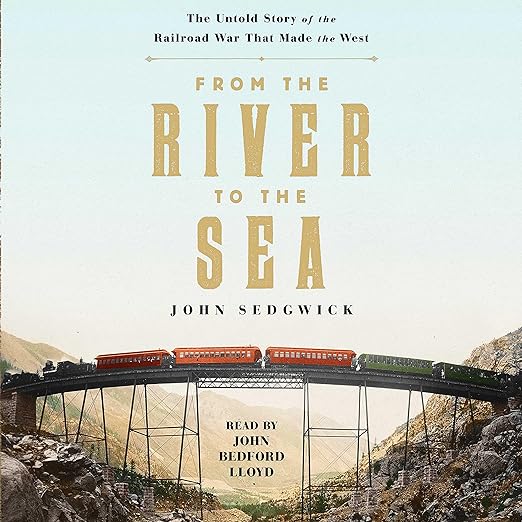
Quick Take
- Narration: John Bedford Lloyd brings the propulsive quality of a western adventure to the material, with a voice that handles both boardroom scheming and mountain-pass standoffs with equal conviction.
- Themes: Manifest Destiny, corporate rivalry, American infrastructure mythology
- Mood: Kinetic and panoramic, like watching a landscape rush past from a moving train
- Verdict: For anyone who thought railroad history was dry, John Sedgwick’s account of the Santa Fe versus Rio Grande war will correct that impression within the first hour.
My grandmother used to say that every American city has a railroad story at its center, whether it knows it or not. I thought of her often while listening to From the River to the Sea during a series of long drives last winter, the kind of gray-sky driving that goes perfectly with a story about men who looked at mountain ranges and saw not obstacles but routes. Sedgwick’s account of the war between the Santa Fe and the Rio Grande is the rare history that makes you feel the physical scale of its subject.
John Sedgwick is a bestselling author whose previous work has ranged across military history and cultural biography. Here he has found a story that combines the ambition of a novel with the satisfying density of documented history. The decade-long conflict between General William J. Palmer’s Rio Grande and William Barstow Strong’s Santa Fe is the kind of American epic that has somehow stayed below the radar of popular history, and Sedgwick clearly relishes the opportunity to bring it forward.
Two Visions Collide in Colorado
The rivalry begins, as Sedgwick explains, almost by accident. Palmer and Strong are not natural enemies at first. They are simply two men with incompatible ambitions operating in a geography that cannot accommodate both. Palmer’s Rio Grande has a family-business quality to it, a personal investment that goes beyond profit. Strong’s Santa Fe is more corporate in its orientation, more willing to use lawyers, press influence, and hired muscle to protect its claims. The contrast between these two institutional cultures is one of the book’s most revealing threads, and Sedgwick develops it with patience.
The escalation is genuinely dramatic. Claims through narrow mountain passes, private armies stationed at tunnel entrances, legal maneuvers that drag through multiple courts while men with rifles hold the ground in dispute. George R.R. Martin’s blurb, calling it “riveting” with “colorful characters and outrageous confrontations,” is not marketing hyperbole. There are sequences in From the River to the Sea that read like scenes from a novel, which is partly what the more skeptical reviewer Catherine Michael flags as a concern. Sedgwick does employ novelistic techniques, reconstructing conversations and interior states from historical evidence. Readers who prefer strict archival journalism may find the approach uneasy. For the majority of listeners, though, it’s what makes ten hours and forty minutes feel much shorter.
The Geography as a Third Character
One of the strongest elements of this audiobook is Sedgwick’s treatment of the landscape itself. The Raton Pass, the Royal Gorge, the silver-mining country of Colorado: these places are not just settings. They are the stakes. Whoever controls the route through a mountain pass controls the economy of everything beyond it. Sedgwick communicates the geography with enough specificity that even listeners unfamiliar with the Southwest can visualize what it meant to stake a claim on a particular stretch of canyon wall. John Bedford Lloyd’s narration carries the geographic scope convincingly, modulating between the intimate and the panoramic as the text demands.
The book also makes a persuasive case for seeing railroad men as urban creators rather than just transportation entrepreneurs. The way the Santa Fe deliberately built up communities along its route, transforming small settlements into proper cities, reframes what it means to call Los Angeles or Albuquerque a “railroad town.” The thirty thousand souls of a sleepy California backwater become a booming metropolis not through organic growth alone but through one man’s calculated decisions about where to lay track.
Where the Narrative Breathes and Where It Strains
The reviewer who called the middle section “heavy going” has a point. The legal battles that occupy a significant portion of the book’s middle are less cinematically satisfying than the physical confrontations on mountain passes, and Sedgwick’s novelistic style sometimes strains when it has to carry courtroom testimony across the finish line. This is not a fatal problem, but listeners who came for the Wild West action sequences may need patience during the litigation chapters.
What saves these sections is Sedgwick’s ability to maintain the personal dimension. Palmer and Strong remain human figures rather than corporate abstractions, and the knowledge that one of them will end the story in anonymity and disgrace while the other achieves something like permanent historical consequence gives even the dry procedural passages a tension the outcome hasn’t yet resolved.
Who This Audiobook Is For
The listener who will get the most from From the River to the Sea is someone who loves American history with narrative energy, who can appreciate a well-constructed rivalry, and who doesn’t require every historical claim to be footnoted in real-time. Railroad enthusiasts, as reviewer Larry T. Spencer notes, will find the operational detail satisfying. General history listeners will find the storytelling accessible. The New Yorker’s observation that it “seems to demand big-screen treatment” is apt: this is history that thinks in images and movement, and John Bedford Lloyd’s narration is a delivery system that honors that quality.
Frequently Asked Questions
Do I need to know anything about American railroad history before listening to From the River to the Sea?
No prior knowledge is required. Sedgwick provides sufficient context about post-Civil War Western expansion, federal land grants, and the first transcontinental railroad to orient listeners who are coming to the subject fresh.
Is the novelistic approach Sedgwick uses based on documented sources, or is he inventing scenes?
Sedgwick draws on extensive historical research, but he does employ reconstructed dialogue and inferred motivations in places. One reviewer notes the style makes you ‘wonder what research could be the support’ for some scenes. Readers who require strict archival sourcing may want to supplement with the bibliography.
How does John Bedford Lloyd handle the large cast of historical figures in this book?
Lloyd differentiates the main figures, particularly Palmer and Strong, with vocal character rather than theatrical accents. He’s more storyteller than actor here, but his steady authority keeps the large cast legible across ten-plus hours.
Does the book cover the transformation of Los Angeles in any depth, or is that just mentioned at the end?
Los Angeles appears as a destination and a consequence rather than as a central subject. The book’s focus is the railroad war itself. The city’s transformation is used to illustrate the stakes and the scale of the Santa Fe’s eventual victory, but it doesn’t receive extended treatment on its own terms.