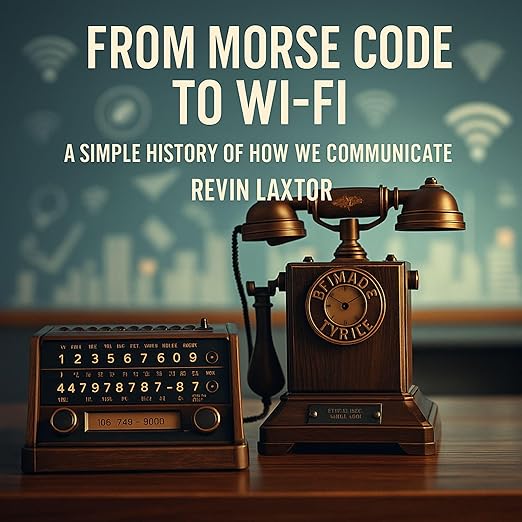
Quick Take
- Narration: Adrenalyn Starr narrates this accessible history of communication technology, and the narrator’s energy suits the book’s mission of making technical history feel like an adventure story.
- Themes: History of communication technology, human connection and innovation, the ten transformative breakthroughs in communication
- Mood: Curious and wonder-driven, engaging and swift
- Verdict: A genuinely warm survey of communication history from telegraph to Wi-Fi, well-suited to audio with its story-first structure, a strong choice for curious listeners of any age.
I was halfway through the chapter on the first telephone call when I realized I had stopped thinking about the commute entirely. There is something about the framing Revin Laxtor uses in From Morse Code to Wi-Fi that taps into the wonder you felt as a kid learning that once, a long time ago, people could only communicate as fast as a horse could travel. The book is structured as a journey through ten transformative communication breakthroughs, and that countdown structure gives it the propulsive quality of a well-made documentary series. Each chapter arrives with a clear destination and a story to anchor it.
This is part of the Simple Science series, which signals its intentions clearly. These are not deep technical histories. They are well-researched, accessibly written surveys that prioritize readability and wonder over exhaustive detail. For a listener who wants to understand the arc of how human communication evolved without getting lost in engineering specifications, that is exactly the right approach.
A Structure That Earns Its Ambition
The book’s ten-chapter architecture is smart. Beginning with the electric telegraph and Morse Code, the first technology that sent information faster than a human being could physically carry it, grounds the whole history in a single transformative idea. From there, Laxtor traces the telephone, radio, television, satellites, computers, the internet, email, mobile phones, and finally Wi-Fi. What makes this sequence compelling is the author’s attention to how each breakthrough built on the last. This is not a collection of isolated invention stories. It is a connected narrative about how human beings kept finding new ways to collapse distance between themselves.
The framing of email as one of the earliest killer apps is one of the more interesting editorial choices in the book. It is easy to forget how radically email changed daily communication for families, businesses, and governments before the smartphone era, and giving it its own chapter rather than folding it into the broader internet chapter is a signal that Laxtor is thinking about impact and cultural weight, not just chronological sequence. That kind of editorial judgment lifts the book above a simple timeline.
Why Audio Is the Right Format for This Story
Communication history, particularly the story of how sound and voice became transmissible, is peculiarly well-suited to the audiobook format. There is something appropriate about listening to the story of the first telephone call, the arrival of radio, and the spread of the human voice through the air. Adrenalyn Starr’s narration leans into the storytelling quality of the material rather than adopting the more neutral delivery you get from technology surveys. The pacing in the early chapters moves with the same sense of discovery that the synopsis describes: you feel wonder as a navigational tool, not just a rhetorical device.
The runtime of just under three hours is well-calibrated for the scope. Ten breakthroughs across roughly seventeen minutes each means no single chapter outstays its welcome, and the listening experience has the rhythm of a serialized documentary rather than a straight-through lecture. For a listener on a long commute or a weekend walk, that structure makes it easy to pick up and put down without losing the thread.
What the Perfect Rating Reflects and What It Obscures
Twenty-five ratings at a perfect 5.0 is promising, and the complete absence of critical reviews suggests a book that is genuinely delivering on its promise to a specific audience. But a 5.0 across twenty-five ratings is also a reminder that this title has not yet reached the scale of readership where outlier critical opinions would emerge. The synopsis’s claim that the book is suitable for all ages is worth taking at face value: this is an accessible history that avoids the condescension of books written explicitly for children while remaining genuinely welcoming to listeners with no prior technical background.
There are no listener reviews quoted in the available metadata, but the rating pattern suggests the core audience of curious non-specialists is finding exactly what it came for. For a survey of this scope, that is the relevant benchmark.
Who Should Listen, Who Should Skip
Listen if you want an engaging, story-first history of how human communication transformed from dots and dashes to the invisible networks that define daily life. The audio format suits the material, and the pacing keeps the nearly three hours moving briskly.
Skip if you are looking for technical depth on any single communication technology, or a scholarly history with primary sources and footnotes. This is a survey, deliberately and well, and readers who want to go deeper on any individual breakthrough will need to look elsewhere.
Frequently Asked Questions
Does From Morse Code to Wi-Fi cover the social and cultural impact of communication technology, or is it mainly technical history?
The synopsis emphasizes how each breakthrough reshaped daily life, relationships, and how we understand the world, suggesting the book prioritizes human and cultural impact alongside technical explanation. It reads as social history with technology as the driver, not a chronicle of patents and engineering.
Is this part of the Simple Science series, and do you need to have listened to other books in the series first?
It is listed as part of the Simple Science series, but the subject matter is self-contained. Communication history from telegraph to Wi-Fi is a standalone topic that requires no prior context from other books in the series.
At under three hours, does the book go deep enough on each breakthrough to be genuinely informative?
Given ten breakthroughs across roughly seventeen minutes each, this is a survey rather than a deep-dive. Each chapter should give you enough context to understand why a given technology mattered and how it connected to what came before and after, but listeners wanting detailed technical or biographical depth on any single innovator or invention will need additional resources.
How does Adrenalyn Starr’s narration handle the more technical passages about how the technologies actually work?
With no specific critical reviews flagging narration issues, and a 5.0 rating across the available reviews, the narration appears to be working well for the audience. The book’s accessible-for-all-ages mandate suggests the technical explanations are written to be heard, which makes a narrator’s job easier than in a textbook format.