Quick Take
- Narration: Frits Zernike reads with a warm, slightly formal quality that suits the book gentle, reflective tone and its sense of an outsider finding his footing.
- Themes: Belonging and outsider status, the discipline of gardening, Americans in France
- Mood: Unhurried, sensory, and quietly affecting
- Verdict: A short, graceful memoir about a man, a garden, and a French village that does not particularly want him, and what happens when he earns his place anyway.
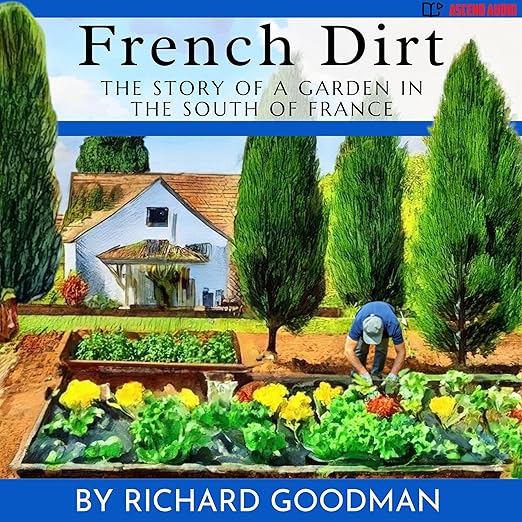
I had been listening to ambitious, dense audiobooks for three weeks straight when French Dirt arrived in my queue, a four-hour and seventeen-minute memoir about a writer who rented a stone house in Southern France and grew vegetables. I was immediately suspicious of how much I needed it. The cover promised exactly the escape I was rationing myself away from, which meant I pressed play with a kind of guilty relief.
Richard Goodman found the house through an ad in the paper: a stone farmhouse near Nimes and Avignon, the kind of listing that is designed to make New Yorkers abandon their better judgment. He went, taking his girlfriend with him, and found himself in St. Sebastien de Caisson, a village small enough to have no shops and no post office, only a cafe and a school. The village had farmers and vintners who had no particular interest in welcoming another American who had come to experience la France profonde and would inevitably leave.
Earning the Ground Under Your Feet
The book central drama is quiet but real: how does an outsider gain admittance to a community that has seen too many tourists to waste warmth on transient visitors? Goodman solution is to work. He goes into the vineyards as hired labor, meets the farmers on their own terms, and eventually gets a small plot of land to tend himself. The garden becomes the mechanism through which he earns his way into something like belonging, and Goodman understands this clearly enough to make it the book organizing metaphor without turning it into a lesson.
One reviewer, a gardening skeptic, made the useful observation that you do not need to care about growing things to respond to this book. The most powerful theme, that reviewer wrote, is the conquest of naivete, self-doubt, and cultural alienation that comes from immersing yourself in an unfamiliar setting, and the garden is a conduit for that journey rather than the journey itself. That reading holds. What Goodman is really writing about is the specific form of loneliness that comes from watching a community daily rhythms from outside and wanting, without quite knowing how to ask, to be allowed in.
The Question of Duration and Authority
One reviewer pushed back against Goodman authority to write a memoir based on roughly six months of experience, finding it cheeky to call that tenure a basis for a book. The criticism is not without logic, and the book does not pretend the time was longer or the immersion more complete than it was. Goodman is honest about what he does not understand, what French he does not have, which social codes he violates without realizing it. That honesty is what saves the book from the worst impulses of the expatriate memoir genre.
French Dirt does not claim to be a comprehensive account of French village life. It is a seasonal record of one man relationship with a specific patch of soil and the people who work similar patches near his. The cabbage, tomatoes, parsley, and eggplant Goodman grows are not symbols; they are the actual subject, handled with the kind of attention to physical detail that makes agricultural writing feel grounded rather than pastoral.
Frits Zernike and Four Hours Well Spent
At just over four hours, French Dirt asks almost nothing of its listener time. Frits Zernike narration has a warm, slightly formal quality that I found oddly well matched to the material: Goodman is writing in a voice that is careful and a little self-conscious about its place in the scene it is describing, and Zernike captures that register without making it feel stiff. The short runtime means the book does not have space for significant structural complexity, and it does not try for any. It is a memoir shaped like a growing season, with a beginning in mud and uncertainty and an end in something closer to harvest.
Readers who go to Southern France travel writing looking for the familiar pleasures of that tradition, the markets, the light, the slow lunches, the skeptical locals eventually won over, will find all of them here. The book earns its place in the genre by staying close to its specific subject and resisting the temptation to inflate a small experience into a large one.
Frequently Asked Questions
Is French Dirt primarily a gardening book, or does the gardening serve a larger story?
The gardening is real and specific, with detailed attention to what Goodman actually grew and how, but the larger story is about belonging, cultural alienation, and earning a place in a French farming community. Reviewers without particular interest in gardening consistently found it engaging.
How does French Dirt compare to other expat-in-France memoirs like Peter Mayle books?
French Dirt is shorter and more focused, and Goodman is more honest about his outsider status and the limits of his experience than writers who settled more permanently. The tone is reflective rather than comic, and the working relationship with French farmers gives it a physical grounding that some expat memoirs lack.
Does the short runtime, under five hours, mean the book feels rushed or underdeveloped?
Reviewers generally find the length appropriate to the material. The book is structured like a season and does not try to be more than it is. Several readers noted wishing it were longer simply because they enjoyed it, which is a different kind of problem.
Is French Dirt available as a free audiobook?
Yes, French Dirt is listed at /bin/zsh.00 on Audible for eligible members. At just over four hours, it is one of the shorter free audiobook options in travel memoir, making it an easy entry point for the genre.