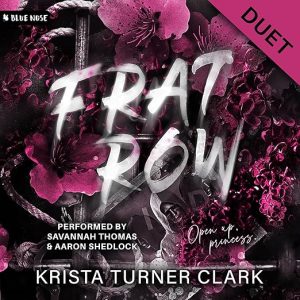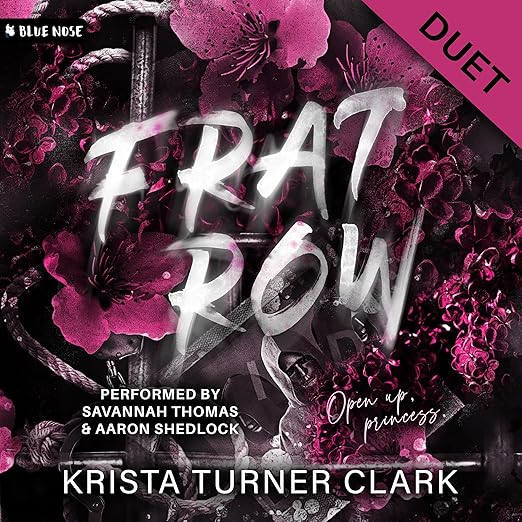
Krista Turner Clark opens Frat Row inside Cassidy's confidence, all sorority-legacy swagger and casual cruelty toward anyone outside her social tier, before spending the rest of the audiobook dismantling that same confidence piece by piece. It is a deliberate craft choice, not an accident, and it is the reason this dark romance lands harder than its campus-party setup initially suggests. Savannah Thomas narrates the whole descent, from rush-week bravado to something considerably grimmer, and the tonal whiplash between those two registers is where this audiobook either earns its pitch-black reputation or loses a listener who signed up for something lighter.
Cassidy is a legacy at the campus's most popular sorority, rushing alongside her best friend Blair, when a one-night stand named Tyler, charming, rushing the equally prestigious Alpha Chi fraternity, becomes something more than casual. Katie Person's review singles out the Cassidy-and-Blair dynamic specifically, calling their dialogue 'cute and funny,' and that friendship is genuinely the audiobook's warmest thread before the plot turns. What Cassidy stumbles into partway through the story upends everything: she becomes a ghost to everyone who knew her, taken in the night and left to survive on will alone once her body has already been broken down.
That pivot from campus romance to captivity narrative is steep, and Clark does not soften the landing. Itzxraibooks' review, written by a self-described longtime follower of Clark's 'unhinged, pitch-black' catalog, frames the book explicitly as being about survival rather than romance in any conventional sense: Cassidy's body may surrender in places, but her will does not, and that distinction is the emotional spine the whole back half of the book runs on. Readers coming in expecting a straightforward frat-and-sorority romance should recalibrate those expectations early.
The word legacy does real work in the opening pages, and it is worth pausing on. Being a legacy pledge means Cassidy's place in this sorority was decided before she ever rushed, inherited status rather than earned membership, and that inherited privilege is precisely what makes her disappearance so disorienting: a young woman whose social position seemed the most secure imaginable becomes, in the space of one sentence, someone nobody can find. Clark sets that reversal up early and lets it pay off hard once the story turns.
Savannah Thomas Has to Sell Two Books
Savannah Thomas has to sell two different books inside one runtime, the flirtatious rush-week comedy of the opening chapters and the considerably darker survival story that follows, and pulling that shift off convincingly is a real narration challenge. A performer who plays the early chapters too broadly comic risks undercutting the later tonal collapse; one who plays everything grim from the first page loses the contrast that makes the turn effective in the first place. Based on the reviewer response, particularly Katie Person's specific praise for how alive Cassidy and Blair's banter sounds, the lighter register in the opening stretch is landing with listeners before the story asks them to sit with something much harder.
This is also a genre where audio has a real structural advantage over the page: first-person present-tense dread benefits from a human voice controlling pace, silence, and breath in ways static text cannot fully replicate. Kayla Reid's review, while more measured than the two five-star reactions, still describes being pulled through the book despite finding herself at a loss for words by the end, which speaks to a story that stays gripping through discomfort rather than losing its audience to it.
Clark also leans on present-tense, close first-person narration throughout, a common dark-romance choice that keeps the listener locked inside Cassidy's immediate perceptions rather than any reflective distance, and that structural choice is precisely what makes a narrator's control over pacing and breath so consequential to how the later chapters actually land. The mirrored structure of two parallel Greek institutions, Cassidy's sorority and Tyler's fraternity, also gives Clark a built-in reason for the two central characters' paths to keep crossing before anything sinister ever surfaces.
A Ghost to All Who Knew Her
Be honest with yourself about the content warnings before starting. All three attached reviews independently flag this as genuinely dark material, not marketing hyperbole: Katie Person wishes there were more erotica horror written at this length, Itzxraibooks calls the catalog pitch-black, and Kayla Reid states directly that anyone picking this up should read the trigger warnings first given the 'very dark and heavy topics' involved. This is not a book that teases danger and then retreats to safety; the synopsis itself describes a battered body and a mind fighting not to break, and the audiobook does not shy away from either.
This is also book one of the Frat Row series, so the ending is very unlikely to resolve everything Cassidy is up against. Listeners who want closure in a single sitting should know going in that this is a launch point rather than a complete arc, and that the sorority-rush setup functions mainly as a contrast to darken later, not as the story's real subject.
The synopsis itself supplies the book's sharpest line: Cassidy becomes a ghost to all who knew her. That phrase does double duty, describing both her literal disappearance from her old life and the erosion of identity captivity narratives depend on, the sense of a person becoming unrecognizable even to herself. Listening to that specific vocabulary land in Savannah Thomas's voice, rather than encountering it silently on a page, gives the line's dual meaning more room to register before the plot moves on.
Endurance Over Rescue in a Campus Setting
This suits listeners who already gravitate toward dark romance and captivity-adjacent thrillers and want a campus setting instead of the genre's more common isolated-cabin or billionaire-mansion backdrops. If Krista Turner Clark's earlier work already has your attention, or if you specifically want a heroine whose arc is framed around endurance rather than rescue, Frat Row delivers on both fronts, and Savannah Thomas's narration keeps the earlier chapters light enough that the descent actually registers as a descent.
Worth noting for anyone weighing the time investment: at just under eight hours, this is a substantial listen for book one of a new series, longer than many dark romance openers, which suggests Clark is building out Cassidy's world with real patience rather than rushing toward a cliffhanger. Readers who prefer a slower, more immersive build before a series accelerates will likely appreciate that pacing choice more than readers wanting a fast, plot-only introduction.
Skip this one if graphic violence and abduction content are hard limits for you, regardless of how the romance elements eventually resolve, since the synopsis and every attached review agree this goes to genuinely brutal places. Listeners hoping for a breezy Greek-life romance with light stakes should look elsewhere in the genre; that is not what Frat Row is building toward, even in its opening chapters.
In Brief
- Narration: Savannah Thomas handles a steep tonal shift from campus flirtation to survival-horror dread convincingly.
- Themes: Dark romance, captivity and endurance, sorority and fraternity social hierarchy
- Mood: Seductive at first, then genuinely harrowing
- Verdict: Recommended for dark romance readers who want real stakes, not for anyone seeking a light campus romance.
Good to Know
How explicit is this audiobook?
Frat Row sits at the explicit end of dark romance, with genuine heat balanced against heavy survival and captivity content; several attached reviews recommend checking trigger warnings before starting.
Does the audiobook resolve Cassidy's story by the end?
No. This is the first entry in the Frat Row series, so significant threads remain open for future installments rather than wrapping up in a single book.
What trigger warnings should I know about before starting Frat Row?
Attached reviews describe abduction, physical abuse, and other heavy survival themes beneath the romance; sensitive listeners should sample before committing to the full runtime.
Does Savannah Thomas's narration handle the shift from campus setting to darker content well?
Based on listener response to the earlier chapters specifically, the lighter register in the opening stretch sets up real contrast once the story turns considerably darker.