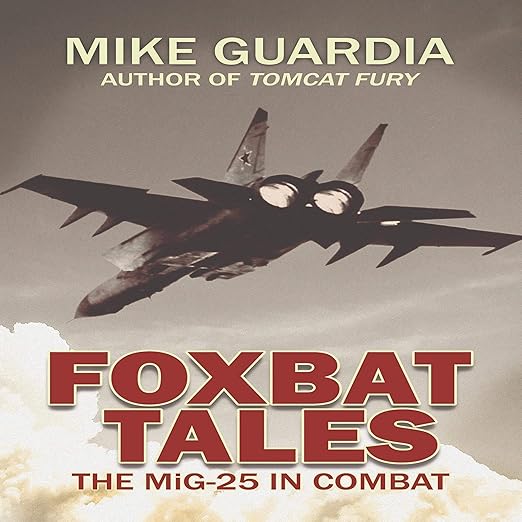
Quick Take
- Narration: Johnny Heller is among the most reliable narrators working in military history, and his performance here keeps three hours of operational and combat material moving without ever feeling like a briefing document.
- Themes: Cold War intelligence failure, the gap between propaganda and performance, Soviet aviation design
- Mood: Crisp and fast-paced, like a good aviation documentary with better sourcing
- Verdict: At just over three hours, Foxbat Tales is a precisely sized piece of military history for aviation enthusiasts who want context, not just specifications.
I listen to a lot of military aviation history. It’s a genre that skews heavily toward technical specification and tends to treat human drama as secondary to airframe data. Mike Guardia’s Foxbat Tales arrived in my queue on a short drive home from the airport of all places, which felt appropriate, and it turned out to be something rarer than I expected: a technical history that actually cares about why things went wrong.
The MiG-25 is, on paper, one of the Cold War’s most impressive aircraft. Capable of speeds exceeding Mach 3, able to reach altitudes that NATO analysts thought were impossible for a tactical fighter, it caused genuine alarm in Western intelligence communities when it appeared at the Moscow Air Show in July 1967. The intelligence response to those six new Soviet aircraft, and specifically to the Foxbat, is one of the more entertaining episodes of Cold War institutional panic, and Guardia recounts it with appropriate relish.
The Gap Between the Legend and the Aircraft
The central tension in Foxbat Tales is the distance between what the MiG-25 appeared to be and what it actually was. NATO’s assessment, based on the aircraft’s observable performance data, was alarming enough that the F-14 Tomcat and F-15 Eagle were developed partly in direct response to the Foxbat threat. What Western analysts didn’t know, and what Guardia explains with clarity, is that the aircraft excelled as a reconnaissance platform and was poorly suited as a dogfighter. The oversized motor that produced its extraordinary speed figures also burned fuel at rates that limited engagement envelopes. The airframe design that allowed extreme altitude meant the aircraft was structurally stressed in ways that made aggressive maneuvering dangerous.
The correction of the Western intelligence community’s assessment came dramatically, through the defection of Lieutenant Viktor Belenko in 1976, who landed his MiG-25 at a Japanese civilian airport, providing Western engineers with their first physical examination of the aircraft. Guardia handles this episode well, using it as the pivot that recontextualizes everything that came before. The aircraft was impressive in narrow parameters and mediocre in others, which describes most weapons systems but was a particular shock given the psychological weight the Foxbat had accumulated in NATO planning documents.
Three Hours, Three Theaters
Guardia structures Foxbat Tales across multiple combat theaters: the Sinai Peninsula, where Egyptian MiG-25s operated during the Yom Kippur War; Afghanistan, where the Soviet aircraft flew reconnaissance missions; and Operation Desert Storm, where Iraqi Foxbats faced American opponents with results that confirmed the aircraft’s real limitations. This three-theater structure keeps the book from becoming a dry catalog of specifications. Each theater adds a different dimension to the argument that the MiG-25 was a product of a specific Cold War logic that didn’t survive contact with actual combat conditions across varied opponents and contexts.
Johnny Heller’s narration is a significant asset. He’s been the narrator on enough military history titles to have developed an instinctive sense of pacing for this genre: brisk where the action warrants it, measured when the technical explanations need space to breathe. Reviewer Joe Donahoe’s comment that the book captures the “need for speed” as its animating energy is fair, and Heller delivers that energy without overselling it. The three-hour runtime is exactly right for this material. Guardia hasn’t padded the book, and Heller doesn’t stretch it.
Aviation Enthusiast or Cold War Generalist
The audience for Foxbat Tales divides fairly cleanly. Aviation enthusiasts who know their Mach numbers and airframe designations will enjoy the operational specificity and may want more. Cold War history readers who come to the subject through the broader geopolitical context will find the book accessible without prior aviation knowledge, because Guardia is always more interested in what the MiG-25 revealed about Soviet-American strategic competition than in the aircraft’s technical parameters for their own sake. Reviewer Jenni J praises the history “brought to life” quality, which captures what Guardia does well: he treats the aircraft as an artifact of a particular moment in history rather than as an engineering object to be catalogued.
Skip it if you want extensive documentation of every mission profile or a comprehensive technical manual. Come to it for a well-argued, well-narrated account of why the most feared fighter in NATO’s threat assessment turned out to be something quite different from the legend it generated.
Frequently Asked Questions
Does Foxbat Tales cover the Viktor Belenko defection in 1976?
Yes. The defection, in which Belenko flew his MiG-25 to a Japanese civilian airport and gave Western analysts their first physical access to the aircraft, is one of the pivotal episodes in Guardia’s account and functions as the corrective to NATO’s earlier overestimation of the aircraft.
Is three hours enough time to cover the MiG-25’s full operational history?
Guardia is selective rather than exhaustive. He covers the key theaters, including the Yom Kippur War, the Soviet-Afghan War, and Desert Storm, and focuses on the aircraft’s combat record rather than attempting a comprehensive maintenance or production history. For a narrative overview, three hours is well-sized.
How does Johnny Heller handle the technical language in an aviation history?
Heller manages the technical terminology fluidly without stumbling over aircraft designations or aeronautical vocabulary. His pacing gives complex information space to land, and he keeps the narrative momentum that Guardia’s structure provides.
Do I need to know anything about Cold War aviation before listening to Foxbat Tales?
No. Guardia provides the necessary context about NATO’s threat-assessment process, the Soviet aircraft development program, and the geopolitical stakes that made the MiG-25 such a focus of Western anxiety. The book is oriented toward engaged general listeners, not only aviation specialists.