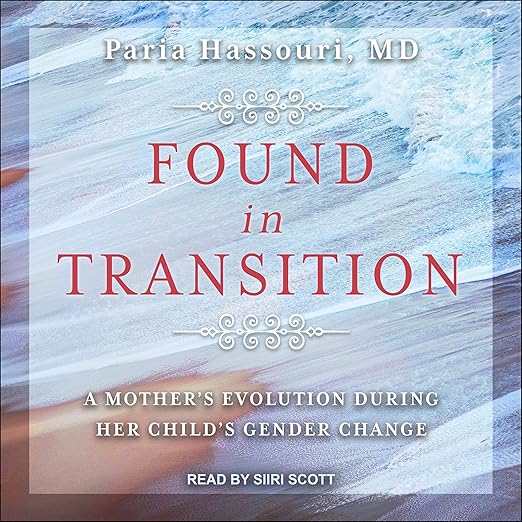
Quick Take
- Narration: Siiri Scott reads with appropriate emotional restraint, she lets Hassouri’s honesty carry the weight rather than amplifying it artificially.
- Themes: Parental identity and transformation, unconditional love under pressure, immigrant experience and fear-based parenting
- Mood: Intimate and honest, often difficult, ultimately warm
- Verdict: A rare parenting memoir that interrogates the parent as seriously as it chronicles the child, Paria Hassouri’s self-awareness is what makes this book work.
I had a particular moment, maybe two hours into this audiobook, where I had to pause and sit with what I had just heard. Paria Hassouri is describing the way her childhood as a brown kid in a white world, as an Iranian immigrant navigating American culture, had shaped her into a parent who operated from fear rather than love. This is not a comfortable thing to admit in print, and the fact that she admits it without softening it is what gives Found in Transition its particular moral authority. This is a memoir by someone who is actually examining herself, not someone performing the examination for the audience.
The book’s premise is familiar from the synopsis: Hassouri’s 14-year-old child, whom she had known as her son, tells her over Thanksgiving that she is transgender. What follows is not a straight line from denial to acceptance, and Hassouri does not pretend otherwise. She documents the anger, the grief, the bargaining, and the specific ways her identity as both a pediatrician (professionally equipped to advise other families in exactly this situation) and an immigrant (carrying her own history of navigating between belonging and exclusion) complicated her response in ways she could not fully predict.
Our Take on Found in Transition
The book earns its emotional resonance through specificity rather than generality. One reviewer who has a trans child described it as invaluable in processing and understanding what their child was going through, and crucially, in crafting how to share the news with family. Another reviewer who does not have a trans child noted being surprised by how deeply the book resonated anyway, on the level of what it means to genuinely see another person rather than the version of them you’ve constructed in your mind. That breadth of impact is not accidental. Hassouri is a careful writer. Siiri Scott’s narration is well-judged throughout: she reads with emotional restraint that lets the material breathe.
Why Listen to Found in Transition
The audio format works particularly well for memoir, and especially for a memoir this interior. Hassouri’s prose is reflective and layered, she will say something, and then come back to it from a different angle several chapters later, having processed it further. That quality of ongoing self-examination is easier to follow in audio than on the page, where you might flip back looking for the earlier passage. At 8 hours and 33 minutes, the book moves at a pace that feels calibrated rather than rushed, there is space for the harder chapters to land without the whole experience becoming relentlessly heavy.
What to Watch For in Found in Transition
This is not a policy book or an advocacy text. Hassouri is a pediatrician and uses her clinical experience as context, but she is explicit that the book is about her own family’s specific journey rather than a universal prescription. Readers who want statistical or medical guidance on supporting transgender youth will need to look elsewhere, this book offers the texture of lived experience, which is a different and often more valuable thing. It is also worth knowing that the book covers Hassouri’s reckoning with her own emotional history at some depth. The thread about fear-based parenting and its roots in her immigrant experience is as much a subject as her daughter’s transition, and some readers may find that wider lens unexpected.
Who Should Listen to Found in Transition
Essential for parents, family members, and educators navigating a child’s gender identity and looking for honest company rather than a manual. Also valuable for anyone interested in the intersection of immigration, identity, and parenthood. Not just for families with trans children, the book’s treatment of unconditional love as something that has to be actively chosen, especially when it conflicts with what you thought you knew, speaks broadly. Listeners who found The Glass Castle or An Unquiet Mind useful for what they said about the complexity of family will find resonance here.
Frequently Asked Questions
Is Found in Transition useful for parents who have just learned their child is transgender, or is it more of a memoir than a guide?
It functions primarily as a memoir, but reviewers who are parents of transgender children consistently describe it as practically useful, both for processing their own emotions and for understanding what their child is experiencing. Several mention using it to figure out how to communicate the news to extended family.
How does Siiri Scott’s narration handle the more emotionally difficult sections?
Scott reads with appropriate restraint rather than pushing the emotion. She lets the writing carry the weight rather than amplifying it with vocal performance. This is the right call for material this personal, overacting would have undermined Hassouri’s careful honesty.
Does the book address the clinical or medical aspects of gender transition for teenagers?
Hassouri’s background as a pediatrician gives her some clinical authority, but the book focuses on her family’s emotional and relational journey rather than medical guidance. Readers looking for information about hormone therapy, gender clinics, or medical protocols will need to consult other resources.
Is this book only for families directly experiencing gender transition, or does it have broader appeal?
Multiple reviewers who are not parents of transgender children describe finding the book deeply resonant, particularly the sections about fear-based parenting and what unconditional love actually requires. The memoir works on a general level about seeing your children as they are rather than as you imagined them.