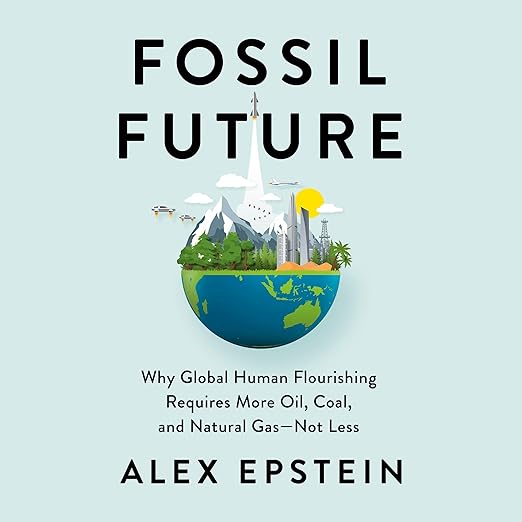
I spent a morning with Fossil Future not entirely sure how to approach it, because the book is simultaneously serious intellectual work and very clear advocacy. Alex Epstein is a philosopher and energy analyst, and he's writing from a specific position: that fossil fuels are morally defensible and practically necessary for human flourishing, that the consensus view on their future is wrong, and that the experts who dominate media coverage of energy have a demonstrably poor predictive record. He makes this argument at length and with considerable supporting data. Whether that argument persuades you will depend significantly on what you believe before you start listening.
Epstein is the author of The Moral Case for Fossil Fuels, a 2014 book that established his framework, and this 2022 sequel develops and deepens that framework with newer data and what he calls the "human flourishing framework" for evaluating energy policy. The core claim is simple: the benefits of fossil fuels to human life, including lifting billions out of extreme poverty and reducing climate-related deaths through development, outweigh their costs including climate impacts, and will continue to do so for the foreseeable future.
The most intellectually interesting contribution here is Epstein's analysis of why he believes expert opinion on energy and climate has been systematically wrong. He attributes this to what he calls the "anti-impact framework," a set of assumptions that treats any human influence on the natural world as inherently negative and measures alternatives against an imagined pristine baseline rather than against the actual consequences of energy poverty. Whether or not you agree with his conclusions, the methodological critique of how media experts frame the climate debate is worth taking seriously.
One reviewer here described moving from enthusiastic green-movement supporter to someone who now sees the issue as "more complicated" after reading Epstein's work. That's a meaningful testimonial, and several others describe similar recalibrations. I'd note that this kind of self-reported perspective shift often reflects the experience of encountering a well-constructed argument for a position you hadn't previously engaged with on its own terms, which is not the same as that argument being correct. Epstein is a skilled rhetorician as well as a researcher, and both qualities are present in this book.
What Stands Out
Epstein narrating his own material is a double-edged feature. He delivers the argument with the fluency and conviction of someone who has been making it in public for years, and for listeners already sympathetic to his position, that advocacy voice is energizing. For skeptical listeners, the absence of a neutral narrator means there's no tonal distance between the author's conclusions and the presentation of evidence, which can make the book feel relentless in a way that's tiring rather than persuasive.
The book is extensively researched. The data on energy poverty, the history of renewable energy predictions, and the statistics on climate-related mortality are drawn from public sources and presented in detail. Reviewers across the political spectrum have noted that the empirical groundwork is real, even when they dispute Epstein's interpretation of it. That's worth acknowledging.
Weak Spots in Fossil Future
The book is long, over 16 hours, and Epstein is characteristically thorough. One reviewer from the book's first edition noted it was "much longer" than The Moral Case for Fossil Fuels and required "more time and patience to complete." That's accurate. Epstein restates his core framework multiple times across the book, which serves listeners who join the argument midway but can feel repetitive to those listening linearly.
The rhetorical strategy is worth noticing: Epstein consistently frames the debate as his "human flourishing framework" versus the media's "anti-impact framework," a binary that positions his critics as systematically irrational rather than legitimately wrong. That framing is effective advocacy but limits the book's capacity for genuine intellectual engagement with the strongest counterarguments. Readers wanting a book that seriously engages with the case for rapid decarbonization will need to look elsewhere to build the full picture.
Who Will Get the Most From It
Best for listeners who want to understand the strongest version of the pro-fossil-fuel argument in contemporary policy terms, whether you're sympathetic or want to understand what you're arguing against. Also valuable for anyone who feels the mainstream energy debate lacks sufficient engagement with the human costs of energy poverty. Less recommended if you want a balanced treatment of the climate debate; this is advocacy from a specific position, and it functions best when understood on those terms.
Key Details
- Performance: Alex Epstein narrates his own material with confident advocacy, which suits the book's argumentative nature but also removes any distance between author and argument.
- What it covers: Energy poverty and human flourishing, challenging anti-fossil-fuel orthodoxy, the framing of climate policy debates
- Feel: Combative and methodical, with a consistent rhetorical confidence that will energize supporters and frustrate skeptics
- Our call: A fully committed argument for a position most mainstream media treats as settled, best approached as advocacy requiring independent verification rather than journalism.
Common Questions
Is Fossil Future politically neutral, or does it advocate a specific position?
It advocates a specific position clearly and consistently. Epstein argues that fossil fuels are morally defensible and practically necessary for human flourishing, and that expert consensus on the energy transition has been systematically wrong. It is advocacy, not journalism, and is best approached with that understanding.
Does Epstein narrating his own book affect the listening experience?
Significantly. He delivers the argument with the practiced fluency of someone who has made it publicly for years, which works well for listeners already sympathetic to his position. Skeptical listeners may find the advocacy voice, without any tonal distance from the material, more tiring than persuasive across 16 hours.