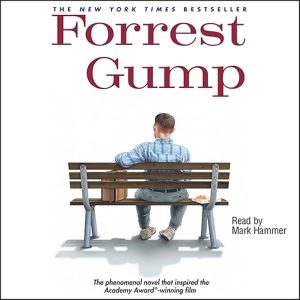
Everyone thinks they already know this story before pressing play, and that assumption is exactly what this audiobook spends nine hours quietly dismantling. Winston Groom's original novel is not the screenplay you already know by heart, and the gap between the two turns out to be the whole reason to bother with the print source at all.
How Forrest Gump Holds Up
The catalog description attached to this listing is a mess. "Hurculean" for herculean, "savy" for savvy, "Univerity of Alabama" for University, "cildlike wisdome" for childlike wisdom, the kind of scanning error that suggests nobody proofread the page before it went live. I mention it only because it primes you for the wrong book. The actual novel underneath that garbled synopsis is sharper and stranger than the sunny back-cover pitch suggests, and Mark Hammer's reading carries Forrest's voice through three decades of American history without leaning on the sentimentality the film is famous for. Hammer is the only credited performer here, which matters more than it sounds like it should: Forrest narrates his own life in the first person, so the entire tone of the book rides on one voice staying consistent from a football field in Alabama to a jungle in Vietnam to a Ping-Pong table on the far side of the world.
Pamala Judd's review puts it bluntly: "Do not expect the Tom Hanks version of Forrest!!!" That review describes reading the novel years before the movie existed, feeling frustrated by the film's popularity at first, and only warming to both once the comparison stopped being the point. It is a useful frame for anyone coming to this listen backward, from screen to page, the way most of us inevitably do.
Groom's synopsis promises a comic odyssey through a football scandal at the University of Alabama, a tour in Vietnam, a stint as a world-class Ping-Pong player, professional wrestling, and eventually a business empire, all narrated by a man who describes himself as an idiot and turns out to be nothing of the sort. A review from Dwayne, titled "I Got to Pee," catches this contradiction directly: the review describes re-reading the novel after twenty-five years and noticing that Forrest calls himself "a idiot" more than once, even while the book quietly reveals him to be a gifted mathematician and a skilled harmonica player. That tension between the label other characters put on Forrest and what he can actually do is the engine of the whole book, and it survives the audio format well because Hammer never plays Forrest as a punchline.
The historical detours are part of the appeal too. The synopsis has Forrest comparing battle scars with Lyndon Johnson and uncovering the truth about Richard Nixon, which gives you a sense of how far this odyssey wanders from a conventional coming-of-age arc. L. Thurman, who grew up loving the film and bought the novel mostly to complete a collection, wrote in a review titled "Curveball!!!" that the book and the movie "does not run parallel," and that several favorite characters end up with fates that differ from what audiences saw on screen. Thurman didn't spell out the specifics, and neither will I, but the warning is worth taking seriously if you are coming to this expecting a page-to-screen retelling.
What struck me most, listening rather than reading, is how much the comedy depends on pacing. Forrest's voice tells you exactly what happened without ever quite explaining why it is funny or sad, and Hammer lets those flat, matter-of-fact statements land without extra emphasis. A silent reader can skim past a devastating line; a narrator has to sit in it for a beat, and that beat is where the book's satire of American institutions, football boosters, military brass, Nixon's inner circle, actually bites. It also means the novel earns its comedy honestly rather than reaching for it, since Forrest never signals that a line is meant to be funny; the humor comes entirely from the mismatch between his plain description of events and how absurd those events actually are.
Weak Spots in Forrest Gump
Beyond the typo-ridden synopsis, one more oddity is worth flagging. The handle grebe left a review titled "Good read!" that consists of a single line: "received after reconnecting kindle device." It says nothing about the story, the prose, or the audio, and reads like a stray note from an ebook purchase that landed on this page rather than a response to the recording itself. It is a small thing, but it is a useful reminder that the review column under any audiobook listing is not always about the audiobook.
The star rating is worth a brief note too. 4.4 is the average shown for 4 counted votes, and no combination of four whole numbers on a five-point scale rounds to that decimal, while the page underneath it displays five separate written reviews rather than four. I cannot tell you which number is closer to the truth, only that the two don't reconcile, so treat the displayed average as a rough gesture rather than an exact tally. Practically speaking, this Simon & Schuster Audio edition currently shows a price of zero dollars on the listing, so don't assume a charge is coming when you check out.
Who Should Listen to Forrest Gump
This is for listeners who have seen the film enough times to recite lines from it and have never actually opened the book, and for anyone drawn to comic novels that use humor as a delivery system for something sadder underneath. Groom's Forrest is funnier, odder, and more pointed about American hypocrisy than the movie's warmer version, and hearing that voice performed rather than read silently sharpens the satire. Skip it if you specifically want the Tom Hanks story reproduced beat for beat; you will spend the whole runtime measuring the differences instead of enjoying them. Skip it too if flat, deadpan comic narration wears on you over a nine-hour runtime, since Hammer doesn't vary the register much from chapter to chapter, and readers looking for a tidy three-act redemption arc may find the picaresque structure, one loosely connected misadventure after another, a little baggy in the middle stretch covering the wrestling years. Anyone outside those two groups will find a comic novel that earns its own reputation on its own terms, typos in the catalog description notwithstanding, and a narrator who trusts the material enough to underplay it rather than sell it.
At a Glance
- Narrator: Mark Hammer carries Forrest's first-person voice solo across three decades of misadventures without softening the character's edges into sitcom warmth.
- Subjects: identity mistaken for disability, satire of American institutions, the gap between a novel and its famous film adaptation
- Tone: Wry and picaresque, with a sting under the comedy
- Bottom line: Worth hearing precisely because it refuses to be the movie you already know.
Is the ending of this audiobook different from the film version?
Reviewer L. Thurman's review confirms several character fates diverge from the movie without spelling out specifics, so plot points that feel settled from the film may not resolve the same way in Winston Groom's original novel. It's worth approaching the ending without assumptions.
Should I trust the catalog description before buying this audiobook?
Be cautious. The synopsis on file contains numerous misspellings, from 'hurculean' to 'Univerity,' and reads as poorly proofread. The actual novel underneath that description is more coherent and sharper in tone, so don't let the garbled text discourage you from trying it.