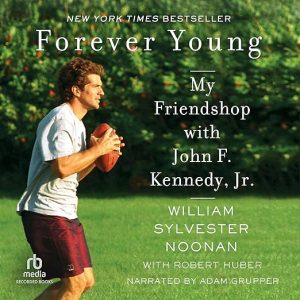
Billy Noonan and John F. Kennedy Jr. met as boys in the Kennedy compound at Hyannisport, Massachusetts, at an age when shared summers and beach bonfires create bonds that outlast almost everything else. For 25 years, those bonds held. William Noonan's memoir Forever Young is a reconstruction of that friendship, and it exists at a kind of angle that most Kennedy books do not reach: the view from inside, from the boy who grew into a man alongside John and knew him outside the framing of history. Adam Grupper narrates this audiobook across 8 hours and 23 minutes with a tone that is warmly reflective without sliding into sentimentality.
The Kennedy literature is vast, and most of it concerns itself with the family as a political and mythological institution. What Noonan offers is the corrective of the personal. He describes yacht-club dances and road trips and sneaked cigarettes on the widow's walk of the house, and Monday nights that were just about the two of them being young. The book's texture is deliberately intimate, and Grupper's narration honors that intimacy without romanticizing it. He reads the ribald episodes, including John's many famous conquests and skirmishes with the paparazzi who never left him alone, with a kind of affectionate rueful clarity that signals he understands Noonan's purpose: to show the human being, not the icon.
One reviewer called this the definitive account of the son of Camelot from someone who knew him as a person rather than a symbol, and there is genuine substance to that claim. The chapters dealing with John and Carolyn Bessette's courtship and wedding reveal details that have not appeared in other Kennedy accounts, and Noonan's honesty about his own complicated feelings, devotion, exasperation, and occasional jealousy for America's prince, gives the memoir a self-awareness that distinguishes it from hagiography. The book does not pretend that being John Kennedy's closest friend was uncomplicated. It acknowledges the asymmetry of that friendship with directness rather than resentment.
The sections dealing with John's unusually close relationship with his mother Jackie are among the most revealing in the audiobook. Noonan had access to those dynamics in a way that journalists and biographers did not, and his portrait of Jackie as both a protective force and a complex presence in her son's adult life is drawn with genuine care. Grupper's performance in these chapters is measured and slightly slower in pace, tracking the emotional weight of the material without overdramatizing it. His instinct for when to slow down and let a passage breathe is one of the narration's consistent virtues across the full runtime.
Grupper Reads Like a Trusted Storyteller
The audiobook format suits memoir particularly well when the narrator can carry the conversational tone that print sometimes flattens, and Grupper manages that consistently. His voice has the quality of a trusted storyteller rather than a performer, which is exactly what Noonan's material needs. The chapters dealing with the plane crash off Martha's Vineyard and its aftermath are handled with restraint that some listeners may find insufficient and others will recognize as the only honest approach. Noonan does not have answers about that night. He has grief, and Grupper reads it as grief rather than as narrative climax.
For listeners who have read extensively in Kennedy biography, Forever Young offers the specific texture of lived friendship that institutional histories cannot replicate. Multiple reviewers note that it is the most personal portrait of John Kennedy Jr. available, and that claim holds. Noonan's position as a lifelong friend rather than a journalist or family insider gives him a particular kind of access: not to the political or institutional record, but to the private person who happened to be one of the most photographed people of his generation. That gap between public and private is what the book is ultimately about.
Two Boys Who Had Both Lost Fathers
The parallel between Noonan's memoir and Noonan's own biography is worth tracking. He was not from the Kennedy world. He grew up near it, and the book is partly about what that proximity costs and what it gives. The chapters where he reflects on his own father's death and the connection that loss created between himself and John are among the memoir's structural anchors. Two boys who had both tragically lost their fathers: Noonan returns to that shared foundation at several points in the narrative, and it is the thread that makes the friendship legible beyond the mythology.
The audiobook's closing chapters, covering the aftermath of the crash and the process of absorbing a loss that the world was experiencing simultaneously in real time, are the most emotionally demanding. Grupper gives them space, slowing his pace without breaking the narrative's momentum. The stint John served as People magazine's Sexiest Man Alive, which Noonan recounts with characteristic dry affection, is a useful reminder throughout the book of just how much of John Kennedy Jr.'s life was lived under a gaze that would have exhausted a lesser person.
More Intimate Than a Political Biography
This audiobook is most directly rewarding for listeners with an established interest in John F. Kennedy Jr. and the Kennedy family who want a genuinely personal account rather than a political or institutional one. It also works well for readers drawn to memoir about male friendship, the particular textures of childhood bonds that survive into adulthood, and the specific experience of friendship with someone who belongs partly to history. Listeners expecting a comprehensive political biography will find it more intimate in scope than they anticipated. That is not a deficiency. It is the book's intention and its most distinctive quality, the one that separates it from the shelf of Kennedy books that preceded it and most of those that will follow.
In Brief
- Read by: Adam Grupper reads with the measured warmth of a trusted storyteller, tracking the memoir's emotional shifts without overdramatizing the material.
- At its heart: male friendship, Kennedy mythology, grief and loss
- Vibe: Intimately reflective, with a rueful honesty that avoids hagiography
- Short version: The most personal portrait of JFK Jr. available in audiobook form, built on 25 years of genuine friendship rather than institutional access.
Common Questions
Does the Forever Young audiobook require prior knowledge of the Kennedy family?
Familiarity with the broad outlines of JFK Jr.'s life helps, but Noonan provides enough context that the memoir stands independently. Readers who know the Kennedy history will find additional depth in the details Noonan adds to the public record.
Does Adam Grupper's narration serve the memoir's intimate tone?
Yes. Grupper reads with the warmth of a trusted storyteller and avoids the dramatic inflation that Kennedy narratives can attract. His pace adjusts appropriately through the more emotionally difficult sections.
Is the Forever Young audiobook primarily about the plane crash?
No. The crash and its aftermath appear in the book's final section, but the audiobook is primarily about the twenty-five-year friendship between Noonan and John Kennedy Jr., including their childhood summers, adult adventures, and John's relationship with Carolyn Bessette.
How does this audiobook compare to other JFK Jr. books?
Most Kennedy books take an institutional or journalistic approach. Noonan's account is unique in being written by a lifelong friend with access to private experiences and family dynamics that outside observers could not observe. Reviewers who have read extensively in Kennedy biography consistently describe it as the most personal portrait available.