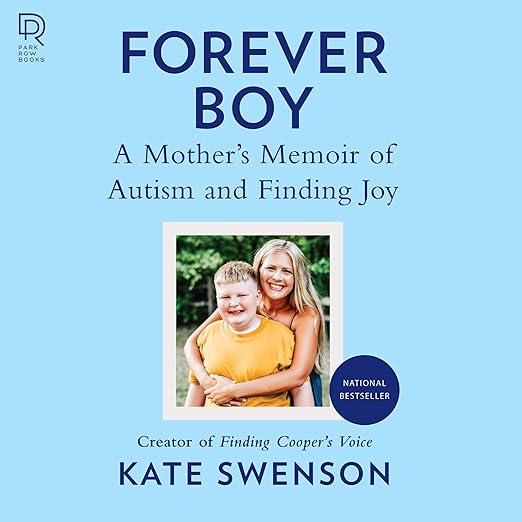
- Voice: The memoirist takes the whole recording; no clinician, no co-reader and no second perspective is credited anywhere on it.
- Big ideas: A diagnosis and the grief around it, motherhood recalibrated, unconditional love without the greeting card.
- Atmosphere: Tender, exhausting, ultimately steady.
- Worth it?: Company rather than guidance, and for parents in the same position that is the more valuable of the two.
Kate Swenson had a readership before she had a book. Finding Cooper's Voice, the blog named for her son, reached parents of children with autism at a scale the copy puts in the hundreds of thousands, and the audiobook is that writing handed nine hours and twenty-six minutes and a shape to fill. Cooper was diagnosed with severe, nonverbal autism. Her world stopped. What follows is not a memoir about a child learning to meet the world halfway. It is a memoir about a mother discovering, slowly and against real internal resistance, that she was the one who had to change.
Where This One Lands
Swenson writes about grief first, and that decision is what makes the book work. Not the therapies, not the school meetings, not the diagnostic vocabulary: the grief of a life she had planned in detail and did not get to have. An August 2024 response describes reading it across a single weekend and highlighting lines and whole paragraphs, and the reason those lines get marked is that they say the unsayable part out loud, which is that you can love a child completely and still mourn the version of parenthood you were expecting. The memoir never apologizes for that sentence. It is the reason parents keep handing this book to each other.
What comes after the grief is the harder half, and it is where the title starts doing its work. The copy names the arc plainly enough: hard work, resilience, personal growth, then acceptance, then joy. Written badly, that sequence is a greeting card. Written this way it becomes a record of somebody dismantling her own expectations one at a time and finding that the child was never the problem waiting to be solved. Forever Boy holds both halves of it, a childhood that does not end on the usual schedule, and a mother who has stopped experiencing that fact as a loss.
Why Forever Boy Works as an Audiobook
Harlequin Audio published this, which surprised me for roughly a second and then stopped surprising me at all. The book is written for an audience that reads for company rather than for information, and that is a publishing tradition Harlequin understands better than most health imprints would. The shelf files it under health and wellness with a children's health tag, and that placement sets an expectation the memoir never tries to meet. The copy promises solace, hope, and an account of motherhood and unconditional love, which is an accurate description of what a memoir can actually deliver. Nothing here is clinical, and nothing here is pretending to be.
Autism memoirs written by parents raise an obvious question about whose story is being told, and this recording answers part of it by construction, because Swenson reads it. The voice that built an audience one post at a time is the voice delivering the long version, and for a book whose whole method is direct address, that continuity is the correct call. You can hear the address in the copy itself, which slips into the second person and stays there: the frustration and exhaustion of having to fight for your child in a world stacked against them. That sentence is written to somebody specific. Having the author at the microphone keeps it pointed at that person rather than routing it through a performer.
What Gives Us Pause
Three whole-star votes cannot average out to 4.9 under any rounding convention you care to apply, and 4.9 over a counter reading three is exactly what the badge on this page shows. Something in that pairing is broken: either the counter is stale, or the average is summarizing ratings the page never displays. The five written responses underneath are real and every one of them awards five stars, so this is not a case of criticism being hidden from you. It is a case of a number that cannot be a summary of the opinions on display. Read the responses and disregard the badge, which is sound practice on any listing whose counter sits this low.
Grief is the dominant mode for a substantial stretch, and that is the honest warning to give. A September 2024 response, written by a family living with autism firsthand, notes that their life is not exactly like the Swensons' but that the parallels run close enough to feel in step, which is the right frame to borrow: this is one family's chronology rather than a template. If your child's profile is different, some chapters will not fit, and the book makes no claim to speak for a spectrum. The other caution is timing. In the first weeks after a diagnosis, these early chapters go straight at the grief with no cushioning at all, and only you can judge whether that is what you need.
Should You Listen to Forever Boy?
Families living with a nonverbal autism diagnosis are the obvious audience, and enough of the responses come from inside that group to be worth trusting. Start here if you want the emotional chronology rather than the clinical one, if you have been managing alone and want evidence that the exhaustion is structural rather than a personal failing, and if you can handle a book likely to make you cry inside the first hour. A response written from Canada in the month of release came to the memoir through the blog's community first and lays out the arc it delivers: the fight for a diagnosis and for supports, then grief, then hope, then acceptance, then the joy.
Nine hours and change is not long for a memoir this dense in feeling, and the length is judged about right. Sit this one out if you want practical guidance, because what the book offers instead is company and it never pretends otherwise. Sit it out too when reading through another family's hardest years is not something you have the capacity for at the moment, which is a legitimate reason rather than a failure of nerve. Another response calls parenting an autistic child the most treacherous water you will ever tread, and then describes finding, every so often, a resource that guides you along it. That is the job this book is doing, and it does it without flattening anybody into a lesson. Cooper is a person in these pages rather than a subject, and given how many memoirs about children fail that test, it is the highest compliment available.
Good to Know
How does an author-read audiobook change a memoir about a diagnosis?
It changes who is talking to you. This memoir began as a blog written for other parents, and the recording keeps the same voice in the same relationship with its audience, which matters more here than polish would. What you give up is the range a trained performer brings to dialogue and to other people's speech, a trade most listeners in this position will take gladly.
How long is the audiobook, and how is it structured?
Nine hours and twenty-six minutes, following the sequence the copy sets out: the diagnosis, the grief that arrived with it, the fight for support, and the slow turn toward acceptance. The description presents that as a progression rather than a set of themes, so plan on taking it in order rather than dipping in.
Who is Cooper, and how much of the audiobook is about him?
Cooper is the author's son, diagnosed with severe, nonverbal autism, and the blog that preceded this book was named for him. The description makes clear that the memoir's subject is the mother's transformation rather than the child's development, so expect him present throughout while the change being tracked belongs to the person writing.
Does the book cover the years before the diagnosis?
The copy opens at the moment the diagnosis lands and describes a world stopping, so the years before it appear mainly as the family life that had been planned and never arrived. What the description does promise is the whole arc afterward, through frustration and exhaustion, into acceptance and eventually joy.