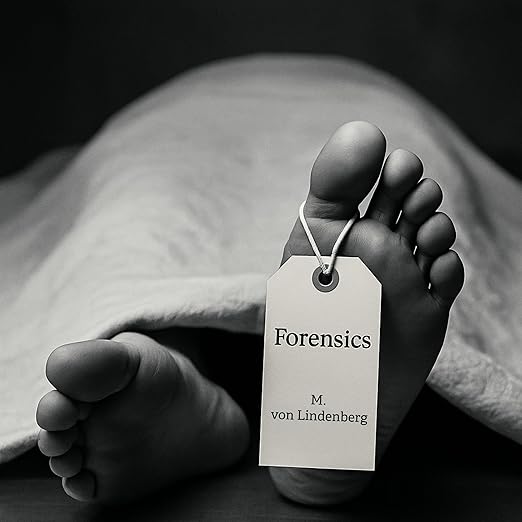
Two hours and thirty-six minutes is barely enough time to fall in love, let alone watch that love curdle into resentment, and M. von Lindenberg's Forensics compresses exactly that arc into a single sitting. Julian and Emilia meet as what the synopsis calls kismet spirits, meant for each other from the start, and the book tracks the unglamorous back half of a relationship, the fire cooling, the pulse running shallow, until, as the synopsis itself puts it, 'the only thing left in their bond is resentment, memory, and dead weight.' Michael Neeb narrates this audiobook, and this is dark, transgressive romance territory rather than a conventional love story.
Kismet Spirits Fated to Unravel Together
Reviewer Sabrina doesn't hedge, calling the book 'unhinged, diabolical and absolutely mind blowing' and placing it in 'a splatter punk/pitch black romance' category, a genre label that tells a prospective listener almost everything they need to know before pressing play. This is not a book aiming for comfort reading, and the two attached reviews agree on that point even while disagreeing about how successfully it lands. At barely over two and a half hours, the story reads as a compressed character study rather than a fully developed arc, closer to a novella's scope than a novel's.
Reviewer M's account of the relationship's origin adds useful context: Julian and Emilia met in high school, and she'd 'sank her claws in deep' while he 'refused to struggle against her grasp,' with both characters coming from troubled backgrounds, Emilia's described specifically as dark, 'even leaving bodies in her wake.' That detail alone signals this sits closer to psychological thriller than straightforward romance, with the erotica classification describing the relationship's intensity rather than its genre conventions alone.
'Splatter punk' is a specific enough genre label to unpack briefly: the term originated in horror fiction to describe graphic, visceral violence pushed past the point of restraint, deployed here for its shock value applied to a relationship's emotional collapse rather than literal gore. Sabrina's choice to invoke it alongside 'pitch black romance' suggests the book borrows horror's willingness to sit in discomfort rather than resolve it quickly, applied to heartbreak and toxicity instead of a slasher plot. That's a meaningfully different reading experience than standard dark romance, which more often still resolves toward some version of redemption.
'Kismet spirits' is a curious phrase choice worth sitting with, since kismet implies fate, destiny, an inevitability neither party chose, which reframes the entire relationship's collapse as something closer to tragedy than failure. Julian and Emilia aren't written as two people who simply grew apart through ordinary neglect; the synopsis's own language suggests they were fated together and are now fated to unravel just as inevitably, a bleaker and more ambitious framing than standard relationship fiction typically attempts.
Michael Neeb's Flat and Clinical Delivery
Michael Neeb's flat, unhurried delivery is the right call for material this deliberately unsettling. Rather than dramatizing the story's darker turns with obvious vocal signaling, dread music in the voice, audible horror, Neeb holds a level, almost clinical register that lets the text's own strangeness do the work. That restraint matches the title directly: forensics implies examination after the fact, a clinical look back at what a relationship became, and a narrator who performed shock or melodrama would undercut that framing badly.
With only two attached reviews and three total ratings, this is thin-data territory, but both reviews that exist are substantive rather than one-line dismissals, and both describe the writing itself, not just the plot, as genuinely distinctive. 'M's writing is very out of the box,' Sabrina notes, a meaningfully different compliment than praising a fast-moving plot alone; it suggests the prose style itself, not just the shock value of the subject matter, is doing real work here.
Short-runtime erotica and dark romance is a well-established format in audio specifically, where novella-length, single-sitting listens are common enough to constitute their own reading habit rather than an anomaly. Two hours and thirty-six minutes fits comfortably within that convention, closer to a long commute or a single evening than a multi-day commitment, and listeners already familiar with the format will recognize the pacing as intentional rather than as a sign of thin content.
The title itself rewards a second look once the story is finished. 'Forensics' as a word implies investigation after death, examining evidence to understand what happened and why, and applying that clinical, retrospective lens to a romantic relationship rather than a crime scene is a genuinely sharp piece of framing. It reframes Julian and Emilia's story as something being autopsied rather than simply told, which matches Neeb's restrained narration choices closely.
Five Stars and Four Stars but Thin Data
The obvious caveat is scope: at this runtime, character development happens in compressed strokes rather than gradual accumulation, and listeners used to slow-burn romance with extended courtship arcs will find almost none of that here. This is a snapshot of a relationship's ending stages more than a full history, and the erotica and dark-romance tags both signal explicit content that won't suit every listener's comfort level, particularly given how directly the reviews describe the material as unsettling rather than merely spicy.
Both attached reviews are enthusiastic, five stars and four stars respectively, but neither reads as a neutral or negative counterweight, and with only three total ratings behind the title, a cautious listener has very little outside data to weigh against the book's own back-cover framing before committing. This is a book that rewards a genuine appetite for dark material rather than casual curiosity.
With so few reviews and ratings on file, this is very much an early-visibility title, and a listener drawn in by genre curiosity rather than an established fanbase should calibrate expectations accordingly: this reads more like discovering a new voice early than picking up a book with a long, settled reputation behind it. That's not necessarily a downside for readers who enjoy finding lesser-known dark romance before it accumulates a wider audience, but it's a different kind of purchase decision than a title backed by hundreds of reviews.
Assuming a Baseline Comfort With Discomfort
Readers drawn to dark, morally complicated romance in the vein of splatter-punk fiction, comfortable with explicit content and genuinely uncomfortable emotional terrain, are the intended audience, and the short runtime makes this an easy single-sitting experiment for anyone curious about the subgenre without committing to a full-length novel.
Readers who specifically enjoy the horror-romance crossover space, rather than romance readers dabbling in darker material for the first time, will likely get the most out of the compressed intensity here, since the book assumes a baseline comfort with discomfort rather than easing a newcomer into it.
Anyone seeking a tender love story, or sensitive to violence and psychological cruelty within a romance framing, should look elsewhere entirely.
Questions Listeners Ask
Is the Forensics audiobook explicit or graphic in content?
Yes. It carries an erotica classification and reviewers describe the material as unhinged and unsettling, closer to splatter-punk dark romance than a tender love story.
How long is the Forensics audiobook by M. von Lindenberg?
Two hours and thirty-six minutes, a compressed, novella-length character study rather than a full-length novel.
Does Michael Neeb's narration style suit this audiobook's dark tone?
Yes. His deliberately flat, unhurried delivery avoids dramatizing the story's darker turns, letting the text's own strangeness carry the discomfort rather than the narration signaling it.
Are there many reviews available for the Forensics audiobook before buying?
Not many. Only two written reviews and three total ratings currently back the title, though both reviews are substantive and specific rather than brief dismissals.