Quick Take
- Narration: Jerry Longe handles a multi-author anthology with consistent steadiness, though the range of voices across twelve chapters naturally creates some tonal variation.
- Themes: human cost of spaceflight, Cold War geopolitics and the space race, the personal dimensions of extraordinary achievement
- Mood: Reflective and historically grounded, with the weight of forty years of hindsight on every page
- Verdict: An unusually personal and multi-voiced account of the Apollo program that distinguishes itself from single-author narratives through its breadth and its intimate human texture.
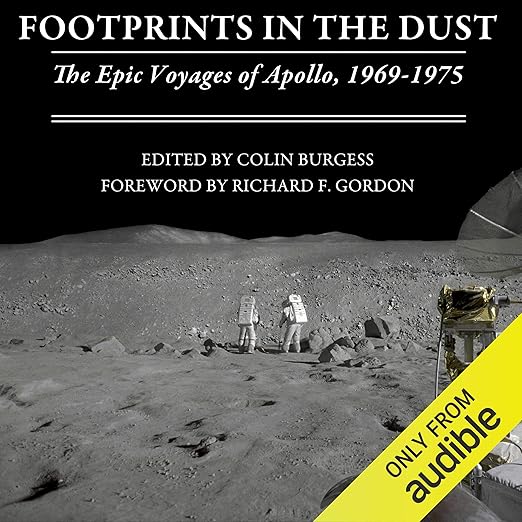
There is a particular kind of space history book that knows it is entering a crowded field and tries to justify its existence through scope. Footprints in the Dust takes a different approach. Part of the Outward Odyssey series, which aims to give the people’s history of spaceflight its proper treatment, this volume covers the Apollo missions from the first lunar landing in 1969 through the Apollo-Soyuz mission in 1975, and it earns its right to exist through something the single-author accounts rarely manage: genuine multiplicity of perspective.
I listened to this one on a long train journey, which turned out to be an oddly fitting context. There is something about space history that suits sustained, unhurried attention, the sense that you are traveling through a documented record of human ambition at its most concentrated. By the time I reached the chapter on Apollo 13’s rescue, I had completely forgotten to check what station we were approaching.
Why the Multi-Author Structure Works
The book is structured around twelve main chapters plus a prologue and a thirty-page epilogue, each written by a different contributor and each focusing on a specific mission or aspect of the Apollo program. This could easily become a collection of essays that fail to cohere, but editor Colin Burgess has assembled contributors who share a commitment to the human story beneath the technical achievement. The result is a book where each chapter has its own authorial sensibility while the overall arc holds together.
The reviews emphasize this dimension: the personal reflections of astronauts, engineers, and scientists who had forty years to process what they experienced produce a depth of reflection that contemporaneous accounts cannot have. One reviewer specifically highlighted the epilogue as exceptional, and I found the same. When these figures have had four decades to understand what they were part of, what they say is both more considered and, occasionally, more surprising than what you find in the immediate post-mission literature.
Apollo 13 and the Human Drama at the Center
The harrowing rescue of Apollo 13 is the emotional center of the book, and the chapter covering it is among the strongest. What Footprints in the Dust does differently from popular accounts like the Ron Howard film is keep the focus granular and personal rather than cinematic. The engineering improvisation is described from the perspective of the engineers who improvised it, not from the perspective of a narrative that has already decided it ends with a successful splashdown. Reading the chapter without the safety net of knowing the outcome intellectually, even though you know it historically, is a tribute to how the contributors have reconstructed the uncertainty.
The Apollo-Soyuz mission of 1975, the joint American-Soviet docking in orbit, receives treatment here that goes beyond its usual footnote status in popular space history. The political and human complexity of that handshake in orbit, at the height of Cold War tension, is given real texture, and the book is better for including it. Not every Apollo narrative bothers with the long tail of the program, the missions after 11, and this one treats them as worthy of serious attention.
The Limits of the Anthology Format in Audio
One thing worth noting for audiobook listeners specifically is that the multi-author structure, which enriches the print experience by giving each chapter a distinct voice, flattens somewhat in audio. Jerry Longe is a consistent narrator throughout, which maintains coherence but also means the tonal shifts between chapters, which should register as different authorial personalities, are smoothed over. This is a structural limitation rather than a narration failure. Longe is technically solid and handles the range of material, from technical mission descriptions to personal testimony, without stumbling. But listeners coming to this from multi-narrator anthologies may notice that the oral delivery is more uniform than the written text beneath it.
Who Should Listen / Who Should Skip
For anyone who has read the major single-author Apollo histories, Andrew Chaikin’s A Man on the Moon remains the benchmark, this is an excellent complement rather than a replacement. It fills in human texture that broader accounts necessarily skip and gives weight to missions that popular history has sometimes overlooked. Complete beginners to Apollo history would do better starting elsewhere before returning here. Those with a serious interest in the program and its people will find it genuinely rewarding. The five-star consensus among reviewers reflects a specific audience well served, and that audience assessment is accurate.
Frequently Asked Questions
Is Footprints in the Dust a good starting point for someone new to Apollo history, or does it assume prior knowledge?
It assumes at least some familiarity. The book does not spend much time explaining the basic mechanics of the program or the political context of the space race, because it is primarily concerned with the human experience of people already inside it. Complete newcomers should probably start with a broader account before coming to this one.
How does the multi-author structure affect the listening experience compared to a single-author narrative?
The listening experience is somewhat more uniform than the print experience because a single narrator, Jerry Longe, reads throughout. The different authorial voices on the page flatten slightly in audio. It still works well, but the structural diversity is more visible in print.
The book covers Apollo 11 through Apollo-Soyuz in 1975. Does it give the lesser-known later missions serious treatment?
Yes, and this is one of its genuine strengths. The later Apollo missions, 15 through 17 and the Apollo-Soyuz flight, are not treated as afterthoughts. The book’s contributors bring the same level of personal and historical attention to them that the more famous missions receive.
Is this volume part of a series, and does it need to be read alongside other Outward Odyssey titles?
It is part of the Outward Odyssey series but functions as a standalone. You do not need to have read other volumes to follow it. The series covers different eras and programs of spaceflight, and each book is designed to be self-contained.