Key Details
- Narration: Alton Brown narrating his own essay collection is the format this book was built for. His timing is sharp, his self-awareness is genuine, and the voice that made Good Eats work carries 7 hours of food essays without losing momentum.
- Themes: The intersection of food and identity, behind-the-scenes culinary media, the meaning of a defining meal
- Mood: Witty and candid, occasionally sharp-edged, always specific
- Verdict: Brown's debut essay collection earns its 2026 Audie Award for short stories and collections with writing and narration that match each other's intelligence.
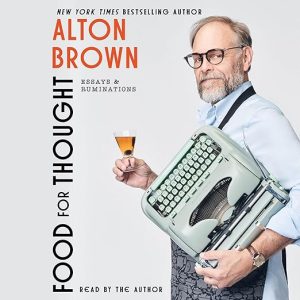
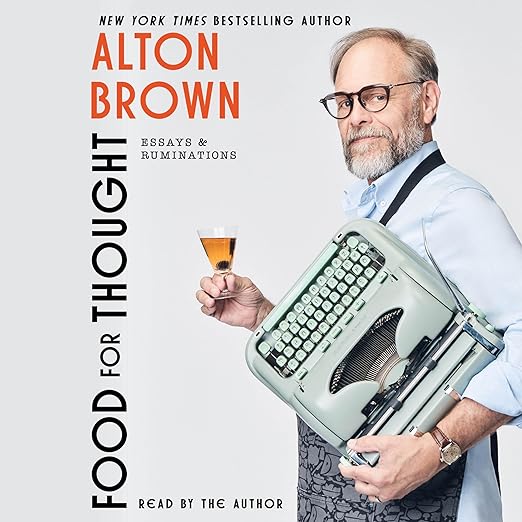
Alton Brown's Food for Thought, which he narrates himself, arrived on the New York Times bestseller list in its first week and left the same month with a 2026 Audie Award for Short Stories/Collections, along with a finalist nod for Narration by the Author. This audiobook is not a cookbook with commentary, not a memoir structured around a career arc, and not a collection of food science lectures. It is something harder to categorize and more interesting: a debut essay collection from a writer who has spent three decades thinking carefully about food and has waited to put it in this form until he had something genuinely original to say about it.
Brown's career has moved through enough formats that any listener arriving at Food for Thought carries some version of him already, the food science explainer from Good Eats, the acerbic hosting voice from Cutthroat Kitchen, the serious culinary interviewer from Iron Chef America. What the essays reveal is a third register that neither the television work nor the cookbooks fully surfaced: a writer who is genuinely reflective about what food means, not in the wellness-lifestyle sense that saturates the current culinary media landscape, but in the specific sense of someone who has wrestled a dumpster full of dough, obsessed over the perfect roast chicken for years, and has opinions about culinary appropriation that he has thought through rather than borrowed.
Audie Award Confirms Brown's Narrating Wit
The 2026 Audie Award finalist recognition for Narration by the Author is the industry's confirmation of what reviewer Amanda noticed immediately: that Brown narrates this material with the same precision and wit that made Good Eats worth watching across decades. The collection is not uniformly funny, which is a strength rather than a weakness. Some essays are comedic set pieces, the dumpster full of dough anecdote lands as pure physical comedy, while others, the culinary appropriation essay, the sections on defining meals from his lifetime, carry genuine critical weight. Brown's narration handles both registers without flattening them.
Reviewer Average Customer described the experience as laughing, learning, and passing time excellently, which undersells the writing's actual ambition. The comparison point is not Food Network content but the tradition of American food writing that includes M.F.K. Fisher and Calvin Trillin: essayists for whom food is a lens onto something larger, including identity, memory, class, and the specific experience of American culture. Brown is working in that tradition, not fully there yet with a debut collection, but close enough that the comparison is instructive rather than flattering.
Decades of TV Timing Built for This Format
Brown's narration is the argument for the audio format. These are performance essays in the sense that they are written with awareness of how they will sound, with the comic timing calibrated to a reader's voice rather than a silent page, and Brown's decades of on-camera presenting have given him the technical tools to execute that calibration. Reviewer Craig Milligan noted the humor, facts, fun, and entertainment in equal measure, and the balance holds across 6 hours and 59 minutes because Brown is disciplined about which essays need room and which need compression.
The collection's structural variety keeps the runtime from becoming monotonous. Some essays are brief and sharp, delivered in minutes and designed to land on a single observation. Others expand across the length of a magazine feature, following Brown through a specific research obsession, the perfect roast chicken quest being the longest and most ambitious thread in the collection, with the patience of a writer who knows the payoff justifies the setup. In audio, that variation in scale is easier to experience as rhythm than it is to navigate on the page, where the reader has no sense of an essay's length before committing to it.
More Candid Than Good Eats Ever Allowed
Listeners who approach this collection as Good Eats in audio form will find it more personal and more critical than that framing suggests. Brown is candid about the television industry, about the specific power dynamics of food media, and about his own position within a culinary culture that has evolved significantly since he helped define it. The behind-the-scenes material is not nostalgic; it is sometimes pointed in ways that will surprise listeners who expect the affable educator persona from the television work.
The essay on culinary appropriation specifically is the collection's most contested territory. Brown does not deliver a simple argument, which means the essay requires more active engagement than the purely comedic material. For listeners who want food writing to remain within the pleasurable and the technically interesting, this section will feel like a departure. For listeners who want their food essayists to have opinions about the cultural politics of what they're eating and writing about, it will be the collection's most interesting piece.
Serious Food Readers Over Casual Celebrity Fans
Alton Brown's existing audience is the obvious starting point, but this collection will also interest listeners who read food writing seriously and who have been waiting for Brown to move beyond television format into something with more of his actual critical intelligence on the page. The Audie Award recognition makes the audio format the primary recommendation over print for this title, and at 6 hours and 59 minutes the collection moves at the pace of someone who respects the listener's time. Listeners who want a conventional celebrity food memoir structured around career milestones should look elsewhere; the essay form refuses that kind of sequential comfort and rewards listeners who are willing to follow Brown wherever a particular subject takes him.
Listeners who have followed Brown's career through its various phases will find the collection functions as a kind of retrospective intelligence test on his public work, the television format, the cookbook writing, the competition hosting, all of which he reassesses from the perspective of an essayist rather than a performer or an educator. That reassessment is not always flattering to the television personality, and the candor with which he approaches his own career choices is one of the things that distinguishes the writing from the genre of celebrity brand-maintenance memoir.
Did Alton Brown win an Audie Award for narrating this audiobook?
The audiobook won the 2026 Audie Award for Short Stories/Collections and Brown received a finalist nomination for Narration by the Author. These are separate recognitions: the collection award reflects the quality of the writing and production, while the narration nomination reflects Brown's specific performance. Both indicate the audio version is the format the publisher and industry consider definitive for this title.
Is this audiobook appropriate for listeners who are not already fans of Alton Brown's television work?
Yes. The essays work as standalone food writing rather than as extensions of the television persona, and Brown's narration provides sufficient context for readers who come to the collection without prior familiarity. The self-awareness Brown brings to the behind-the-scenes material actually reads differently for listeners who are not attached to the Good Eats persona, sometimes more clearly.
How does Food for Thought compare to Brown's cookbooks as an audiobook experience?
The essay format is a fundamentally different experience from a cookbook in audio. Cookbooks in audio are inherently constrained by the format's inability to convey visual instructions; the essay collection is designed for audio from the ground up. Brown's writing here is calibrated to his own voice, and the collection delivers what his cookbooks cannot: sustained critical and comedic thinking without reference to a recipe or a technique.
Does the audiobook address Brown's television career and the culinary media industry?
Yes, extensively. Behind-the-scenes material from Good Eats, Iron Chef America, and Cutthroat Kitchen appears throughout, and Brown is candid rather than promotional about the industry dynamics he navigated. Several essays are specifically concerned with what culinary media does to food culture and to the people who work within it, and Brown's perspective is informed by decades of direct experience rather than critical distance.