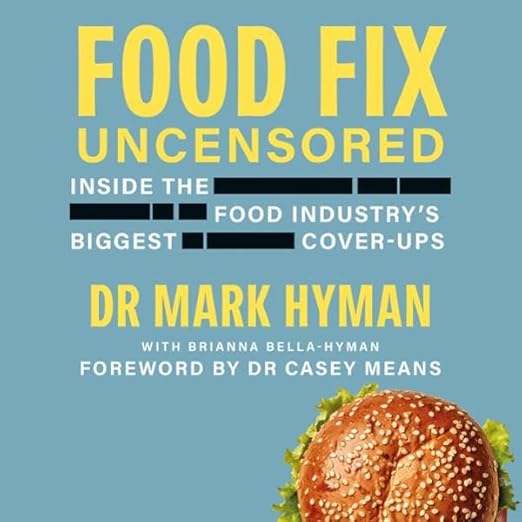
Quick Take
- Narration: Brianna Bella-Hyman delivers the material with conviction, her familiarity with the subject apparent in how she handles the more technical nutritional science sections.
- Themes: Corporate food system corruption, chronic disease, nutritional activism
- Mood: Urgent and confrontational, with practical uplift
- Verdict: Hyman’s updated edition is sharper and angrier than the 2020 original, and Bella-Hyman’s narration keeps the fire lit across thirteen-plus hours.
I came to Food Fix Uncensored already skeptical of wellness audiobooks that promise to change everything, and I left it with a more complicated reaction than I expected. Dr. Mark Hyman has been in this space long enough to have developed both a loyal following and a significant chorus of critics. This fully updated edition of his 2020 book arrives in a political moment where the conversation about processed food, chronic disease, and corporate influence on public health policy has become considerably louder than it was six years ago, and Hyman has positioned himself at the center of that conversation.
The core argument is laid out early and returned to throughout: poor diet is the single largest driver of premature death globally, and this is not an accident but the engineered outcome of a food system that prioritizes corporate profit over human health. The toxic triad of Big Food, Big Ag, and Big Pharma, as Hyman frames it, works in concert to keep populations sick and dependent. The statistics he opens with are not comfortable reading: more than sixty percent of Americans living with chronic disease, one in two Americans with pre-diabetes or type 2 diabetes, thirty-eight percent of children overweight or obese. This is the book’s thesis, and Hyman pursues it with considerable energy across thirteen hours of listening.
Our Take on Food Fix Uncensored
The updated edition adds material that reflects developments since 2020, and the uncensored framing suggests Hyman has sharpened some positions that were more tempered in the original. Whether you find this persuasive will depend partly on your prior relationship with Hyman’s work and partly on your appetite for righteous indignation as a listening posture. The reviews are uniformly enthusiastic from people already in agreement with the thesis. Reviewer Josef Antinucci, a personal chef and functional nutritionist who has been making similar arguments for two decades, describes the book as validating rather than revelatory, which is a useful frame.
Food Fix Uncensored works best as a structured, well-researched articulation of a position rather than a genuinely persuasive document for the unconvinced. Professor Chris van Tulleken’s endorsement, describing it as a powerful and urgent account, is meaningful; van Tulleken’s own Ultra-Processed People covered adjacent territory with considerable rigor, and the two books are useful companions.
Why Listen to Food Fix Uncensored
Brianna Bella-Hyman’s narration is one of the audio version’s genuine assets. She brings an evident familiarity with the material that keeps the technical nutritional science sections from becoming dense, and her energy through the more polemical stretches does not tip into hectoring. Reviewer Braden O’Bright specifically acknowledged both Hyman and Bella-Hyman for throwing their heart and soul into the work, and that quality comes through in the performance across the full thirteen hours.
What to Watch For in Food Fix Uncensored
The book’s weakness is a weakness of the genre: it is better at diagnosing the problem than at scaling the solutions. The individual actions Hyman recommends are sensible and practical, but the structural critique, which is genuinely bracing, sits in some tension with the consumer-level calls to action. If the food system is as comprehensively corrupted as the book argues, the path forward requires more than personal dietary choice, and Hyman is more comfortable on the diagnostic side than the prescriptive one. Listeners who finish this wanting a more policy-focused treatment will find useful companions in van Tulleken’s work or Marion Nestle’s writing on food politics.
Who Should Listen to Food Fix Uncensored
Listeners already interested in the intersection of food policy, corporate influence, and public health will find this a well-organized and energetically delivered case. Hyman’s writing is accessible without being dumbed down, which makes the science navigable for non-specialists. Those who found Ultra-Processed People or similar titles persuasive will find familiar arguments here, updated and sharpened. Skeptics of wellness advocacy or listeners looking for a genuinely balanced account of the food system’s problems will want to pair this with contrasting perspectives. Those with a prior relationship to Hyman’s work, through Young Forever or his other titles, will find the voice and framework immediately familiar.
Frequently Asked Questions
How does Food Fix Uncensored differ from the original 2020 edition of Food Fix?
Hyman describes this as a fully updated and uncensored edition, with new material reflecting developments in nutritional science and food policy since 2020. The uncensored framing suggests some positions have been sharpened or expanded from the more measured original.
Is the narration by Brianna Bella-Hyman a good fit for the material?
Yes. Bella-Hyman demonstrates genuine familiarity with the subject matter and handles the technical nutritional science sections clearly. Her energy through the more polemical stretches stays engaged without becoming preachy, which is a real achievement over thirteen hours.
Does the book offer actionable steps, or is it primarily a critique of the food industry?
Both, though the critique is where Hyman is most confident. He includes practical recommendations for individuals, but the book’s more compelling sections are its structural analysis of corporate influence on food policy rather than its consumer-level guidance.
How does Food Fix Uncensored compare to Ultra-Processed People by Chris van Tulleken?
Ultra-Processed People tends to stay closer to the scientific literature and is slightly more careful about distinguishing between corporate malfeasance and emergent market forces. Hyman is more willing to take a polemical stance, which makes his book more energizing and less nuanced depending on your priorities as a reader.