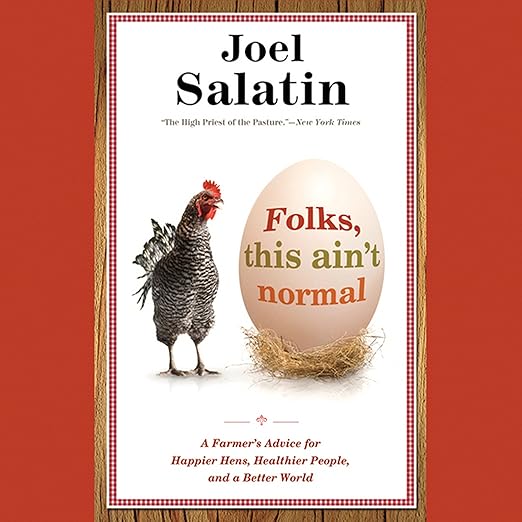
Somewhere between 2011 and now, the description attached to this audiobook picked up a sentence about the Department of Agriculture. The recording is dated October 10, 2011, from Center Street, fifteen hours and fourteen minutes of Joel Salatin reading his own argument about food, farming, and the ordinary competence a culture forgets. The copy opening that page, however, introduces him as a Virginia farmer who has been offered a prominent role in a presidential administration, which is news from a great deal later than 2011. Somebody has been keeping the marketing current on a fourteen-year-old file, and once you notice that, you start checking everything else the page tells you.
Philosophy With Chickens In It
Salatin's thesis is right there in the title and it is a good one. Life in the twenty-first century is not normal in any sense a human being would have recognized for most of history, and the book's method is to walk through the ordinary business of eating, raising children, and living near land, asking at each step how far we have drifted from something workable. Salatin's argument is not primarily agricultural. It is philosophical, with chickens in it, and the strongest sections are the ones where a practical question about where food comes from turns into an uncomfortable question about what we have agreed to stop noticing.
Reviewers are more useful on this than the publisher is. The most detailed entry works through the book as a complete statement of a philosophy covering culture, food, farming, and everything connecting them, and identifies the central move accurately: demonstrating how many ordinary practices today would have been unrecognizable a generation or two ago. Another, and this is the most valuable response on the page, grades it five stars and then argues with it, calling the book wonderful and scary and inconsistent, and objecting to a conflict between the principles of the first half and the second. That reviewer also makes the point the publisher will not: this is not a manual for how to farm, it is a philosophy of self-sufficiency, and an attentive listener will pick up practical detail along the way rather than by design.
Credentials are stacked here in a way worth naming, because they explain who the book is for. A New York Times line calling him Virginia's most multifaceted agrarian since Thomas Jefferson, and the high priest of the pasture besides. A profile in an Academy Award nominated documentary. An appearance in The Omnivore's Dilemma. Those are the credentials of a public figure rather than of a researcher, and the book behaves accordingly, arguing from a life rather than from a literature. That is a specification more than a criticism. What you are buying is a point of view tested against a working farm, not a survey of the evidence, and the difference determines whether the fifteen hours feel like company or like a lecture.
Salatin's Own Timing Makes the Tall Tales Work
Salatin reads his own book, and for this one that is close to essential rather than merely pleasant. The description advertises a wicked sense of humor and a storyteller's knack for the revealing anecdote, and both of those qualities live in timing. A hired professional reading a Virginia farmer's tall stories about pigs and pastures would be a translation. Fifteen hours in the author's own idiom is the original, and the page confirms it plainly: author and narrator are the same name.
Length is the trade. Fifteen and a quarter hours is a lot of anyone's opinions, and the book is discursive by nature, moving between the state of soil, the state of childhood, and the state of a food system in ways that are associative rather than structured. Listeners who want an argument that proceeds in order will feel the sprawl. Listeners who like being talked at by someone with a strong point of view and a good store of stories will find the length is the pleasure rather than the cost.
Dates That Disagree and a Subtitle That's Missing
Dates on this page do not agree with each other. The listing records the audio release as October 2011. The earliest response, posted in November 2013, states that the book reached shelves less than a year earlier, in October of 2012. One of those is wrong, and a reader cannot tell which from here. The same review supplies something the listing withholds, namely the full subtitle, a farmer's advice for happier hens, healthier people, and a better world, which appears nowhere in the title as recorded. If the subtitle is what would have told you this book is as much about child-rearing as about chickens, the listing has quietly hidden the most informative words on the cover.
Grades here are strange twice over. Every readable grade is a five, all five of them, and the badge sitting under those five write-ups says 4.7 over a vote count of one, which no rounding convention permits. Two separate problems sit on top of each other: an average that cannot be built from the votes it claims, and a visible column uniformly more enthusiastic than the average it supposedly produced. The responses themselves also arrive from the United States, Australia, Canada, and the United Kingdom across four years, which is a pooled book column rather than an audience for this recording. Read them as evidence about Salatin and not about the fifteen hours. The shelving is no steadier: this sits under health and wellness and under home and garden, tagged for hygiene and healthy living, on a book whose actual subject is a centralized food chain and the culture that grew around it.
Homesteaders Will Recognize Their Own Instincts
Anyone already uneasy about industrial food, and wanting the case made with humor rather than statistics, is well served, and anyone who enjoys a strongly opinionated companion for a long stretch of listening. Homesteaders and small-farm people will find their instincts articulated. Listeners who came through the documentary and book world that made Salatin a public figure and want him at length, in his own voice, are getting exactly that.
Be warier if you want instructions, since the most honest reviewer on the page says outright that this is not a book about how to farm. Be warier still if the politics will bother you, because the argument is not neutral and does not pretend to be. Take the description with real skepticism, since it has been updated for a present the recording never knew.
Key Details
- Narration: author and narrator are the same name, which for a book selling a farmer's humor and anecdote is closer to necessary than to a bonus.
- Themes: industrial food and its costs, self-sufficiency, soil and pasture, child-rearing, what a culture forgets how to do
- Mood: cantankerous, funny, discursive across fifteen hours
- Verdict: a philosophy of living close to the land rather than a farming manual, and best taken in the voice that wrote it.
Common Questions
Does the Folks, This Ain't Normal audiobook teach you how to farm?
No, and the sharpest reviewer on the page says so directly. It is a philosophy of self-sufficiency rather than a manual, though an attentive listener picks up practical detail along the way. Anyone wanting operational instruction on raising animals or managing pasture should treat that as incidental rather than as the purpose.
Does Joel Salatin narrate the audiobook himself?
Yes. Author and narrator carry the same credit across fifteen hours and fourteen minutes from Center Street. Given that the description sells a wicked sense of humor and a storyteller's instinct for anecdote, both of which depend on timing, the self-narration is the strongest practical argument for choosing this edition.
Why does the description mention a government appointment on a 2011 release?
The recording dates from October 2011, but the marketing copy has been refreshed since and now opens with a reference to a role in a presidential administration. It is a current sentence on an old file. Nothing in the audio itself can be responding to events that far in its future.
What is the full subtitle, and why is it missing?
One reviewer restores the missing words, which name hens, human health, and a better world as the three concerns. The listing carries only the main title. That omission matters, because the subtitle is what signals the book covers child-rearing and community as much as it covers livestock and soil.