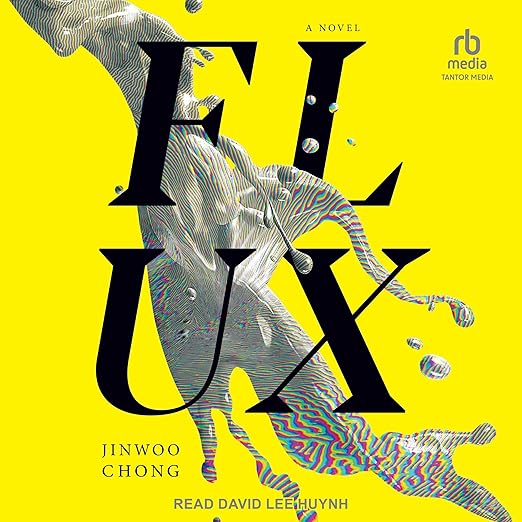
Quick Take
- Narration: David Lee Huynh handles the three-pronged structure with quiet precision, modulating tone between Bo’s childhood grief, Brandon’s adult anxiety, and Blue’s weathered exhaustion, a performance that rewards patience.
- Themes: Identity and racial assimilation, cyclical grief and trauma, corporate corruption and technology
- Mood: Disorienting and emotionally dense, with flashes of neo-noir cool
- Verdict: Flux rewards listeners willing to sit with confusion until the architecture reveals itself, but those seeking linear momentum should proceed with caution.
I started Flux on a Tuesday evening with absolutely no map of where it was going. I had read the back-cover pitch, time travel, neo-noir, a ’80s TV detective show woven through it all, and thought I knew what kind of listening experience I was signing up for. I did not. By the time I hit chapter four, I had pulled over my car in a parking lot just to make sure I hadn’t accidentally skipped something. I hadn’t. That disorientation is, it turns out, entirely intentional, and what Jinwoo Chong is doing with it takes a while to understand.
This is a debut novel that announces a genuinely distinctive voice. It is also a book that asks a great deal of its listener in the early hours, and I want to be honest about that before anything else.
Our Take on Flux
Flux follows three men whose names all begin with B, Bo at age eight, Brandon at twenty-eight, and Blue at forty-eight, each navigating a life-shattering moment that arrives four days before Christmas. The relationship between them is the novel’s central mystery, and Chong withholds the full picture long enough that some readers have bounced off the book before reaching what one reviewer called the payoff of chapters nine, ten, and eleven. That frustration is real and worth naming. The first half of this audiobook is genuinely confusing in the way that a fever dream is confusing: you know something meaningful is happening, but you cannot yet organize it into meaning.
What keeps the experience from collapsing under its own weight is the quality of Chong’s prose. He writes with a compression and clarity that coexists oddly with structural ambiguity. The sentences are lucid; the story’s architecture is not, at least not yet. Woven through the three timelines is the story of Raider, a fictional ’80s detective show whose star has imploded after revelations of long-concealed abuse, and this metafictional layer adds a texture that feels unusually precise for a debut. Chong is thinking about storytelling itself, about the way iconic narratives get contaminated by the people who made them.
Why Listen to Flux
The strongest reason to choose the audiobook format specifically is David Lee Huynh’s narration. He carries the weight of three distinct emotional registers, a child’s raw grief, a young man’s desperate scrambling, an older man’s exhausted reckoning, without overdramatizing any of them. The performance is notably restrained, which suits material that is already doing a great deal structurally. Huynh doesn’t impose clarity on scenes that aren’t meant to be clear yet, and that discipline matters here.
Beyond the narration, Flux is doing something that very few debut novels attempt: it’s exploring Asian American identity not through coming-of-age comfort but through the pervasive, corrosive influence of whiteness on self-concept across a lifetime. The corporate media context, Brandon’s hostile takeover, the now-defunct tech startup at the center of Blue’s legal troubles, gives Chong a framework for talking about complicity, assimilation, and the price of belonging. These themes accumulate quietly across the runtime until they become genuinely affecting.
What to Watch For in Flux
The time travel in Flux is never fully explained in any conventional sci-fi sense, and that choice will either feel artistically deliberate or maddeningly evasive depending on your tolerance for ambiguity. One reviewer specifically noted this as a sticking point, and it is fair to flag. Chong is less interested in the mechanics of temporal manipulation than in its emotional consequences, the way a single event reverberates across decades, reshaping everyone it touches. If you’re coming to this expecting a clean time-travel puzzle to solve, you’ll find something messier and more literary than that.
The early chapters also contain a structural looseness that tightens considerably in the second half. Multiple reviewers noted the book gets great around 75% through, and while I wouldn’t frame it quite so cleanly, the back third of the audio runtime does deliver the cohesion the opening withholds. Stick with it past the disorienting middle section.
Who Should Listen to Flux
Listeners who gravitate toward experimental literary fiction, who are patient with disorientation, and who find the intersection of identity and genre exciting will be well served here. Fans of Paul Tremblay’s structural risks or Tommy Orange’s fragmented approach to time and selfhood will recognize the ambition at work. This is not a book for listeners who need their narrative chronology handed to them, or who prefer their speculative elements rigorously explained. At 3.9 stars, it is divisive, and that division is honest, Flux earns its admirers and its detractors in roughly equal measure.
Frequently Asked Questions
Do Bo, Brandon, and Blue turn out to be the same person?
The reviews strongly suggest this, though the novel deliberately withholds confirmation for much of the runtime. Chong structures the reveal to emerge gradually rather than as a single plot twist.
Is the ’80s detective show Raider a real series?
No, Raider is fictional, created by Chong as a metafictional layer within the novel. The show and its disgraced star serve as a commentary on how beloved cultural artifacts become entangled with the abuse of their creators.
How confusing is Flux in audio format compared to reading it on the page?
Several readers report that the structural ambiguity hits harder in audio, since you can’t flip back as easily to re-read. David Lee Huynh’s steady narration helps ground the listener, but plan to be patient in the first few hours.
Does Flux require familiarity with the Power of the Dog trilogy or any other series?
No, Flux is a standalone debut novel with no series connections. The only prior context that enriches it is a general familiarity with neo-noir fiction and speculative literary fiction conventions.