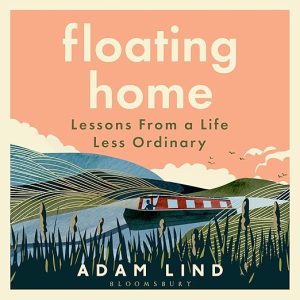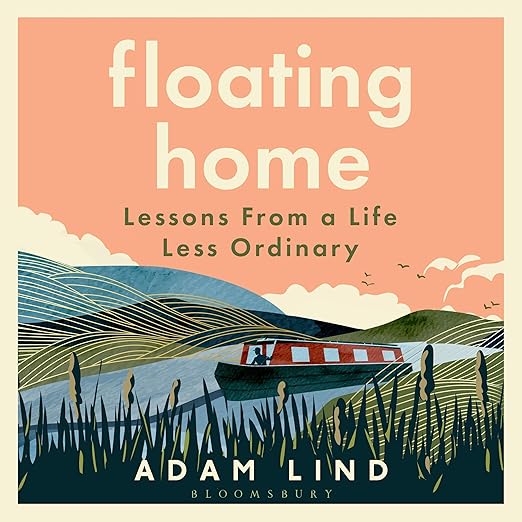
Floating Home lands as an audiobook that does something the self-help memoir genre rarely manages: it earns its gentle conclusions. Adam Lind lost his father, spent five years hitchhiking across twenty-six countries, worked as a motorcycle journalist, and eventually took to the UK waterways aboard a narrowboat called The Raman Rose. The book that emerges from that sequence of experiences is less interested in prescribing a particular lifestyle than in examining what happens when you give yourself permission to stop optimizing and start paying attention. Lind self-narrates here, and that decision turns out to matter enormously.
The endorsements on this book are worth noting: Joe Sugg, Poppy Okotcha, TJ Power, Joshua Fletcher, Stuart Sandeman, and Amy Wright have all provided praise that clusters around the same words: slow, soulful, honest, grounding. That is not accidental. Floating Home is deliberately positioned against the productivity-maximization strain of contemporary self-improvement, and the endorsers are people whose audiences are receptive to that alternative framing. The book speaks to people who already suspect that something in the standard script for a successful life is missing but have not yet found language for the alternative.
Mexico Without Spanish, an Engine Without Mercy
The narrowboat sections of the book, describing Lind's life on The Raman Rose on the UK waterways, are where Floating Home finds its most specific and vivid material. There is a concreteness to the difficulties of narrowboat life that keeps the book from floating into pure abstraction. A temperamental engine is not a metaphor; it is an actual mechanical problem that must be solved in cold weather with limited tools, and Lind's account of that kind of practical intimacy with a life stripped of urban convenience grounds the philosophical observations that surround it.
The hitchhiking sections across twenty-six countries over five years provide the book's most structurally interesting material. Lind is honest that this period was motivated at least in part by grief and an inability to return to conventional patterns after his father's death. The wisdom he distills from those years, about human connection, about trust, about the gap between media narratives of danger and actual human behavior in places the media characterizes as threatening, is earned rather than tourist-derived. He went to Mexico without speaking Spanish and without experience of the region, expecting what fear suggested, and found something else entirely. The same pattern recurs across countries and continents throughout the hitchhiking years: the gap between the danger projected by distance and the reality of individual human encounter, measured in actual meals shared, actual problems solved together, actual conversations across language barriers. Lind does not universalize this into a naive global-kindness thesis; he is honest that his experiences were also shaped by being a young male traveler with a certain kind of mobility and privilege. But the pattern holds, and it is worth holding. He went to Mexico without speaking Spanish and without experience of the region, expecting what fear suggested, and found something else entirely.
Lind Reports Vulnerability Instead of Performing It
The self-narration is the main reason to choose the audiobook over the print edition. Lind's voice has the quality his endorsers are describing when they use words like "honest" and "tender." He is not performing vulnerability; he is reporting it, which is a harder thing to do and a more valuable one to witness. Melanie Crawley and David Thorpe join the narration in a supporting capacity that adds texture without disrupting Lind's first-person intimacy. One reviewer noted that reading the book caused her to discover she was "learning as much" from the experience as she expected, which suggests that Lind's particular combination of specific travel narrative and philosophical observation works at a level beyond mere inspiration.
At just over five hours, Floating Home is sized for a single extended listen or two comfortable sessions, which suits its contemplative quality. This is not a book that benefits from being consumed in ten-minute increments. The accumulative effect of Lind's voice across the full runtime is part of the experience, and the audiobook format allows that accumulation in a way that dipping in and out of the print edition cannot replicate.
Connection, Peace, and Compassion, Told as Stories
Listeners who come to Floating Home expecting a structured self-help program will find something different. The book's three core areas, human connection and community, control of the mind and achieving peace, and the transformative power of compassion, are addressed through story and reflection rather than frameworks, bullet points, or step-by-step instruction. This is the memoir as wisdom transmission rather than methodology, and it works in that mode. If you need a clear protocol to follow at the end of a book, look elsewhere.
The book's UK-centric context, both the narrowboat culture and some of the travel destinations, will feel slightly foreign to American listeners unfamiliar with the culture around inland waterways. This is a minor issue, and Lind is a clear enough writer that the specifics translate across that gap, but it is worth noting that the world he describes is geographically and culturally specific rather than universalized.
Grief and Career Doubt Find a Slow Companion
Listeners in transition, whether processing grief, reconsidering career priorities, or simply feeling the particular exhaustion of lives lived at modern speeds, will find Floating Home a useful companion. It belongs in the same shelf as Rolf Potts's Vagabonding and David Grayson's Adventures in Contentment: books that advocate for slowness not as an escape from reality but as a more honest engagement with it. Those who prefer their travel memoirs action-oriented or their self-improvement books directive will find the pace and register of Floating Home frustrating. But for the listener the book is actually speaking to, its quietness is precisely the point.
Questions Listeners Ask
How does Adam Lind's self-narration compare to professional narrator audiobooks in terms of audio quality and performance?
Self-narration can vary widely in quality, but Lind's performance here is consistently praised for its intimacy and authenticity. The presence of Melanie Crawley and David Thorpe in supporting roles also adds professional texture to the production.
Is Floating Home primarily a travel memoir or a self-help book, and which listeners will get the most from the audiobook?
It blends both modes. The travel narrative provides the structure and the specific detail; the self-help framing provides the reflective context. Listeners who enjoy memoir-style wisdom transmission, rather than prescriptive programs, will find the balance works well in audio.