Key Details
- At its heart: First-generation wealth building, artificial intelligence as an equalizer, family expectations around money, breaking a generational poverty cycle
- Vibe: Encouraging and brisk, pitched at somebody starting from zero with nobody at home to ask
- Short version: The premise is genuinely underserved and the framing is honest, though a synthetic reading with no buyer feedback of any kind behind it makes this a leap of faith.
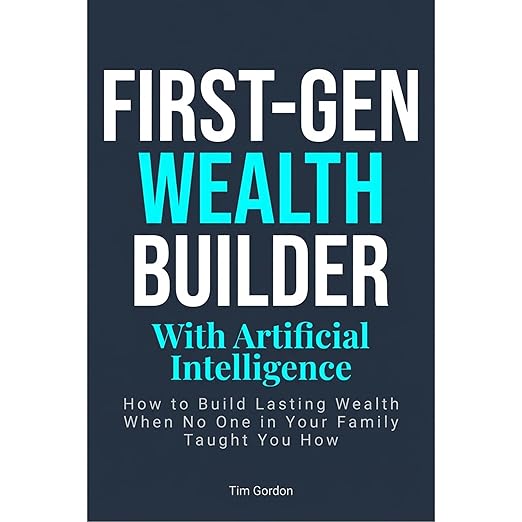
Can a book whose selling point is a set of prompts you paste into a chat window survive the move to audio? That is the first question this audiobook raises and the last one it answers. Tim Gordon writes for anybody who is the first in the family to work out money, investing and artificial intelligence all at once, with no financial wisdom handed down at the dinner table and no family business to inherit. Three hours and twenty-nine minutes is the whole file, and Virtual Voice is what the narration credit says.
Virtual Voice Is Not a Person Reading This
Virtual Voice is not a person. It is the label a synthetic reading carries, which means no performer is auditioning for you, no interpretation is on offer, and a sample tells you precisely as much as the full file will. For a book about money that carries one specific cost: the passages about family expectations and the psychological weight of going first are written to land emotionally, and a synthetic delivery gives them the same temperature as a paragraph about tax optimization.
Break the Cycle is the copy's opening line, and the cycle in question is generational rather than behavioral, which is the smartest thing about the framing. Gordon is not running the familiar argument that you would be rich if you skipped the coffee. The premise is that a first-generation builder starts from a steeper position: no inherited guidance, no safety net, and a set of expectations at home pointing the other way. Naming that gap accurately is worth something on a crowded shelf.
Artificial intelligence arrives as the equalizer, and this is where to keep your skepticism handy. The copy promises automated budgeting that finds hidden savings, machine learning that reads your spending patterns, and passive income streams from automation tools that work while you sleep. Some of that is ordinary software described in newer vocabulary, and the description never draws the line between the two. The runtime leaves no room to draw it either, and the line matters more than any single tactic.
Ten Areas, Two Hundred Nine Minutes, Twenty Each
First-generation buyers get something here that most finance titles withhold: an acknowledgment that the obstacles are social as much as arithmetical. The description names money mindset shifts, family financial expectations, and the psychological barriers that come with breaking a generational poverty cycle. Anyone who has sent money home while trying to build savings knows those items are the whole difficulty, and knows how often a book treats them as a footnote before returning to index funds.
Ten areas get named in the description: budgeting, investment research, passive income, algorithmic trading, side hustles, credit building, debt elimination, tax optimization, money mindset and family expectations. Across two hundred and nine minutes that works out at roughly twenty each, before you subtract an introduction and a closing pitch. Take the file as an orientation rather than a manual: it will tell you what exists and where to point an assistant, which for a beginner has real value, without making you competent at any of it.
Unfair advantage is how the copy describes what artificial intelligence hands you, and the phrase repays a second look, because it works differently depending on where you start. For somebody with inherited capital, an assistant that drafts a tax question is a convenience. For somebody without that background, it stands in for the adviser, the parent and the family accountant at once. Gordon's whole argument rests on that asymmetry being real, and the book is built on it rather than decorated with it, which counts in its favor.
Words That Arrive Once, at Somebody Else's Pace
Prompts are the structural problem. Each chapter, the copy says, includes specific AI prompts you can use immediately, alongside case studies from first-generation builders who made it work, and practical workflows. A prompt is a string of text you copy. A workflow is a sequence you follow with a screen open. Neither survives a format where words arrive once, in order, at somebody else's pace, and the record names no companion PDF or download to compensate. If the prompts are why you are buying, buy the text.
Five months have passed since the March 15, 2026 publication date, and the page still shows no rating and no written response of any kind. Silence proves nothing in either direction, but it does make the description your entire evidence base: nobody has confirmed that the case studies are specific, that the prompts do what they claim, or that synthetic delivery stays tolerable right across the file. You carry that risk alone.
Cutting-edge is a claim the copy makes for itself, and cutting-edge ages fastest. A book organized around current assistants and no-code platforms describes a landscape that shifts every few months, and nothing on this record is versioned: no edition number, no revision date beyond publication, no indication of which tools the workflows assume. Independently Published is the imprint, so no editorial apparatus stands behind the currency of the material either.
Synthetic Reading Grates, No Narration Alternative Offered
Immigrants building wealth in a new country, first-generation college graduates, and young professionals with nobody at home to ask are the three groups the copy names, and they are the right ones. If you are early enough that the vocabulary itself is the barrier, three hours spent learning what a tax optimization question even sounds like is a fair trade. Bring a notebook, expect to search for tools by name afterward, and treat every income figure as a claim.
Look elsewhere if you already run a budget, already hold investments, or already use AI assistants for more than drafting email. The same goes if synthetic reading grates on you, because no alternative narration is offered on this record. Anyone who wants the prompts, the case studies and the workflows in a form they can actually use should buy the printed version and keep this file for the parts that are argument rather than instruction.
Does the audiobook name the specific AI tools it recommends?
The description discusses AI assistants, no-code platforms and machine learning algorithms as categories rather than by brand, and no companion file is listed where names might sit. Expect to finish with a set of questions to search rather than a shortlist of products, which is also what keeps the material from dating overnight.
Is this audiobook aimed at complete beginners?
Explicitly so. The copy says it is not another guide assuming you already have money or family guidance, and it addresses people meeting money, investing and artificial intelligence at the same moment. Anyone already comfortable with two of those three will find the third covered too lightly to justify the purchase.
What does the listing tell you about Tim Gordon?
Independently Published, with a March 15, 2026 release date and a byline reading Tim Gordon. No author biography, series field or supplementary material appears anywhere on the page. Self-published finance titles vary enormously in rigor, and this listing gives you nothing beyond the description to place this one.