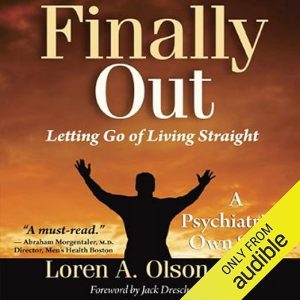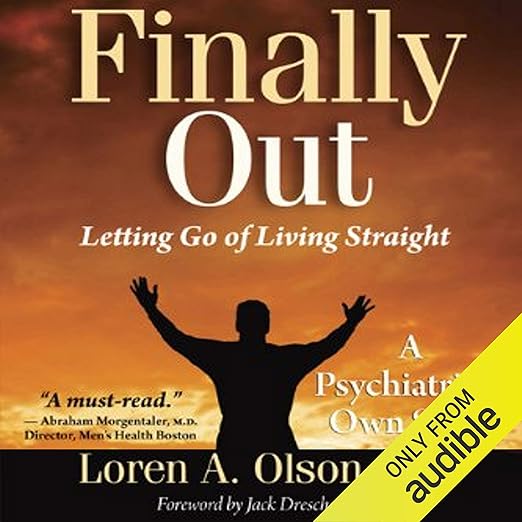
Forty is the age Dr. Loren A. Olson finally understood he was gay, and Finally Out keeps circling back to the question that fact provokes in almost everyone who hears his story: how does a man not know that about himself for four decades? This audiobook doesn't treat the question as rhetorical. Olson, a psychiatrist by training, answers it directly, weaving his own marriage and eventual divorce together with psychological research and gay history to explain how a mature man's sexuality can stay hidden, including from himself, for that long.
The book's dual structure is its real distinguishing feature: not just a coming-out memoir, but an argument about a specific, under-discussed population, men who come out later in life after living substantially as straight men, sometimes well past the point of first noticing same-sex attraction. That combination of personal narrative and professional framework gives the book an analytical spine that a pure memoir wouldn't have on its own.
Reviewer John Bourassa's comparison is worth including for what it signals rather than as a literal claim: he suggests that even Freud, living today as a straight man, couldn't have analyzed the intricate, complex depth of being caught between a dual life and a marriage the way Olson does from the inside. That's a reader's way of marking the book's psychological seriousness, not an academic endorsement, but it captures the register accurately.
Most public coming-out narratives, in memoir and in media generally, center younger people discovering and naming their sexuality for the first time. Olson's story sits apart from that default narrative almost entirely: a man who married, had children, built a full adult life, and only in mid-life confronted a truth that had been present, in some form, for decades. That specific gap in the broader coming-out conversation is a large part of what makes the book feel necessary rather than redundant with more familiar accounts.
The synopsis's own phrase, that Olson "vigorously answers" the two questions he's most often asked, signals something about the book's stance worth noting: this isn't a passive, purely descriptive memoir content to lay out events and let readers draw their own conclusions. It argues its position directly, pushing back specifically against the assumption that a long marriage to a woman must have been a deliberate cover story rather than a genuine, if incomplete, understanding of himself at the time.
Reviewer S. Georgescu's word for the book, a "template," points at something clinicians and researchers have increasingly recognized in recent decades: men who come out well into adulthood, often after marriage and children, are a real, identifiable population with a shared set of psychological questions, not a scattering of unrelated individual stories. A book that functions as a usable template for that specific experience fills a gap that younger-coming-out narratives simply don't address.
Olson Narrates with Double Authority
Olson narrating his own memoir carries double authority: lived experience and clinical, professional training as a psychiatrist, a stronger-than-usual case for self-narration since both halves of the book's approach, personal story and professional framework, come from the same voice rather than being stitched together from separate sources.
Reviewer CharleS's account is a genuinely useful signal of the book's real function for its intended audience: coming out fairly late themselves, with a lot of unanswered questions, they found reading Olson's own Q&A material and eventually this book gave them direct, applicable answers, describing their own experience as remarkably similar to his. That's the book working as recognition, not just information.
Olson's psychiatric training shapes how the book explains its central mystery, not just that men can be unaware of their own sexuality for decades, but why that's psychologically plausible: internalized social expectation, genuine cognitive dissonance, and a slow, cumulative process of self-recognition rather than one dramatic realization. Framing it that way gives listeners real conceptual tools, not just one man's individual story.
Olson Trained Before Psychiatry Caught Up
The book addresses direct, sometimes difficult questions about marriage, fidelity, and what a spouse did or didn't know throughout, worth flagging clearly for listeners approaching it specifically from a spouse's or family member's perspective rather than the person coming out, since the framing centers Olson's own interior experience throughout.
At over ten hours, it moves at a reflective, unhurried pace that mixes memoir with research citation rather than racing through either mode, considerably more measured than a quick personal-essay collection. Listeners should set expectations for a patient, layered listen rather than a fast, propulsive one.
The gay history Olson weaves through his personal narrative situates his own experience against real, documented shifts in social and legal acceptance across his adult lifetime, giving individual memory a historical backdrop rather than leaving it isolated. Listeners unfamiliar with that broader history will still follow the personal story easily, but the historical layer adds real depth for those who want it.
That historical backdrop includes his own field: homosexuality remained officially classified as a mental disorder in American psychiatry until 1973, meaning Olson trained and began practicing medicine against a professional backdrop that had only recently stopped pathologizing the very identity he was still working to recognize in himself. Knowing that timeline sharpens just how tangled his personal and professional understanding of his own sexuality genuinely were.
For a listener still questioning their own sexuality privately, the audiobook format itself carries real, practical value beyond convenience: headphones and a private listen let someone engage with material this personal without a visible book cover or a library record announcing what they're working through, at exactly the stage when that privacy often matters most.
All three attached reviews land at a full five stars, and that uniformity is worth reading as a specific kind of signal rather than simple across-the-board quality: this is a book that resonates intensely with the exact audience it's written for, men navigating or having navigated the same late-recognition experience, rather than one aiming for broad, general-audience crossover appeal.
Men Who Came Out Later Are the Audience
Men questioning their own sexuality later in life, and their partners and family members trying to understand that experience from the outside, are the clearest audience, alongside readers generally interested in gay history and psychology intersecting with personal memoir.
Skip it if you want a purely historical or purely clinical treatment without memoir woven through it, or if you're specifically looking for a coming-out story centered on a younger person's experience rather than the particular, less-discussed dynamics of coming out in mid-life after decades lived as a straight man, since that specific vantage point is the book's whole reason for existing.
Common Questions
Does Dr. Olson narrate this audiobook himself?
Yes, and that self-narration carries real weight here, combining his own lived experience with his professional training as a psychiatrist in a single voice, rather than having someone else interpret both halves of the book secondhand.
Is this audiobook mainly memoir, or does it include psychological research too?
Both. Olson weaves his personal story of marriage, divorce, and coming out at forty together with psychological concepts and gay history, giving the memoir an analytical framework beyond straightforward personal narrative.
Would this audiobook help a spouse understand a late-life coming out experience?
It could offer real insight, though the framing centers primarily on Olson's own interior experience rather than a spouse's perspective specifically, worth knowing going in if that's the angle you're most interested in.
How long is the Finally Out audiobook, and what's the pacing like?
It runs ten hours and thirty-one minutes at a reflective, unhurried pace, mixing memoir with research citation rather than moving quickly through either mode.