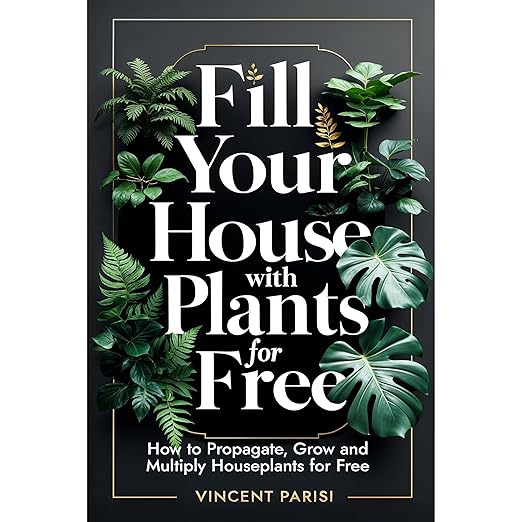
Quick Take
- Narration: Virtual Voice AI narrator delivers functional but flat audio, the information is accessible, but the format is better suited to a visual how-to guide than to purely audio consumption.
- Themes: Budget-friendly plant propagation, indoor gardening for beginners, growing from kitchen scraps
- Mood: Encouraging and practical, like being talked through something by someone who genuinely wants you to succeed
- Verdict: A genuinely useful propagation guide with strong beginner-friendly content, but the AI narration and heavily visual source material make the audiobook a compromised format for this specific book.
I want to be straightforward about what this audiobook is and what it is not, because the gap between those two things matters more here than it does for most titles I review. Fill Your House with Plants for Free is, in its written form, a genuinely well-regarded beginner’s guide to houseplant propagation. The reviews from people who have read it in print or ebook format are consistently warm: the step-by-step instructions work, the plant selections are sensible, the troubleshooting sections are useful. Reviewer Ben described learning how to propagate “from seeds, cuttings, and root splitting” and feeling equipped to do it. That is a real recommendation.
What the audiobook format cannot deliver are the fifty beautiful images the synopsis prominently features, the plant ID profiles, the quick reference lists, and the room-by-room plant selections that depend on visual layout. Those are not minor features. They are structural elements of how this book teaches. So the question I want to answer here is not whether the content is valuable, it clearly is, but whether the audiobook version successfully translates that value into audio.
Our Take on Fill Your House with Plants for Free
The honest answer is that it partially does. Vincent Parisi’s text is clear and sequential enough that the core propagation concepts, water propagation, soil propagation, root division, seed starting, and growing from kitchen scraps like avocado pits and turmeric root, translate into audio without losing their essential logic. Reviewer A’dri Cerda noted that Parisi “keeps things simple” and walks you through “low-tech propagation methods,” and that simplicity is what saves the audio version from being entirely unsuitable for the format.
The kitchen scrap section is one of the book’s genuine pleasures and works well in audio. The idea that you can grow fruit trees and edible plants from materials you would otherwise discard is intrinsically interesting to hear about, and the descriptions of what specific plants need to establish themselves are concrete enough to follow without pictures. Reviewer A+ mentioned being surprised to learn about a plant grown from a 30,000-year-old seed, and that kind of factual hook lands regardless of format.
Why Listen to Fill Your House with Plants for Free
For listeners who are primarily looking to understand the concepts of propagation rather than execute specific procedures immediately, the audio version provides a useful orientation. Reviewer Hilary described learning “quite a bit” as a new plant person, and that beginner introduction function works in audio. The runtime of just under three hours is appropriate for an introductory guide, and the pacing gives each propagation method enough time to be understood in principle.
Reviewer Whitney’s observation that the book works for “both beginners and experienced plant parents” is borne out by the content breadth. There is enough variety across water propagation, soil methods, and the specialized kitchen-scrap techniques that intermediate gardeners will find at least some unfamiliar territory.
What to Watch For in Fill Your House with Plants for Free
The AI narration is the most significant caveat here. Virtual Voice delivers the text clearly and accurately, but it lacks the capacity to signal emphasis, adjust pacing for particularly important instructions, or add the warmth that a human narrator brings to instructional content. For a book that is trying to be encouraging and accessible, the flat delivery works against the book’s emotional ambition even while it serves the informational content adequately.
Listeners who intend to use this as a reference guide while actually propagating plants will find audio a poor format for the purpose. You cannot rewind to a specific section mid-cutting, and the absence of visual plant ID profiles means you may need to supplement with internet searches when working with unfamiliar species. The book is better as a listening introduction that motivates further reading than as an operational guide you consult while your hands are dirty.
Who Should Listen to Fill Your House with Plants for Free
The audio version serves listeners who are curious about plant propagation and want an encouraging introduction they can absorb passively, commuters who want to learn a new skill without sitting in front of a screen, and people who have heard about propagation and want to understand what it involves before committing to a physical book. If you intend to actively practice propagation while referencing the book, a visual format is genuinely more practical. If you want the companion ebook or paperback alongside the audio version for reference during actual propagation sessions, that combination would give you the best of what the content offers.
Frequently Asked Questions
Does the Virtual Voice AI narration make this audiobook harder to follow for a practical how-to guide?
Yes, to a degree. The AI narration is clear but lacks the inflection and pacing adjustments that help listeners distinguish key steps from supporting context. The information remains comprehensible, but important procedural moments do not receive the emphasis a human narrator would provide.
Can I follow the propagation instructions just from listening, or do I need the images?
The basic concepts of water propagation, soil propagation, and root division are followable in audio. But the plant ID profiles, the room-by-room selection guides, and the quick reference lists that the book emphasizes are essentially inaccessible in audio format. For active propagation, a visual format is strongly recommended.
Does the book cover advanced propagation techniques, or is it strictly beginner-level?
The book primarily targets beginners but includes enough variety across propagation methods that intermediate gardeners will find useful material. Experienced propagators with years of practice are unlikely to encounter much that is new.
What kinds of plants are featured in Fill Your House with Plants for Free?
The book covers over fifty plants selected for ease of growth, spanning popular houseplants suitable for water and soil propagation, root division candidates, and kitchen scrap plants including avocado, papaya, turmeric, and various herbs. The selections prioritize hardy, forgiving species for new propagators.