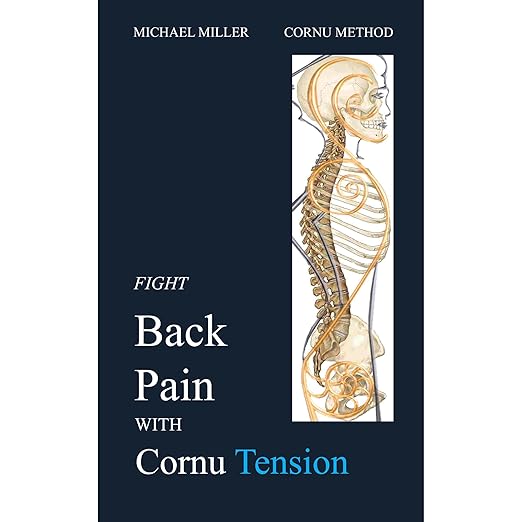
Learning to feel something already happening inside your own body is what this book asks of you, and the voice doing the asking is generated rather than human. That pairing is the whole story of this audiobook page. Thirty-three minutes is all it runs, and inside that the description promises to change the way you understand your own back and to hand you practical tools for fighting pain from within. Half an hour is not automatically too short for an idea, and any number of real principles fit comfortably inside a walk around the block. It is short for a method, though, and the gap between an idea and a method is exactly what somebody in pain is paying for.
Cornu Tension Defined, a Pilates Claim Unchecked
Cornu Tension is the coined term at the center of the book, and the description does define it, which is more than a good many method books manage. The definition runs like this. A productive, decompressive force is created when opposing axes of the body rotate against each other. Hips and shoulders engage in opposition. Ears and shoulders work in counter-rotation. The tension that results, the copy insists, does not compress the spine but opens it, so length is created and space returns, and for a great many people the pain begins to ease inside that new space. Clear enough to follow. What the copy never does is say where the word Cornu came from or why it was chosen.
Pilates is the frame the book sets itself inside, and the claim it stakes inside that frame is not a modest one. The copy calls this the principle at the heart of Pilates, articulated with new precision by teacher and movement specialist Michael Miller. That is a large statement about a large discipline, and it arrives with no supporting apparatus whatsoever: no citation, no study, no named practitioner besides the author. It may be entirely fair. Nothing on this page lets you check it, and the usual checks a listener would run, meaning the rating and the reviews, are not available here either.
Sensation Needs a Voice, Timing Needs a Human
Half an hour on a single mechanical idea is a defensible shape for audio, and arguably a better shape than a book. You cannot study a diagram while lying on the floor with your hips rotating one way and your shoulders the other. A voice in your ear is the correct delivery system for that instruction, which is the entire reason guided-movement recordings exist. The description seems to understand this, insisting the point is not information but sensation, that you have to learn to feel what is already happening inside your body. Sensation is what a voice can prompt and a page cannot.
Movement instruction handed to a generated voice runs into the opposite problem, and it is a real one. Guided movement depends on timing. A human teacher slows where a body needs slowing, waits on a breath, lets one cue land before stacking the next on top of it. A generated reading delivers each sentence as the sentence was written, and no more than that. If the text was composed with the format in mind, with the pauses built into its punctuation, this could work perfectly well. If it was composed to be read on a page, half an hour of instruction will arrive at an even clip that has nothing to do with what your spine is doing.
Raising Surgery Without Offering a Second Opinion
Surgery is named in the second paragraph of the description, and that raises the stakes on everything else here. The copy addresses people who have tried rest, medication, and physical therapy, and people who have been told an operation may be the only option remaining. It then offers this principle as the reason so many people facing surgery found relief through mindful movement instead. Anyone in that position deserves the plain version: a thirty-three-minute recording with no clinical citation, no rating, and no listener account behind it is not a second opinion. Listen if you want to. Take what you hear to whoever is treating you.
No score sits on this listing. No tally of votes, no written reaction, nothing whatever to weigh. On most titles that means only that a book is new, and this one carries a March 2026 date, so the emptiness is expected. On a health title the cost runs higher than elsewhere, since the questions a buyer actually has are the ones only another buyer can answer. Does the instruction make sense with nothing to look at? Can you follow a counter-rotation cue while lying down? Is half an hour long enough to learn the sensation the whole book is built around? Nobody has said a word.
Michael Miller turns up in the third person at the end of his own description, in a short paragraph identifying him as a Pilates teacher and movement specialist who has spent his career studying the relationship between rotation, tension, and spinal health. That paragraph is a jacket convention, the sort of author note printed on a flap, and it has been carried straight onto a page where no flap exists. Harmless in itself, and one more small sign that this page was put together from print materials rather than written for sound. Nothing else on the page corrects for it.
Thirty-Three Minutes of Principle, No Program
Curious listeners with half an hour to spare and a back that bothers them are who this was made for, especially anyone who has already brushed against the idea in a Pilates class and would like it spelled out properly. The description is clear that no equipment, no particular fitness, and no clinical training are needed, which is an unusually low bar to entry. If the counter-rotation cue lands for you, thirty-three minutes will turn out to have been an efficient use of an afternoon, and the low commitment is the strongest argument the listing has.
Do not start here if you want a program rather than a principle, because the copy promises tools to begin with and half an hour cannot hold a progression. Do not start here either if you need a human voice pacing you through movement, since the reading is generated and nothing on the page pretends otherwise. And if an operation is genuinely on the table, treat this as reading around the subject rather than as grounds for changing a plan. The description raises that stake by itself. It should not be the thing that settles it.
How long is the Fight Back Pain with Cornu Tension audiobook?
Thirty-three minutes, which is the length of one idea rather than a program. The description promises to change how you understand your own back and to supply practical tools, and half an hour is ample for the first of those and thin for the second. Expect a principle explained once, with no progression to follow.
Can generated narration work for movement instruction?
Virtual Voice is what the credit says, which means the reading is generated instead of acted. Guided movement normally depends on a teacher pacing you and pausing where a body needs it, while a generated voice delivers each sentence as written. Whether that suits depends on how the text was built. The sample answers fastest.
Should this audiobook replace medical advice about back surgery?
No. The description speaks directly to people who have been told an operation may be their only remaining option, and it carries no clinical citation, no rating, and no listener account of any kind. Half an hour of movement principle is worth hearing and is not a second opinion. Bring whatever it raises to your clinician.