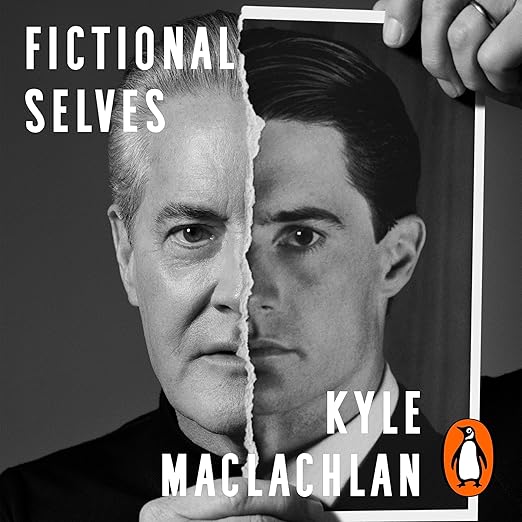
Kyle MacLachlan opens his memoir with a doppelganger problem: a the person, and then a 'Kyle MacLachlan,' the public construction, the actor, the cult icon who lives in perpetuity inside Twin Peaks and Blue Velvet and whatever else people project onto that face. Fictional Selves is his attempt to account for both. It is one of the more unusual actor memoirs this audiobook listener has encountered, not because the career it chronicles is unusual, though it is, but because MacLachlan's framing device, the split between self and persona, is pursued with enough intellectual seriousness that it keeps the book from becoming a conventional behind-the-scenes account.
The title is precise. MacLachlan's life has been defined by fictional selves, in the plural: Agent Dale Cooper, Jeffrey Beaumont, Trey MacDougal, a string of characters so distinctive that they take on independent cultural life. His memoir asks where those characters end and where he begins, and whether that question has a stable answer. It is a genuinely interesting question for a genuinely interesting career, and the audiobook is the right format for it.
An Inner Critic Called the Other Kyle
The David Lynch sections are the parts that many listeners will come for, and they deliver. MacLachlan's relationships with Lynch across Dune, Blue Velvet, and Twin Peaks is described with the intimacy of long collaboration and the particular strangeness of being directed by someone whose vision was frequently inexplicable in the moment. MacLachlan is honest about what it was like to be a young actor cast in Dune when that film was being made as a potential blockbuster, then to watch it struggle, and then to find redemption in Blue Velvet's more controlled circumstances.
The 'Other Kyle' conceit, the ego or inner critic or public persona who follows MacLachlan through his career, functions as a structural device for examining the gap between ambition and anxiety. MacLachlan is candid about the fear that has accompanied his public life, the sense of inadequacy that coexists with external success. His account of navigating fame without fully understanding it is more vulnerable than the typical Hollywood memoir, and more honest about the toll of sustained public identity.
No Narrator Listed, and That's a Real Question
No narrator is listed for this audiobook, which raises the question of whether MacLachlan performs his own memoir. Given the deeply personal material and the explicit first-person framing around the split between self and persona, this audiobook would be most fully realized with MacLachlan's own voice. His deadpan, his specific cadence, the way he inhabits the ambiguity between earnestness and irony are part of the experience of watching him in anything. Listeners should verify the narration before purchasing if that question is a deciding factor.
The prose, as delivered, has what Penguin Audio describes as funny, moving, and playfully self-aware qualities. The memoir covers collaborators including Laura Dern, Dennis Hopper, and Anthony Hopkins. The Showgirls section, and MacLachlan's account of his 'infamous and delightful' pool scene, is apparently handled with the self-deprecating humor that characterizes the best of his public appearances. Memoirs that can find comedy in career embarrassments without evasion are worth reading for that quality alone.
One of the Most Distinctive Actors of His Generation
MacLachlan addresses ambition, love, and fatherhood alongside the career narrative. The personal sections carry their own emotional weight, and the account of how his offscreen life intersected with and diverged from the personas he performed is more reflective than most actor memoirs manage. He is described in his publisher's framing as 'one of the most distinctive actors of his generation,' and the memoir bears that out not through self-aggrandizement but through specificity: this is what it was like to be exactly this person making exactly these choices at exactly these moments.
The memoir was published in 2026 by Penguin Audio, which means it is genuinely current and covers the full arc of MacLachlan's career through the most recent chapter of Twin Peaks revival and beyond. For listeners who have followed his work through its various phases, the audiobook offers the account that completes the picture.
Showgirls as Information, Not Apology
The book's account of the Showgirls period, including MacLachlan's performance in a film that was critically savaged and commercially disastrous, is worth the audiobook alone for anyone who has followed his career through the Lynch years and wondered what the non-Lynch work tells us about who he is as an actor. MacLachlan does not treat this as a chapter to apologize for. He treats it as information about himself: about the choices that led him there, about what he was trying to do, and about the particular intelligence required to inhabit a role in a film that the world decides to mock and find in that experience something still useful.
MacLachlan's career has been built on the unusual edges of mainstream entertainment, and this audiobook makes a compelling case that those edges were not accidental. His sustained collaboration with Lynch, his recurrence in prestige television through Twin Peaks: The Return, and his capacity to occupy cult status without becoming a parody of it, all of these reflect deliberate choices about what kind of work is worth doing. The memoir reveals the reasoning behind those choices in a way that changes how you watch the work.
Essential for Anyone Who Loves Lynch
Fans of Twin Peaks, Blue Velvet, and the broader world of David Lynch filmmaking will find this essential. Listeners interested in intelligent, reflective actor memoirs that treat the experience of sustained public identity with philosophical seriousness will find MacLachlan's framing genuinely rewarding. Anyone curious about what it is like to build a career on the interesting margins of American entertainment, cult classics, festival darlings, and prestige television rather than franchise blockbusters, will find this a generous and honest account.
Does Kyle MacLachlan narrate this audiobook himself?
No narrator is named anywhere on this edition's listing. Given the deeply personal material and MacLachlan's distinctive voice and cadence, listeners should verify the narration details before purchasing, since the choice of narrator would significantly affect the listening experience of a memoir this closely tied to his personal identity.
Is this audiobook suitable for listeners who are not familiar with MacLachlan's work?
The memoir provides enough context that unfamiliar listeners can follow the career arc, but the emotional weight of the collaborator descriptions, including Laura Dern, Dennis Hopper, and Anthony Hopkins, will land more fully for listeners who know the films in question. A basic familiarity with Blue Velvet or Twin Peaks is helpful.
What distinguishes Fictional Selves from other celebrity memoirs as an audiobook?
MacLachlan's 'Other Kyle' framing device, a sustained examination of the split between private self and public persona, gives this audiobook a structural and philosophical dimension that separates it from straightforward behind-the-scenes accounts. The memoir is interested in what it costs to inhabit fictional selves professionally over decades, not just what it was like to make specific films.