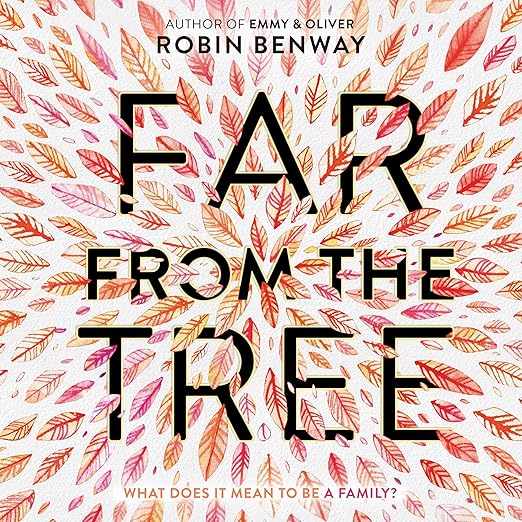
Grace has just placed her newborn baby for adoption when she starts searching for the biological family she herself never knew. That's the premise of Robin Benway's Far From the Tree, a National Book Award winner narrated in audiobook form by Julia Whelan, and it announces itself as a story about circles: the ones that close, the ones that break, and the ones you build yourself out of people who have no obligation to love you. Whelan's narration makes the three-way perspective structure feel natural rather than mechanical, and the result is a listening experience that holds together even when the emotional stakes are at their highest.
The book alternates between three siblings who share a biological mother but have lived entirely different lives. Grace, the middle child who begins the search, was adopted into a loving family but has always felt the absence of origin. Maya, the younger sister, grew up the only brunette in a family of redheads, a difference that has made her sharp-tongued and perpetually searching for proof of herself. And Joaquin, the older brother, has been in foster care for seventeen years and has learned to keep his emotions precisely managed in order to survive institutions that offered him no permanence. Three people defined, in different ways, by the families they didn't have.
What Andrew Solomon Delivers
What distinguishes Benway's novel from other adoption narratives is its resistance to sentimentality as an end state. Each of the three siblings is allowed to be difficult. Maya in particular frustrated at least one reader reviewer, who 'would have loved to slap Maya and tell her what an entitled jerk she was,' which is a response that says something accurate about how fully Benway develops her: entitled teenagers in novels are often softened for likability, and Benway refuses that. Maya's sharpness is the product of specific circumstances, and the book earns her growth rather than assuming it.
Joaquin is arguably the book's most affecting character. Seventeen years in the foster care system have produced a young man who has mastered the art of controlled presentation: he keeps secrets not for dramatic effect but because secrets are the only reliable form of self-protection he's known. His reluctance to bond with his biological siblings reads not as obstinacy but as a finely calibrated survival response, and the audiobook format, with Whelan differentiating his register from Grace and Maya's, makes that interiority audible in useful ways.
What Andrew Solomon Gets Right
Julia Whelan is one of the most accomplished YA narrators working in audiobooks, and this is a performance that showcases why. The three siblings are vocally distinct without relying on caricature: Grace is measured, Maya is percussive, and Joaquin is careful in a way that sounds different from ordinary quietness. Whelan manages the book's multiple timelines and emotional registers without any of the seams showing, and in a novel where the structure is doing as much thematic work as the plot, that transparency is essential.
The book handles adoption, teen pregnancy, and foster care not as issues to be examined but as lived realities that have shaped three specific people. That distinction matters in listening terms. You are not receiving a lecture about the foster care system; you are spending time with a young man who grew up inside it. The specificity prevents the narrative from becoming earnest in the way that can make YA fiction feel condescending to adult listeners.
Where Andrew Solomon Loses Some Ground
One reviewer mentioned that the book 'tried to weave in a couple of themes' including an Alice in Wonderland throughline and the concept of being 'untethered,' and found these elements somewhat underworked. That's a fair observation. Benway has a light touch with her thematic scaffolding, which works in service of naturalism but may leave readers who want the symbolism more legibly developed feeling the book pulls its punches on those registers.
The ending is warm without being easy. Joaquin's resolution in particular is earned slowly, and Whelan's narration of his final sections carries the cumulative weight of everything the book has built. The Alice in Wonderland callbacks, which appear through the book as a kind of tonal underscore, arrive more fully in the closing chapters. Some readers will find this satisfying; others will want the threads tied more tightly. The 'happy ending' designation in the reviews is accurate in terms of emotional landing, but Benway doesn't smooth over the messiness that preceded it.
The runtime of under nine hours makes this an accessible listen for anyone coming to the audiobook without a long block of time to commit. It covers significant emotional ground without overstaying. That economy is one of its genuine strengths.
The biological mother who connects Grace, Maya, and Joaquin remains largely offscreen throughout the novel, which is itself a structural choice with emotional meaning. The three siblings are defined not by the woman who carried each of them but by the families, and the absences of families, that shaped their separate lives. That decentering of the origin figure allows the book to focus on chosen bonds rather than biological ones, and it gives the eventual meeting between the siblings the weight of something genuinely chosen rather than merely discovered.
Who Should Pick Up Far From the Tree
This audiobook is well-suited for listeners who want a character-driven YA novel that takes its subjects, adoption, teen pregnancy, foster care, seriously without reducing any of them to lesson material. Julia Whelan's narration is a genuine reason to choose the audio format. If you are looking for something plot-driven above all else, this is more interested in interiority than event. But for listeners who respond to voice and the slow accumulation of specific emotional truths, Far From the Tree is a rewarding and well-executed listen.
A Few Questions About Far From the Tree
Is the Far From the Tree audiobook appropriate for younger listeners?
It's written for a teen and young adult audience and is appropriate for readers from roughly age 13 up. The themes of teen pregnancy and foster care are handled with sensitivity and without graphic content.
Do I need to have personal experience with adoption to connect with this audiobook?
Not at all. The book's central questions about belonging, identity, and chosen family are broadly accessible. Listeners with personal connections to adoption or foster care will likely find additional resonance, but it's not a prerequisite.