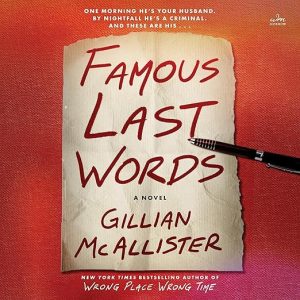
Camilla wakes up on June 21st, the longest day of the year, and her husband is gone. In his place: a cryptic note and, on the news, a hostage situation unfolding across London. And then the police arrive to tell her that Luke, doting father and eternal optimist, is not a victim. He is the gunman. Emilia Fox narrates this audiobook version of Gillian McAllister's Famous Last Words, and the way she delivers that first hour sets the tone for everything that follows: composed on the surface, with something sliding loose underneath.
I listened to most of this in two long evening sessions. McAllister's previous title, Wrong Place Wrong Time, built a devoted following on the strength of its structural ingenuity, and this novel carries that same ambition into different territory. The domestic thriller genre has a long tail of similar premises, but McAllister consistently finds the pressure point that her peers miss: she is less interested in what the crime is than in how knowing about it changes the people adjacent to it. Camilla is not simply a wife in shock. She is a literary agent, a new mother on the verge of returning to work, a woman who has spent months of maternity leave constructing a theory of her own identity, and all of that collapses in one news alert.
What We Made of It
The novel's central engine is a simple but effective question: what do you do when someone you love has done something you cannot process? McAllister is patient about letting Camilla sit in that impossibility rather than rushing her toward resolution. The pacing is deliberate in the first half, and this is where one reviewer's observation about the middle becoming slow and repetitive has merit. McAllister is building something, but the scaffolding is visible enough that impatient listeners may feel the length. Fox handles the repetitive emotional terrain well; she does not allow the narration to become repetitive in the same way the prose occasionally does.
Fox is an exceptional choice for Camilla. Her voice has an English restraint that works precisely against the subject matter. The more catastrophic the circumstances become, the more clipped and controlled Fox sounds, and that contrast produces an unnerving effect. Jodi Picoult's blurb describes the novel as blindsiding with twists and with a poignancy about relationships rarely found in the genre, and Fox's narration amplifies the poignancy specifically. She reads the marriage flashbacks with a warmth that makes the present-tense horror more disorienting, because you are hearing the same voice describe the same man in completely contradictory registers.
The structural device McAllister employs in the second half is the point where opinions divide. One reviewer called it magical in a way that doesn't fit a non-magical story, and that criticism has some validity. McAllister has always been willing to push her plots past conventional plausibility in service of emotional effect. Whether that trade-off works depends on your tolerance for thriller mechanics that prioritize impact over strict realism. Fox navigates the device with admirable commitment, treating it as seriously as the surrounding material rather than as a gimmick.
The Best Parts of Famous Last Words
The audiobook format suits this novel particularly well because Camilla's internal monologue is the novel's primary vehicle, and Fox makes that interiority audible without making it claustrophobic. Print readers have reported losing patience with Camilla's processing; audio listeners tend to find the same passages absorbing, and I think the difference is Fox's voice, which carries a sense of someone actively working through something rather than merely describing past states.
McAllister's reputation as the best at putting characters in impossible situations is well earned here. The scenario she constructs for Camilla has real edges. The police presence is not a procedural backdrop; it is a pressure source that shapes every decision Camilla makes, including the one at the center of the novel's third-act mystery. What is in the note Luke left, and what does Camilla do with that knowledge? The answers require you to sit with a character making choices you might not make yourself, and that discomfort is the novel's actual subject.
For listeners who came to McAllister through Wrong Place Wrong Time and found the time-loop mechanism more gimmick than substance, Famous Last Words may land differently. The structural cleverness here is more embedded in the character psychology than in a narrative device applied from outside. The story is fundamentally about how Camilla reconstitutes herself in the aftermath of impossible information, and that is a quieter project than a temporal puzzle but one with more lasting resonance.
What Might Not Land
The novel's third act moves faster than some listeners will want. After the deliberate pace of the first two-thirds, McAllister accelerates into resolution territory, and the shift can feel abrupt. Fox handles it by tightening her delivery, which works rhythmically but may leave you wanting more time with certain revelations. The thirteen-hour runtime gives the novel real room, and some of that space is used with more care in the setup than in the payoff.
The character of Luke is a structural problem the novel never quite solves. He is present in the flashbacks and in Camilla's reconstruction of their marriage but essentially absent as a full character. The mystery of what he did and why depends on this absence to function, but it means that the most significant person in the novel is also the least rendered. Listeners who want to understand Luke independently of Camilla's perspective will find themselves waiting for a depth that does not fully arrive.
Those caveats aside, the novel maintains its grip throughout. Reviewer Debra Knapp described it as one of those books she was sad to see end, and that sense of reluctant completion is real when listening. McAllister consistently earns the next hour even when a specific passage drags. Fox is a significant contributor to that effect. Her voice keeps the listener in Camilla's corner even when Camilla's logic becomes strained.
Who Should Pick Up Famous Last Words
Listeners who want domestic thrillers with genuine psychological texture rather than pure plot mechanics will find this audiobook satisfying. It is best for readers already familiar with McAllister's style and willing to accept that her novels prioritize emotional truth over procedural tightness. Listeners who need a neatly closed ending or want deep characterization of the perpetrator may find the book's architecture frustrating. Fox's narration alone is worth the entry price for anyone who enjoys high-quality British audiobook performance.
In Brief
- Voice: Emilia Fox is exceptional here, her composed English delivery working in deliberate contrast to Camilla's unraveling circumstances throughout all thirteen hours.
- Big ideas: Marital deception, identity reconstruction after catastrophic revelation, the impossible loyalty of loving someone who has done something unforgivable
- Atmosphere: Tense and psychologically pressured, with enough domestic warmth in the flashbacks to make the present-tense horror land harder
- Worth it?: A domestic thriller that prioritizes emotional honesty over procedural neatness, elevated substantially by Emilia Fox's narration and most rewarding for listeners willing to sit with discomfort.
Do I need to have read Wrong Place Wrong Time before this audiobook?
No. Famous Last Words is completely standalone. Knowing McAllister's previous work helps calibrate expectations for her structural approach, but the novel introduces its own premise from page one and requires no prior knowledge of any of her other books.
Is the audiobook ending satisfying or does it leave questions open?
The ending closes the central mystery definitively but leaves some thematic questions open in ways that feel intentional. Whether that satisfies or frustrates depends on what you want from a thriller. Listeners who prize emotional resolution over plot resolution will likely find it more satisfying than those who want all threads tied.