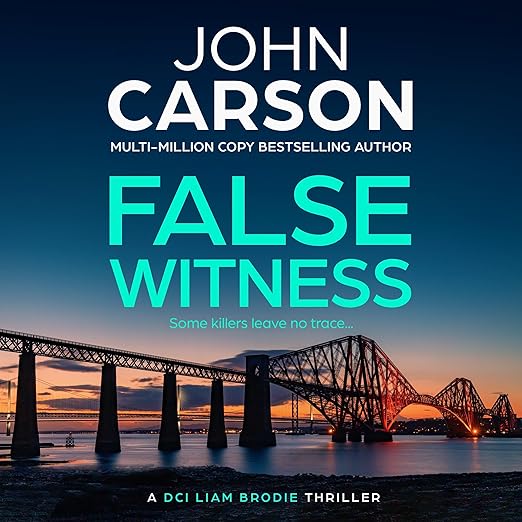
Fife, Scotland at dusk has a particular quality of grey, flat, coastal, indifferent, and John Carson uses it mercilessly in False Witness, the second installment in the DCI Liam Brodie audiobook series. The premise opens where any good procedural thriller should: in the middle of a nightmare that the reader recognizes before the detective does. Seven years ago, Brodie hunted a killer who called himself The Embalmer. Seven women, displayed like exhibits, no witnesses, no profile, no arrest. And now, seven years later, the killings have started again. This audiobook is an exercise in compounding dread, and Carson is skilled at compounding dread.
What John Carson Delivers
The central tension of this series, a detective who has a cold case in his professional past that is not actually cold, is productive territory for crime fiction. Brodie is not haunted in the generic sense; he is specifically wrong-footed by the resumption of crimes he thought he understood. The killer is not just repeating the past: he is rewriting it, which means every assumption Brodie made during the original investigation becomes potential misdirection. That structural conceit gives Carson room to do something more interesting than a straightforward serial killer procedural. He makes the detective's accumulated knowledge a liability rather than an asset, and the tension derives from watching Brodie unlearn what he thought he knew.
The Fife setting is handled with the kind of local specificity that distinguishes regional British crime fiction from its more generic counterparts. Carson writes about landscape the way crime writers should: not as backdrop but as atmosphere, something that actively shapes the mood of the investigation. The coastal geography, the institutional textures of the Scottish police procedural, the specific weight of a cold case reopened, all of it is rendered with precision.
The series is recommended for fans of J.D. Kirk and Ed James, two authors who operate in similar territory, and the comparison is apt. Carson writes with the same commitment to atmosphere and pacing that distinguishes that end of the British procedural genre. Readers who have worked through the Kirk and James catalogues will find this audiobook comfortable territory and will likely appreciate what Carson does differently within the shared conventions of the form.
What John Carson Gets Right
Crime fiction rewards audio more than almost any other genre. The unfolding of a procedural investigation benefits from real-time listening; you cannot skip ahead, you cannot check the ending, you are locked into the same information horizon as the detective. False Witness is built for that constraint. Carson parses information carefully, revealing just enough at each turn to sustain forward momentum without delivering resolution prematurely. The audiobook's pacing architecture is tight and deliberate throughout.
The additional twist that Brodie is not only hunting but being hunted transforms the novel from a procedural into something closer to a cat-and-mouse thriller in its final act. That shift in register is handled without abandoning the character work that the earlier chapters build, which is harder than it sounds. Carson earns the escalation rather than imposing it, which keeps the tonal shift from feeling like a betrayal of the quieter, more atmospheric first half.
The pacing of False Witness deserves specific attention because it is doing something more sophisticated than standard procedural structure. Carson alternates between Brodie's investigation and glimpses that suggest the killer's perspective without ever delivering that perspective fully. The result is asymmetric: the reader knows slightly more than Brodie does, or thinks they do, which creates the specific discomfort of dramatic irony operating in a thriller register. You are not simply watching a detective investigate; you are watching a detective investigate while dimly aware that the ground is shifting underneath him.
Where John Carson Loses Some Ground
No narrator is listed for this audiobook, which means production details remain to be confirmed before you commit to it. For a series with this level of atmospheric investment, the choice of narrator matters considerably. The Fife setting, the institutional Scottish police culture, and the specific quality of Brodie's interior exhaustion all require a voice that can navigate Scottish registers without caricature. Potential listeners should verify narrator information before purchasing if vocal performance is a primary criterion for their listening decisions.
As the second book in the series, False Witness does carry some serial structure. The relationship between Brodie and his team, certain personal details from his past, and the emotional context of the original Embalmer case are developed more fully in the preceding title. The novel functions as a standalone thriller, but the investment in Brodie's character will be higher for listeners who have followed from the beginning.
Who Should Pick Up False Witness
Listeners who have worked through the DCI Liam Brodie series from the start should not hesitate. Carson delivers on the promise of the setup with genuine craft. Fans of British regional procedurals who enjoy the Ian Rankin school of crime writing, where setting and character psychology carry as much weight as plot mechanics, will find the atmosphere exactly right.
Those looking for a light or cozy mystery will find this audiobook too dark in register. Carson is writing in the tradition of serious Scottish crime fiction, with violence depicted unflinchingly and psychological stakes that accumulate throughout the narrative. New listeners to the series might consider beginning with the first Brodie installment to fully appreciate what this one delivers. Carson's narrative compression and his refusal to give Brodie easy resolution make False Witness one of the more rewarding Scottish procedural audiobooks of recent years.
Before You Press Play
- Themes: Serial killer procedural, reopened cold case, hunter becomes hunted
- Mood: Atmospheric and cold, Scottish coastal grey rendered as sustained dread
- Verdict: A well-constructed British procedural that earns its serial killer premise through character psychology and regional atmosphere rather than shock value.