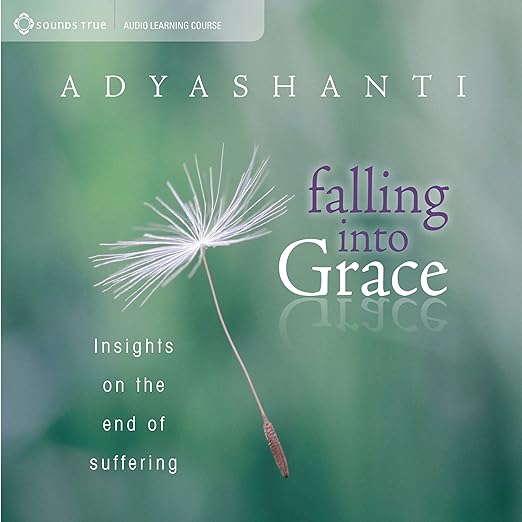
I came to Adyashanti through a recommendation from someone who described him as the teacher they turned to when other teachers felt like they were performing spiritual depth rather than embodying it. That distinction is useful. Falling into Grace is a ten-hour program recorded from live teaching sessions, it is not a book adapted for audio but a teaching recorded and formatted for home practitioners, which means the audio version is, in a meaningful sense, the original.
Adyashanti spent fifteen years as a formal teacher before recording this program, and that experience shows in the economy of his presentation. He has distilled his approach to what he considers the fundamental insights, the ones that actually shift something rather than simply describe what needs to shift. The result is dense with implication in ways that reward repeated listening rather than single-pass absorption.
A Closer Look at Falling into Grace
The central premise is straightforward in articulation and radical in implication: suffering arises from the belief in a separate self, and the end of that belief, not intellectual understanding of it, but the actual dissolution of the experiential assumption, is what spiritual awakening means. Adyashanti approaches this not as a metaphysical claim but as a practical observation about the structure of human experience.
What distinguishes his teaching from the broader self-help and mindfulness space is its refusal to frame awakening as a comfortable or self-affirming process. He explains plainly why spiritual awakening can be a disturbing process, and does not soften this. The dismantling of ego-constructed identity is not pleasant simply because it leads somewhere better. He is honest about the difficulty of the in-between.
What Makes Falling into Grace Worth Hearing
Self-narration here is not merely a convenience but a feature. Adyashanti is a spoken teacher, his primary medium is the recorded talk and the retreat, not the printed page. His delivery carries information that text cannot: the pauses, the tonal shifts when a concept is approached from a new angle, the quality of attention in his voice when he is describing something he has directly experienced rather than intellectually formulated. One reviewer specifically noted that his language and expression are direct and straightforward while finding his spiritual depth and insight immense, that combination of accessibility and depth is evident in the delivery.
The program covers substantial territory: breaking the trance of ego, experiencing raw emotion without being overwhelmed, cultivating inner stability, transcending the framework of opposites, and what he calls intimacy and availability, the state of being fully permeable to each moment of experience. Each topic is developed across multiple sessions, allowing the teaching to circle back on itself and accumulate meaning.
Things to Know Before Starting Falling into Grace
This is not a passive listening experience. Adyashanti is teaching toward an experiential shift, not delivering information. Listeners who engage while doing other tasks will receive the content but likely miss the invitation. The work is designed to be listened to in the kind of attention you bring to meditation rather than the kind you bring to a podcast.
The teachings draw on Jesus, Buddhist, Taoist, and Zen traditions in a way that one reviewer described as making them relatable for the modern Western mind, which is accurate but worth noting. Adyashanti works in a non-dual framework that synthesizes across traditions rather than teaching within any single one. Listeners deeply committed to a specific religious tradition and its interpretive boundaries may find the syncretic approach either liberating or disorienting.
Who Adyashanti Is Writing For
For practitioners already engaged in serious contemplative work, meditation practitioners, yoga teachers, people working within Zen or Tibetan Buddhist frameworks, or those exploring Christian mysticism, Adyashanti offers a precise and accessible contemporary voice that does not oversimplify. He is particularly useful as what one reviewer called a second supportive teacher: someone whose perspective enriches rather than replaces an established primary practice.
Those new to contemplative practice may find the direct pointing style disorienting without some grounding in what ego dissolution or non-dual awareness even means as a practical proposition. The book is not designed as an introduction but as an invitation to drop more deeply into territory already partially known.
- Read by: Adyashanti narrates his own teaching, and the effect is significant, this is a teacher whose spoken delivery is the primary vehicle of his work, and hearing him rather than reading him is the intended experience.
- At its heart: Ego dissolution, the nature of suffering, spiritual awakening as surrender
- Vibe: Still, open, and disorienting in the best sense, demanding full presence from the listener
- Short version: For listeners drawn to non-dual spirituality and serious contemplative practice, Adyashanti's teachings have rare depth and accessibility, this is the format the work was designed for.
Before You Listen
Is Falling into Grace a good starting point for someone new to Adyashanti's work?
It can serve as an introduction, but Adyashanti's work assumes a listener already asking certain questions. Those completely new to contemplative spirituality may find the direct non-dual teaching style difficult to access without some prior exposure to meditation or related frameworks.
Can this audiobook be used as a meditation guide, or is it primarily intellectual teaching?
It is closer to direct pointing than guided meditation, Adyashanti describes and points toward states rather than leading formal meditation sessions. Listeners may find it useful as preparation for or reflection on formal practice rather than as a meditation substitute.