
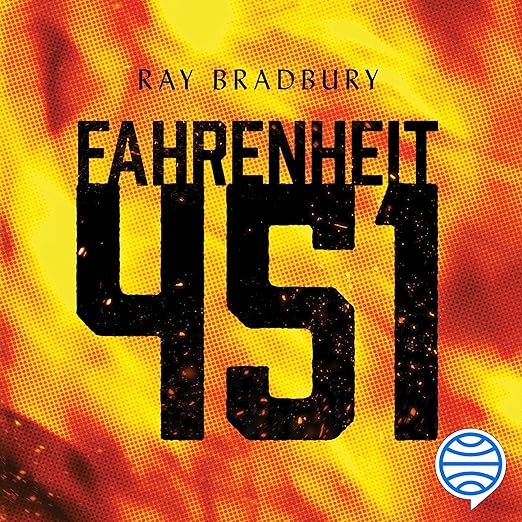
Important note before anything else: this edition of Fahrenheit 451, published by Planeta Audio in 2020 and narrated by Toni Mora, is recorded entirely in Spanish. The audiobook listing is not always immediately clear about this, and several reviewers have expressed frustration at discovering it mid-listen. If you are seeking the English-language edition of Bradbury's novel, this is not it. If you are a Spanish-speaking listener or a student of the language, read on.
Fahrenheit 451 is one of the defining texts of twentieth-century speculative fiction, written in 1953 and set in a future America where firemen do not extinguish fires but start them, specifically, fires to burn books. Guy Montag is such a fireman, and the novel follows his slow awakening from complicit participant in censorship to something more dangerous: a person who wants to think. The title refers to the temperature at which paper ignites.
Bradbury's Predictions Now Just Read as Description
What strikes me most about this novel, returning to it in its Spanish translation, is how precisely Bradbury identified the mechanisms of intellectual pacification. The television walls that fill entire rooms with interactive drama, the tiny earbuds delivering a constant stream of noise into citizens' ears, the automobiles racing at speeds that prevent any meaningful observation of the world outside the window, these were imaginative extrapolations in 1953. They read now as description. Bradbury was not predicting a dystopia. He was mapping the one already beginning to form around him, and the Spanish adaptation of his language captures that quiet horror with reasonable fidelity.
Reviewer Xebaxtian's note that Bradbury is a genius is both simple and accurate. Kingsley Amis called Fahrenheit 451 the most convincing of all the conformist hells, placing it alongside Orwell's 1984 and Huxley's Brave New World in the tradition of dystopian fiction that uses future settings to examine present anxieties. What distinguishes Bradbury from those contemporaries is the emotional temperature: where Orwell is cold and clinical, Bradbury is elegiac. He mourns. You feel, throughout the novel, someone grieving the loss of a world that valued the slow, difficult, irreplaceable act of reading.
Mora's Measured Spanish Misses Some Visceral Heat
For Spanish-speaking listeners, this Planeta Audio edition offers a thoughtful translation of one of literature's essential texts. The translator's work preserves the rhythmic, almost poetic quality of Bradbury's prose, which is unusual among science fiction writers of his era. Narrator Toni Mora delivers the text with appropriate seriousness, though some reviewers have found her performance less viscerally involving than they hoped. The complaint is one of degree rather than failure: the material is so inherently compelling that even a measured reading carries weight.
Reviewer marialicia notes having come to the novel late and being glad to have finally encountered it, describing it as a classic they are happy to have read now. That response is typical of first-time Bradbury readers: there is a sense of recognition, of encountering ideas that were already floating in the culture but have never been stated with quite this precision and feeling.
Clarisse Vanishes Before the Novel Explains Her
The novel is short by contemporary standards, this audiobook runs seven hours and seventeen minutes, and Bradbury packs a great deal of thematic material into a narrative that sometimes sacrifices character depth for symbolic resonance. Montag's transformation from compliant fireman to rebel is rapid and not always fully motivated. The character of Clarisse, the young woman who first disrupts his complacency, appears briefly and then disappears in a way that some readers find structurally abrupt.
Reviewer Karen L. Kingrey, who purchased this edition to read alongside her grandson's school assignment, found the narration painful to listen to, calling it not a good narrator in her opinion. This is worth noting as a genuine reservation from an engaged listener, even though the majority of responses to this edition are positive. The narrator's approach is deliberate and consistent, but it may not suit all temperaments.
Wrong Language Here, Try Christopher Jones Instead
Spanish-speaking listeners seeking a high-quality production of one of literature's most important dystopian novels will find this a worthwhile edition. Students of literature who read Spanish and want to experience Bradbury in a new linguistic register will also find value here. The novel itself is appropriate for high school age and above, and it has lost none of its relevance in the decades since its publication, if anything, the cultural conditions it describes have deepened rather than receded.
English-speaking listeners should seek a different edition entirely. Multiple reviewers purchased this version without realizing it was in Spanish, and the frustration of that discovery is understandable. The English-language Audible version narrated by Christopher Jones is the standard recommendation for non-Spanish-speaking listeners.
Good to Know
Is this edition of Fahrenheit 451 in English or Spanish?
This edition is entirely in Spanish, narrated by Toni Mora and published by Planeta Audio. The audiobook page notes this, but several reviewers have found the language disclosure insufficiently prominent. English-speaking listeners should seek a different edition.
Is Fahrenheit 451 still relevant for contemporary listeners, given it was written in 1953?
Strikingly so. Bradbury's descriptions of wall-sized interactive televisions, constant audio streams piped directly into people's ears, and automobiles moving too fast for anyone to observe the world outside are now descriptions of technologies that exist. His concern about the gradual erosion of contemplative reading culture has only sharpened in relevance over the decades.







