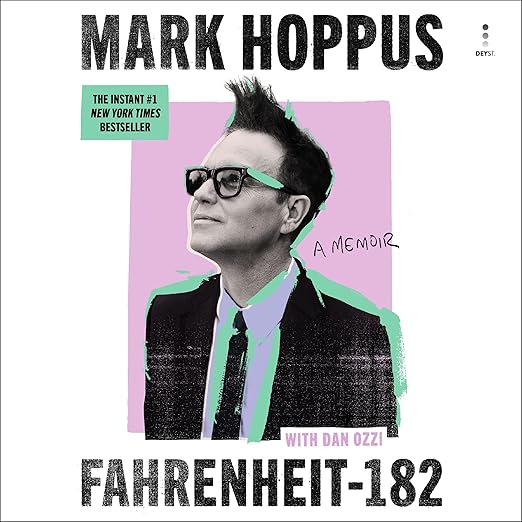
- Narrator: Self-read by a singer whose speaking voice a generation already knows, which is the one casting decision this memoir could not have got wrong.
- Subjects: Reinvention move by move, anxiety carried for a lifetime, friendship as a career, illness made public
- Tone: Funny, self-deprecating, rawer than it lets on
- Bottom line: A strong author-read memoir for anyone who was there, and a decent one for anyone who was not.
Mark Hoppus reads his own memoir, and the publisher says so twice: once in the narrator field and once in the description, which promises the audiobook is narrated in his own voice and calls the result intimate and immersive. That is the only claim about this recording anywhere on the record. Not one of the five written responses mentions hearing it. All five describe reading instead, and the listing has several other gaps besides that one.
Not One of Five Responses Mentions the Voice
A life told in relocations is the shape of this book. An angst-filled kid from the desert, a bitter divorce between his parents, and a run of moves across the country, each one an opportunity to reinvent: dork, then goth, then skate punk, until he met the best friend who turned out to be his musical soulmate. A latchkey childhood in the 1980s built on punk rock, skateboards and MTV. Then anxiety, then a career, then cancer.
Generational context arrives from a five-star dated the seventeenth of April 2025, and it lands better than the copy manages. That reader started listening to the band in 1997, in seventh grade, when skateboarding meant freedom, baggy jeans were battle gear, and somebody at every local high school played Dude Ranch off a battered boombox. Arriving at this memoir expecting a few laughs, some nostalgia and a couple of anecdotes, that account reports being unprepared for how thoroughly it made them feel seen instead.
Reinvention is the organizing idea and it earns the position. A kid who changed identity every time the family moved becomes an adult who maintained a public one for decades, and the copy is explicit that this is a book for anyone who struggled, reinvented themselves, and wanted to quit but kept going. Framing a rock memoir that way is a real decision: the band becomes the circumstance, and the subject is the person who kept restarting.
A Reader From Ridgecrest Confirms the Portrait
January 2026 brought the strangest and most persuasive endorsement on the page. That five-star grew up in Ridgecrest and went to school with him, says he explained the desert perfectly, and reports laughing and crying through it before observing that he has stayed exactly the person that reader remembers. Somebody who was actually there, confirming the texture of a childhood, is a rarer kind of verification than a critic's, and on a memoir it counts for more.
Self-narration matters more on this book than on most. Hoppus made a living from a voice a generation recognizes instantly, and the memoir covers anxiety, a divorce watched from child height, and a cancer diagnosis conducted in public. Material like that, read by a hired professional, acquires a layer of tact nobody asked for. The publisher's line about intimacy is marketing, but the logic underneath it holds: a singer reading his own worst years is a different object.
Nostalgia is the other engine, and the description is unashamed about it. Punk rock, skateboards and MTV, a latchkey kid in the 1980s, a band that became enormous. Anyone who was fifteen at the right moment will recognize the coordinates immediately, and the book seems aware its readers arrive with a soundtrack already running in their heads. That is a legitimate pleasure, and this memoir is engineered to supply it without embarrassment.
Photographs That Never Make the Move
Four stars in March 2026 flags a genuine problem without intending to. That response closes by noting the book carries lots of pictures, and pictures do not survive the move to audio. Nothing on this record mentions a companion file. A music memoir illustrated with photographs loses a real part of itself when the images go missing, and anyone choosing between formats should put that on the scale before deciding which one to buy.
Here the Average Is Real, Not the Count
Rating fields are the other oddity, and this one resolves cleanly. Two votes, says the counter. The five written responses grade it five, five, five, five and four, which averages exactly 4.8, the very figure the listing displays. So the average is real and the counter is not. Whatever that field is counting, it is not the population that produced the number printed beside it.
Audience is the last consideration. The copy works hard to widen it, insisting this is more than just a memoir for blink-182 fans and aiming it at anybody who ever restarted a life and kept going. That pitch is defensible and the material supports it. Even so, the density of band history, tour anecdote and 1990s reference means a listener with no attachment at all will do more translating than the description admits, particularly in the touring chapters where names arrive faster than context.
Generous Book, Less Generous Listing
February 2026 supplies the best audience test available. That five-star worked for MTV and Viacom during the years the book covers, was around when the band visited the 1515 Broadway studios, and went through it alongside a son raised on 1990s bands, with the touring stories landing for both of them across the gap. A household holding two versions of the same fandom will get two different books out of this one.
Celebrity memoir bores some people on principle, and this one follows the form closely: childhood, formation, ascent, crisis, reflection. Give it a miss on that basis, or if the photographs matter to you, since the audio cannot deliver them. And anyone hoping for a complete band history should understand this is one member's account, told from inside his own anxiety, making no claim to be the comprehensive version. A memoir and a group biography want different things, and this one never pretends to be the second.
Fahrenheit-182 is the better sort of rock memoir, the kind where the band is the circumstance rather than the point, and hearing it from the person who lived it is the format's whole advantage. What the record around it will not tell you is that a second writer helped build it, that the title has a subtitle, or that photographs form part of the printed experience. The book is generous. The listing is not.