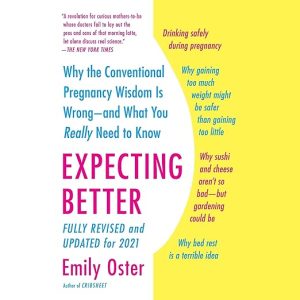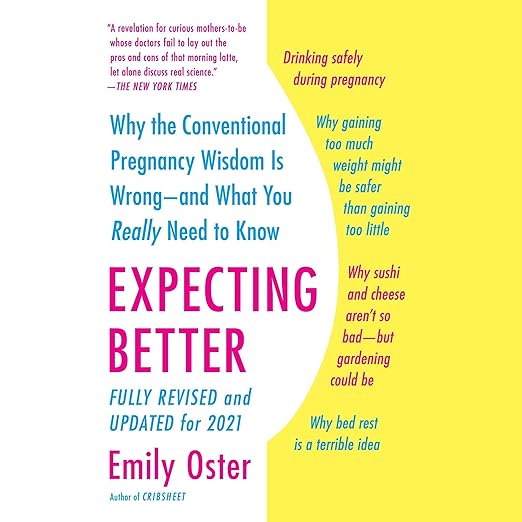
Charts and graphs live in a downloadable PDF here, which is the most important fact about this audiobook and the one buyers notice last. The description says so plainly, in an asterisked line at the bottom: the recording comes with a separate file containing charts, graphs and an appendix from the book. For a title whose entire method is showing you the numbers behind a recommendation, that is not a bonus attachment. It is a load-bearing part of the argument, sitting outside the format you just bought.
One Famous Manual Meets One Famous Economist
Method is what separates this from the rest of the shelf. Pregnant women get told to avoid cold cuts, sushi, alcohol and coffee, and told very little about why; the rules for prenatal testing arrive with the same absence of reasoning. Emily Oster went to the studies underneath those rules, found that many were misguided and some flatly wrong, and wrote down the actual evidence with its actual uncertainty attached. The pitch in the copy, one famous pregnancy manual meeting one famous economics book, is unusually accurate.
Sarah B, writing in November 2015 from a first trimester, names the problem this book was built against: popular pregnancy literature that offers blanket advice in a condescending tone while assuming every reader and every pregnancy are identical. That entry graded it four stars and called it refreshing, which is a fair summary. Being addressed as an adult capable of weighing a risk is the product, and plenty of readers have never been offered it before.
Wine is the part everyone mentions and the part most easily misread. The description promises a healthy, relaxed pregnancy and the occasional glass, and a buyer should understand that the book's position is evidentiary rather than permissive: the argument is about what the data support and how confident anyone should be, not about a blanket clearance. If you want a rule handed down, this will frustrate you at every turn.
Oster Narrates Her Own Confidence Intervals
Coverage is broader than the wine headline suggests. Elisa, writing in August 2013, lists what the book actually works through: the pros and cons of prenatal tests, epidurals, induction, doulas and home birth, plus which foods genuinely warrant avoiding and which are less dangerous than received wisdom claims. That is most of the decision map of a pregnancy, and having summaries of the studies rather than the conclusions is what makes it reusable across nine months.
Alex, filing from Australia in August 2025, describes the effect that keeps this book in circulation more than a decade on. Understanding the actual odds of an event, rather than being told to worry about it, eased worries that had been running unchecked. Anxiety reduction through numbers is a strange promise for a pregnancy book to make and an unusually durable one, because the arithmetic does not expire the way advice does.
Self-narration cuts both ways here, and the PDF is why. Penguin Audio put the economist herself behind the microphone, which suits material full of caveats and confidence intervals that a hired reader might flatten. What no voice can do is show you a table. Ten hours of odds, ratios and study comparisons arrive through one channel while the appendix that organizes them sits in a second file, so plan on listening with something to read on nearby rather than treating this as hands-free.
Old Reviews and Foreign Storefronts Share One Score
Two of the five written responses on this page were filed years before the recording existed. One dates from 2013 and one from 2015, against a Penguin Audio release of March 9, 2021, which means the column pools print readers and audio listeners under a single score without distinguishing them. Their observations about the content remain perfectly valid. Their grades tell you nothing whatsoever about this edition.
Pooling runs across borders too. A May 2023 entry filed from Spain, written in Spanish, praises the book as the only pregnancy title that reader finished, precisely because it is built entirely on data. Another comes from Australia. Three storefronts feeding one rating column is common and worth knowing, particularly on a book whose specific medical guidance varies by country in ways no aggregate score can capture.
Eleven Ratings, Four Stars Missing Somewhere
Column size makes the arithmetic worth doing. A displayed 4.6 across eleven ratings admits exactly one possible total: fifty-one stars out of a maximum fifty-five. Four stars are missing somewhere, and the five visible entries account for four fives and a four. Eleven ratings on a book of this reach is a startlingly thin base, and any single new grade will visibly move it.
Length raises the last practical question. Nine hours and fifty-eight minutes of reference material is a long linear pass through something nobody consumes linearly. Most readers use this book by trimester and by decision, jumping to the chapter that matches this week's question. Audio makes jumping harder, so a listener is better served doing one full pass early and then using the PDF and the chapter list for lookups afterward.
Gifted to Other Expecting Couples Twice
Laura, writing in January 2026, describes the ideal buyer precisely: a couple wanting to understand the statistics, the risks and the reality rather than a list of prohibitions, and someone who has since gifted it to two other expecting couples. That gifting pattern is the strongest signal in the whole column. People do not hand out pregnancy books they merely tolerated.
Anyone who finds uncertainty stressful rather than reassuring should think twice, because the book replaces confident rules with probabilities and asks you to make the call. Anyone who wants a week-by-week developmental narrative is in the wrong place entirely. For a first-time parent who has already been condescended to once and did not enjoy it, ten hours here is a better investment than any amount of forum reading.