Before You Press Play
- Performance: Maxine Mitchell holds fourteen and a half hours of first-person confession alone, with no second voice anywhere to break the register.
- What it covers: Returning to the town that made you, shared guilt among a group of friends, grief treated as an illness to be survived
- Feel: Haunted and retrospective, heavy with things already lost
- Our call: Start with book one, and disregard the star average on this listing, because it was earned by a completely different Exodus.
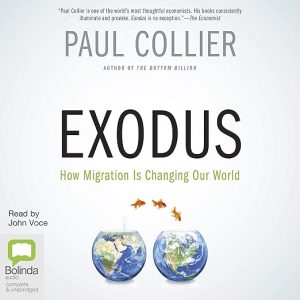
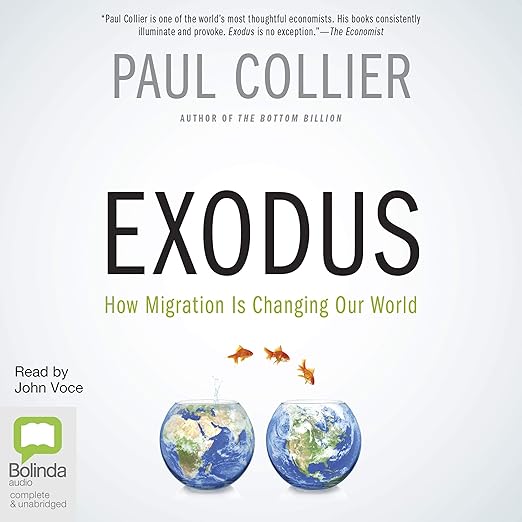
Something has gone wrong on this listing before you press play, and any honest look at the Exodus audiobook has to start there. Kate Stewart's novel is the second book of The Ravenhood, a romance trilogy the copy describes as a gritty, modern-day take on Robin Hood, running fourteen hours and twenty-four minutes with Maxine Mitchell reading. The written responses underneath it are about migration policy, the EU and the social capital of regions. Every one of them belongs to a different book that happens to share the word Exodus.
Triple Falls Confession Without a Single Name
Set the contamination aside for a moment, because the book deserves to be described on its own terms. The publisher copy is a confession delivered in the first person by someone who has come back to Triple Falls, a place the speaker calls a ghost town, the one that made me. It is written entirely as aftermath. Whatever happened has already happened, and the voice we get is the one that survived it. Confession is a difficult mode to sustain, because a speaker who already knows the ending has to withhold it convincingly for hours, and the copy suggests Stewart intends to do exactly that.
That is a bold way to sell a novel, and I think it mostly works. The passage moves through guilt held in common, careless youth, and a sickness the speaker hopes to grieve out and fears will remain a curse. Phrases like my boys of summer and the men who built me point at a group, at damage distributed among several people, and at the possibility that love and harm were coming from the same direction the whole time.
Nowhere does the copy tell you what actually occurred. No antagonist, no incident, not a single character name beyond the town itself. For a second volume that choice is defensible, since anyone arriving in order already knows, but it leaves a prospective listener with atmosphere and no architecture. Romance readers used to a listing that signals tropes and heat level will find nothing of the sort here, and the one hard fact on offer is the trilogy tagline, which arrives after the confession as a sort of afterthought.
Fourteen and a Half Hours From a Single Reader
The voice in that copy is genuinely good. Stewart writes lines like I let my sickness and my love both rule and ruin me, and I am done pretending I did not leave the largest part of me between these hills and valleys, and they carry an ache that sustains itself over sentences rather than collapsing after the first clause. Prose with that rhythm is built for reading aloud, and it is the strongest argument for taking this one by ear.
Fourteen and a half hours is also a serious commitment that suits the material. This is not a quick contemporary romance; it is the middle movement of a suspense trilogy, and middle books are where consequences accumulate. Podium Audio credits a single reader, so one voice carries the whole account with nothing arriving to change the temperature, which is the correct call for a book written as one person finally saying it.
Robin Hood as a template gives the series its spine, and the tagline promising suspense, thrills and all the feels sets expectations honestly enough for a romance whose own language admits that something irreversible already happened. Everyone serving a sentence, the sea of trees that hold my secrets: this is a book about a crime and its cost, dressed as a love story, or possibly the reverse. The outlaw framing also explains the moral shape of the thing, since a Robin Hood story asks you to root for people who have broken the law and to decide how much that ought to cost them.
Migration Policy Reviews on a Romance Listing
Now the contamination, because it will affect what you pay and why. The five visible responses discuss immigration and emigration, multiculturalism, the EU, and a book of roughly three hundred pages. One names Paul Collier outright as the author. Another compares it favorably to Bottom Billion and Plundered Planet and calls it the most important social sciences book of 2013. A third is written in German. The dates run from 2013 to 2020.
This recording came out in June 2021. Not one of those responses can possibly describe it, which means the average and the count on this listing tell you nothing whatever about Kate Stewart's novel, its reading, or its production. Treat both numbers as noise. If you want real reactions to this book, you will have to look at the series rather than at the page in front of you.
The second caution is structural. Entering a trilogy at volume two is always a gamble, and it is a worse one here because the copy withholds so much: you would be starting a fourteen-hour recording with no idea who the speaker is mourning or what the group did. The tagline arrives too late and says too little to fix that, promising suspense and thrills after four paragraphs of grief. A listener deciding between this and a standalone romance has almost nothing concrete to weigh.
Series Readers Are the Fit, Newcomers Should Wait
Readers already inside the trilogy are the obvious audience, and for them the case is simple: this is the middle book, one reader carries all of it, and the copy signals no change of register from the voice they already know. Fans of dark contemporary romance with a suspense engine, small-town secrets and a group of men at the center will recognize the territory immediately.
Everyone else should wait. Newcomers to Kate Stewart, listeners who want a self-contained romance, and anyone who needs a clear signal about heat level or content before committing will be better served starting at the beginning of the series or picking a different title entirely. Fourteen hours is a lot to spend catching up on a story you were never told, and the series is short enough that starting properly costs you one extra book rather than a decade of backlist.
My real complaint is not with the novel, which I suspect is doing exactly what its readers want. It is with a listing that shows a confident star average earned by a study of global migration, on a page selling a Robin Hood romance set in Triple Falls. Nobody buying this deserves that kind of confusion at checkout.
Before You Listen
Can you start the Ravenhood trilogy with the Exodus audiobook?
You should not. This is the second entry, and the publisher copy is written entirely as aftermath: a speaker back in Triple Falls, addressing events you are assumed to have witnessed in book one. Coming in here means fourteen hours of allusion to a story you have not been told.
Is the Exodus audiobook told from a single point of view?
The description is, from beginning to end: one voice, first person, looking back at a town and a group of men from the far side of whatever happened. Maxine Mitchell holds the sole narration credit, so if the novel keeps that perspective throughout, all fourteen hours stay inside one head.