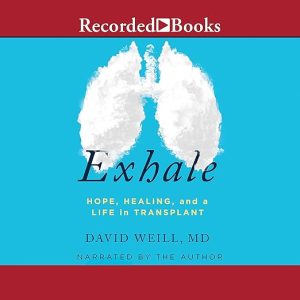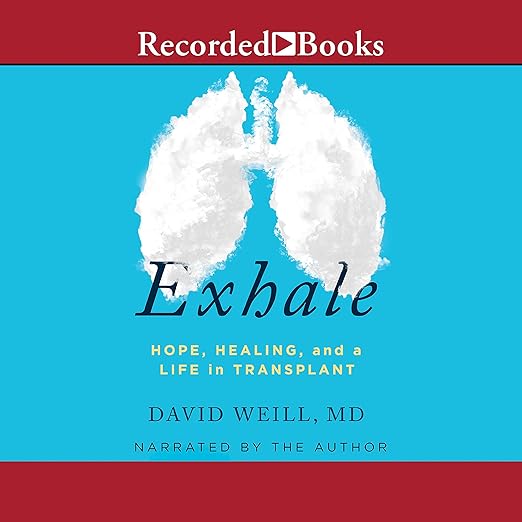
Turned away from transplant lists at hospital after hospital despite an aggressive, uncommon strain of lung cancer, one young father anchors an early chapter of David Weill's memoir Exhale, and Weill narrates this audiobook himself, in the same voice that once delivered news like that to real families. He led Stanford's lung transplant program for a full decade, and the book moves through specific patients, a mother dying on the waitlist in front of her own small children, a grieving father whose daughter did not survive her own transplant, to build toward the gradual realization, dawning on him over years rather than in one moment, that it was time to walk away from the work entirely.
Patient's Mother Verifies Weill's Honesty Firsthand
Weill's own narration is about as strong a case as self-narrated medical memoir gets, real memory weight audible in passages a hired narrator could only approximate from the outside. Reviewer Robin Modlin, who identifies as the mother of one of Weill's actual patients, wrote that he was 'so honest and authentic' in the telling, a judgment that carries unusual authority coming from someone who was inside the real events being described rather than encountering them only as a listener.
JLM admitted going in with a narrower assumption than the book delivers, expecting the story to focus mainly on 'the challenging process of a lung transplant' itself, the mechanics of matching organs to waiting patients. What the book actually is turns out to be broader: an account of a full career spent making impossible triage decisions, and eventually the personal cost of making them for a decade straight.
Robin Modlin's connection to the material goes further than typical listener praise. She identifies herself as the parent of a patient Weill treated at Stanford across the exact period covered in the memoir, which means her assessment of his honesty is not a stranger's guess but a firsthand check against the man she actually knew as a physician, a rare kind of independent verification for a medical memoir to receive from someone genuinely inside the story.
Leaving Stanford Reframed as an Act of Courage
Very few medical memoirs state their central moral weight as directly as this one does: someone else's death is frequently the precondition for a patient's survival, and Weill sits with that fact rather than sanitizing it for easier listening. The story of a child deemed, in the system's own cold calculus, 'not smart enough to be worthy of a transplant' is one of the book's hardest passages, and it exemplifies how Weill uses individual, specific cases rather than abstract policy discussion to make the ethical stakes of transplant allocation concrete.
Mika, another listener, wrote that Weill's writing was 'so vivid and detailed' that she 'felt like I was part of the story,' and specifically credited his 'anguish, grief, and joy' with coming through clearly. That range matters: a memoir spending this much time inside loss needs real tonal variation to avoid becoming an undifferentiated wall of grief, and multiple listeners independently describe finding real joy and connection inside the hard material too.
The synopsis frames Weill's eventual departure from Stanford as 'the power of another kind of decision,' one built around choosing 'to leave behind everything for a fresh start.' Most medical memoirs treat burnout as a private failure to be endured or overcome quietly offstage. Weill instead treats his own exit as a genuine act of professional courage, arguably the hardest decision in the entire book, which gives Exhale a different shape than the typical doctor memoir that ends exactly where it began, still in scrubs.
One Grieving Father Returns Across Nine Hours
This book asks a lot emotionally, and it does not let up for relief chapters. The grieving father introduced early on returns more than once across the memoir, and Weill does not use his loss as brief scene-setting before moving on to safer material; he returns to that particular weight repeatedly throughout the remaining chapters. Anyone currently on a transplant waitlist themselves, or with a family member on one, should know this book sits close to real, ongoing fear rather than offering comfortable distance from it.
Weill also implicates himself directly in some of the memoir's harder moments, describing his own mistakes and the toll a decade of these decisions eventually took on his own judgment and health. This is not a hagiography of a heroic doctor. Listeners expecting a purely admiring portrait of a medical career should be ready instead for real ambivalence, including moments where Weill's own account of himself is genuinely unflattering rather than carefully softened for sympathy.
At nine hours and twenty-two minutes, the book covers a full decade of cases, and the pacing across that many individual stories means some receive only a chapter's worth of attention before the narrative moves on to the next. Listeners hoping for one single case followed from beginning to end in exhaustive detail should know the structure is closer to a mosaic of many patients than a single sustained narrative thread.
The book also sits comfortably at the intersection of medical memoir and social policy, and that dual identity is earned rather than a stretch. Transplant allocation is inherently a policy question as much as it is a medical one, who gets prioritized, who gets turned away, and on what grounds, and Weill does not shy away from the institutional and systemic dimensions of these decisions that a purely personal wellness framing would leave out entirely.
ICU Nurses Will Recognize This Moral Fatigue
Healthcare workers, particularly anyone in transplant medicine, palliative care, or ICU nursing, will likely recognize the specific texture of moral fatigue Weill describes better than a general audience can. Families who have navigated a loved one's own transplant journey, waitlist and all, may find the book validates experiences that are otherwise difficult to put into words for people outside that world. Listeners interested more broadly in career reinvention after decades spent in one demanding field will also find real substance in the book's back half, even without any personal connection to medicine specifically.
Recent, similar grief may make the specificity of these transplant stories too close for comfortable listening right now, even though the book is ultimately about survival and honest reckoning rather than despair. Timing matters more with this one than with most memoirs, and setting it aside until a better moment carries no shame at all. Listeners looking specifically for hard clinical or statistical detail about transplant success rates and outcomes, rather than narrative and moral reflection, will find this weighted heavily toward the human side of the equation instead.
Good to Know
Does David Weill narrating his own audiobook add real value compared to a professional narrator reading Exhale?
Yes. A reviewer who was personally treated by Weill's transplant team confirms his narration reads as honest and authentic, a kind of firsthand verification a hired narrator's performance could not offer.
Is this audiobook mostly about the medical mechanics of lung transplantation?
No. One listener expected that narrower focus and found the book was actually broader, centered on the emotional and ethical toll of a decade spent making life-and-death triage decisions.