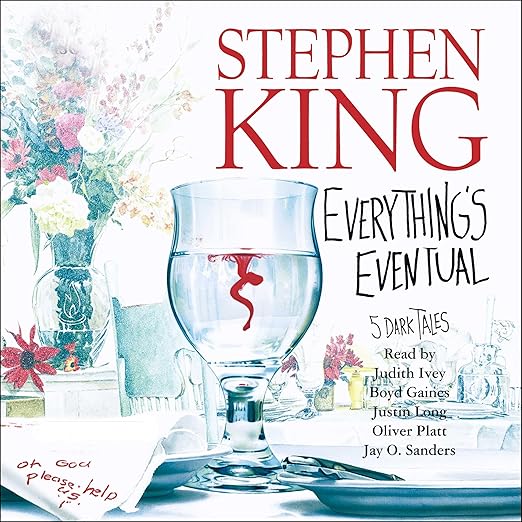
Stephen King's short fiction has always operated differently from his novels, and Everything's Eventual is an audiobook that makes the formal difference unusually legible. Oliver Platt narrates all fourteen stories plus King's characteristically candid story notes, and the 7 hours and 17 minutes of listening time constitute something closer to a guided tour of King's workshop than a single sustained experience. The range is audible: from the mordant domestic comedy of 'L.T.'s Theory of Pets' to the grinding supernatural dread of 'The Road Virus Heads North,' from the O. Henry Prize-winning 'The Man in the Black Suit' to the debut-of-a-universe gravity of 'The Little Sisters of Eluria,' which first brought Roland Deschain's world to short fiction. Platt is equipped to navigate that range, and the collection benefits considerably from having a single narrator who can hold its contradictions together.
What We Made of It
The collection's most celebrated story, '1408,' is also the one that benefits most from the audio format. King wrote it as an audio piece first, specifically designed for listening rather than reading, and Platt's performance of the claustrophobic hotel-room sequence, in which writer Mike Enslin discovers that Room 1408 at the Dolphin Hotel cannot kill you but will ensure you never write about ghosts again, leans into that design with precise pacing. The horror of the room is cumulative and atmospheric rather than image-based, which makes it ideal for audio. Platt never overplays the mounting wrongness; he lets Enslin's controlled professionalism erode incrementally, which is exactly the correct interpretive choice for a character whose method of containing fear is intellectual classification.
'Riding the Bullet,' the story whose massive initial online readership made news before this collection's print publication, holds up as a hitchhiking nightmare with a genuinely uncomfortable moral: protagonist Alan Parker faces a choice that implicates him even before anything supernatural happens. Platt plays the vulnerability of a young man thumbing a ride to see his dying mother with enough earnestness that the shift into terror registers as a betrayal of trust rather than just a genre escalation. The French-language reviewer who found King's later work less compelling than his output through Dolores Claiborne has a point worth taking seriously; the collection is uneven, and 'That Feeling, You Can Only Say What It Is in French' sits awkwardly between the heavier pieces. Platt's even-tempered narration papers over some of these tonal inconsistencies, though the gaps are not entirely invisible over seven hours.
Why Everything's Eventual Works as an Audiobook
The audiobook makes a persuasive case for short fiction as a form in a way that King's novels cannot, because it demonstrates the range available to a writer freed from the obligation to sustain a single world across five hundred pages. 'Autopsy Room Four' opens with a premise, a man who is conscious during his own autopsy, that would be unsustainable across a novel but burns perfectly at short-story length. 'The Death of Jack Hamilton' is straight historical crime fiction with no supernatural element at all, demonstrating King's genuine range outside genre. The King who writes about quitting smoking and yard sales as sources of dread is also the King who writes the Dark Tower's mythology, and this audiobook holds both simultaneously, which is its real accomplishment.
Platt's storytelling voice, measured, slightly ironic, adult without being cold, suits King's first-person interjections and authorial notes particularly well. The story introductions King writes for each piece are often as interesting as the stories themselves, explaining the genesis of each idea or its publication history, and Platt delivers them as conversations rather than liner notes. The listener who catches King describing his own stories with frank assessment of what worked and what did not is getting something unavailable in the print collection, because Platt renders those notes in a register that makes King feel genuinely present in the room rather than authoritatively distant on a page.
What Might Not Land
Listeners new to King's short fiction should know that the collection's title story, 'Everything's Eventual,' features Dinky Earnshaw, a young man with a strange and terrible gift, and serves partly as connective tissue to the Dark Tower universe. It is interesting without being representative of the collection's best work, and borrowing its name for the full collection sets a slightly misleading expectation. The best entry point for a newcomer is '1408,' followed by 'The Man in the Black Suit' and 'Riding the Bullet,' which together cover the full tonal range and quality ceiling of what this audiobook offers.
The comparison one reviewer makes to Nightmares and Dreamscapes is instructive: that earlier collection runs longer and casts wider, while Everything's Eventual is tighter and more consistently strong at the upper end. The floor is also higher in this collection, meaning fewer of the ambitious-but-failed experiments that made Nightmares interesting in its own way. Listeners who prioritized the stranger, more experimental pieces in Nightmares may find this collection somewhat more conventional; listeners who wanted the hits without the misses will find this one delivers that trade-off cleanly.
Who Should Pick Up Everything's Eventual
King readers who have focused primarily on his novels and want an efficient introduction to his short fiction will find this the strongest single collection after Night Shift. Horror enthusiasts who know '1408' from the John Cusack film adaptation and want the source story in its intended audio form should seek it out specifically. Skip it if you need a single building narrative across the full runtime; anthologies reward selective listening and returning to favorites, and this audiobook handles that use pattern well. The French-speaking reviewer's ambivalence about King's post-Dolores Claiborne work is a useful signal for potential listeners: if that describes your position, this collection is unlikely to change it, but fans of King's output across multiple decades will find this a confident and varied showcase of what he can do at compression.
Key Details
- Voice: Oliver Platt brings a conversational authority to King's intros and a range of tonal registers across the fourteen stories, handling the mordant comedy of 'L.T.'s Theory of Pets' and the dread of '1408' with equal conviction.
- Big ideas: the uncanny hiding in the ordinary, the persistence of the dead, the quiet horror of lost control
- Atmosphere: Uneven by design, darkly funny then genuinely unsettling, anthology pacing
- Worth it?: A strong King collection for listeners who want variety in their dread, though the 7-hour format surfaces the anthology's tonal range more starkly than the page does.
Before You Listen
Does this audiobook include all fourteen stories from the print collection?
Yes. All fourteen stories are included, along with King's personal story notes for each, which Platt narrates as part of the full experience.
Is '1408' better in audiobook form than in print?
King wrote '1408' specifically as an audio piece before it was transcribed for print, so the audiobook format is the intended delivery method. Platt's performance of the escalating wrongness inside Room 1408 is particularly well-suited to listening.
Do I need to know the Dark Tower series to follow the stories in this audiobook?
'The Little Sisters of Eluria' and 'Everything's Eventual' connect to the Dark Tower mythology, but both function as standalone stories. Prior knowledge adds depth but is not required to follow either narrative.